These first aid and CPR frequently asked questions cover everything from CPR levels and certificate validity to recertification rules, prices, and refunds. Because every answer comes from Aspire First Aid Guide Training, a Canadian Red Cross Training Partner, you can book your WSIB-approved course in Mississauga, Hamilton, or St. Catharines with confidence.
No matching questions. Call (289) 890-2898 and we'll answer it for you.
Start here if you are new to first aid. These first aid and CPR frequently asked questions explain what each skill is and, in addition, which course teaches it.
First aid is the immediate care you give an ill or injured person until medical help takes over. In practice, a first aider recognizes the emergency, calls 9-1-1, and then helps within their skills, knowledge, and comfort level.
For example, our Basic and Standard First Aid courses cover severe bleeding, heart attack and stroke, anaphylaxis, head, neck and spinal injuries, and diabetic emergencies. As a result, you can keep someone safe until paramedics arrive.
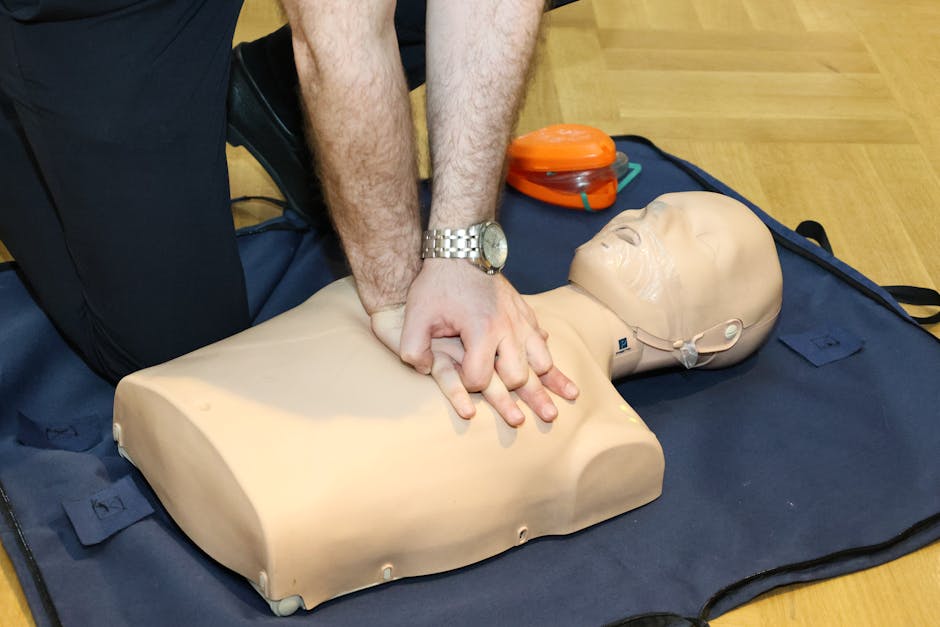
CPR (cardiopulmonary resuscitation) combines chest compressions and rescue breaths to keep oxygen flowing to the brain and vital organs. However, CPR alone rarely restarts the heart. That is why every Aspire CPR course also teaches you to use an AED as quickly as possible.
An AED (automated external defibrillator) is a portable device that analyzes the heart and, if needed, delivers a shock to restore an effective rhythm. Because AEDs speak step-by-step instructions, anyone can use one after training. In fact, AED training is included in all of our first aid and CPR courses, such as Standard First Aid with CPR-C and AED.
In addition, CPR-HCP can be combined with a Standard or Basic First Aid course.
A blended course splits your training into two parts. First, you complete the theory online through a Canadian Red Cross link that we email you after registration. Then you attend one in-class skills day, where an instructor coaches you through hands-on practice and testing. Because of this, you spend less time in a classroom while earning the same certificate. Learn more about our blended first aid and CPR training.
Yes. The Canadian Red Cross course formerly called Emergency First Aid is now offered as Basic First Aid. It includes CPR Level C and AED, is WSIB approved, and is valid for 3 years. So, if your employer asks for Emergency First Aid, book our Basic First Aid CPR-C course.
Psychological First Aid helps people cope with loss, stress, trauma, and grief, in the same way traditional first aid treats physical injuries. Specifically, you learn to spot signs of distress using the Look, Listen, Link, Live model, and you also learn how to protect your own wellbeing. However, it focuses on urgent, immediate needs after a crisis; it is not ongoing therapy. See our Psychological First Aid course.
Absolutely. Most importantly, first aid training gives you the skills to potentially save a life at home, at work, or in your community. In addition, many Ontario employers require it, so a valid certificate can also help your career.
Among all first aid and CPR frequently asked questions, these come up most: how long each certificate lasts and, just as importantly, who can renew instead of retaking the full course.
Canadian Red Cross First Aid and CPR certificates are valid for 3 years. However, the Red Cross recommends refreshing your CPR skills every year, and some employers require yearly retraining. Therefore, always check your workplace policy.
BLS (Basic Life Support for Healthcare Providers) certification is valid for 1 year. As a result, most healthcare workers recertify annually. Book a session through our BLS certification locations.
Yes. Our courses are Canadian Red Cross programs that meet WSIB and Ontario Regulation 1101 workplace first aid requirements. For a full list, see all of our courses.
In Ontario, the WSIB regulates workplace first aid training. Under its rules, a Standard First Aid certificate can be renewed once, through a one-day renewal course with the original provider, before it expires. Because Aspire is a Canadian Red Cross Training Partner, we can therefore only recertify Red Cross certificates. Your new certificate will be marked as a renewal.
We offer recertification for Red Cross CPR-C/AED and Standard First Aid with CPR-C/AED. To qualify, all of the following must be true:
However, BLS and Basic (Emergency) First Aid are not eligible for recertification in Ontario under WSIB rules. See our first aid recertification courses.
Here you will find course fees, payment options, and, in addition, our cancellation rules.
Our most popular courses start at the prices below (CAD). Because prices can change, please confirm the current fee when you book.
| Course | Length | Price |
|---|---|---|
| Basic First Aid CPR-C (formerly Emergency First Aid) | Blended: online + 1 skills day | $80 |
| Standard First Aid CPR-C | 7 hrs online + 7 hrs in class | $120 |
| First Aid Recertification | 1 day (8 hrs) | $120 |
| BLS-HCP | 4 hrs in class | From $55 |
| Marine Basic First Aid | 14 hrs in class | $125 |
No. Instead, payment is required at registration to secure your seat. If you cannot pay by credit or debit card, contact our office for e-Transfer details. Alternatively, you can call us and book by phone.
Yes, courses are partially refundable. However, please note these rules:
Before you register, please read our full payment and refund policy.
Once approved, refunds usually take 7 to 10 business days to process. After that, your bank may need a few extra days to show the credit. Our office processes requests Monday to Friday, 9 AM to 5 PM, excluding public holidays.
Finally, these first aid and CPR frequently asked questions help you prepare for class day and, if needed, book training for your whole team.
Note that the course manual is electronic only, so we no longer hand out printed copies.
A CPR pocket mask is a small barrier device that lets you give rescue breaths safely. Because you practise breaths on manikins, each student needs their own mask for hygiene. If you don't have one, you can simply buy one on site for $5.
First, email info@fagt.ca or call (289) 890-2898 with the number of seats you need, and we'll check availability. Then each person pays at registration to secure their seat.
Alternatively, we can run a private course at your location. In that case, the minimum charge is 8 participants, so smaller groups are still welcome but are billed for 8. Request a quote through our group and on-site training page.
We train 7 days a week at three Ontario centres:
In addition, we deliver on-site group training across Ontario, including Brampton, Oakville, Burlington, and Stoney Creek.
It depends on your role. For example, most workplaces with 5 or fewer workers per shift need Basic First Aid, while larger or higher-risk workplaces need Standard First Aid. Healthcare workers, on the other hand, usually need BLS-HCP. If you are unsure, call us and we'll help you choose.
Ready to book? Choose a course below, and then pick the location closest to you.
If your question isn't among our first aid and CPR frequently asked questions, our team is happy to help you choose the right course, book a group, or check your recertification eligibility. Call, email, or message us on WhatsApp.