
Every minute without CPR and defibrillation reduces a cardiac arrest victim’s chance of survival by 7 to 10 percent. For healthcare providers and first responders in Mississauga, possessing current, certified **basic life support** skills is not optional; it is a professional and ethical requirement. This training provides the core **lifesaving skills** needed to act decisively before advanced medical help arrives.
Basic life support, or BLS, represents the fundamental level of medical care used for patients with life-threatening illnesses or injuries until they can receive full medical care at a hospital. In Mississauga, numerous organizations offer courses, but the quality, certification, and flexibility of training can vary significantly. A 2022 report by the Heart and Stroke Foundation of Canada noted that survival rates for out-of-hospital cardiac arrests improved in communities with higher concentrations of BLS-trained individuals, underscoring the program’s community-wide impact. For professionals, this certification is often a mandatory prerequisite for employment in hospitals, clinics, and emergency medical services.
What is Basic Life Support Training?
Basic life support training goes beyond standard first aid. It is a program designed specifically for healthcare providers, such as nurses, dentists, paramedics, and firefighters. The curriculum is often aligned with guidelines from the Heart and Stroke Foundation of Canada, focusing on high-performance team dynamics and advanced techniques.
A comprehensive BLS course covers several critical areas. Participants learn to perform high-quality CPR for adults, children, and infants. They receive thorough instruction on using an Automated External Defibrillator (AED). Training also includes how to relieve choking for responsive and unresponsive victims and how to effectively ventilate with a barrier device. These components ensure a responder can manage a respiratory or cardiac emergency in any setting. For instance, the proper use of a bag-valve-mask device, a core BLS skill, can significantly improve oxygenation for a non-breathing patient compared to mouth-to-mask techniques alone.
Who Requires BLS Certification in Mississauga?
While CPR knowledge is valuable for anyone, BLS certification is typically mandated for roles within the healthcare sector. If your job involves direct patient care, you likely need a valid BLS certificate. This requirement is a standard part of **workplace safety training** protocols in medical environments.
Common professions that require BLS include registered nurses and practical nurses, doctors and medical residents, dental hygienists and dentists, paramedics and EMTs, respiratory therapists, and clinical support staff. Furthermore, many students entering healthcare programs must obtain certification before starting clinical placements. Healthcare students or professionals searching for “**CPR classes near me**” should specifically look for a BLS provider, not a general public course. Hospitals like Trillium Health Partners and other major Mississauga healthcare facilities typically mandate BLS certification from a recognized provider like the Canadian Red Cross for all clinical staff.
BLS vs. Standard CPR/AED: Knowing the Difference
Choosing the right course is crucial. A standard CPR/AED course for the public teaches essential skills but at a different depth and pace than a BLS program. The BLS curriculum is more rigorous, with a focus on precision, team communication, and scenarios common in clinical settings.
Feature | Standard CPR/AED (CPR-C) | Basic Life Support (BLS) |
|---|---|---|
Target Audience | General public, workplace first-aiders, teachers, coaches. | Healthcare providers and professionals. |
CPR Technique | Single-rescuer sequence for adults, children, & infants. | High-performance, single and two-rescuer sequences for all ages. |
Breathing Barriers | May include pocket masks. | Emphasis on bag-valve-mask (BVM) use. |
Team Dynamics | Not typically covered. | Critical component; effective communication and role clarity. |
Certification Body | Often Red Cross or Heart & Stroke. | Often Red Cross or Heart & Stroke (Healthcare Provider level). |
What to Expect in a Mississauga BLS Course
A quality **BLS training Mississauga** program balances knowledge with hands-on practice. Reputable providers like Aspire First Aid Guide Training deliver courses that are certified by the Canadian Red Cross, ensuring national recognition. The modern approach often involves a **blended learning** format, which is highly effective for busy professionals.
This format splits the course into two parts. First, you complete interactive online modules at your own pace, covering the theory and principles. Then, you attend a shorter, in-person session focused entirely on hands-on skill practice and testing with a certified instructor. This method maximizes your time in class for practical **emergency response training**.
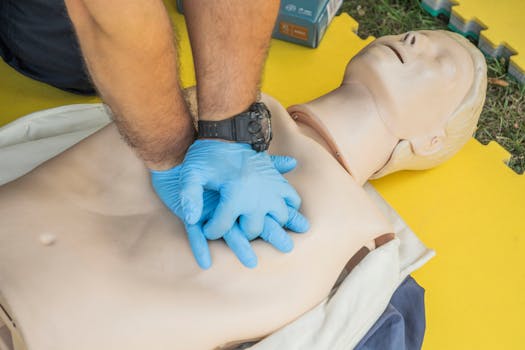
The in-class portion is where skills are solidified. You will practice cycles of CPR on manikins that provide feedback on compression depth and rate. **AED training** will involve using training devices to simulate real defibrillation scenarios. You will also work with other participants to practice the team response skills that are vital in a hospital or clinic setting. Successfully completing both portions leads to a nationally recognized **first aid certification** that is valid for one year. A common scenario practiced is managing a sudden cardiac arrest in a clinic waiting room, requiring rapid coordination between staff to retrieve the AED, perform compressions, and manage patient positioning.
Selecting a BLS Training Provider
With several options for **CPR certification Mississauga** residents can choose from, knowing what to look for ensures you receive quality education. Always verify that the provider is certified by a recognized national body, such as the Canadian Red Cross. Check that the course content explicitly follows the latest guidelines for healthcare providers.
Consider the instructor’s background. Instructors with real-world healthcare or emergency response experience bring invaluable insights. Review the course logistics, including class size (smaller is better for personalized feedback), location, and schedule flexibility. Many seek **blended courses** for their convenience. Finally, inquire about the certification process and how you will receive your digital or physical wallet card upon completion. For a seamless path to certification, explore our dedicated BLS for healthcare providers course.
Maintaining Your Readiness
Certification in basic life support is typically valid for 12 months. Skills degrade without practice, which is why annual recertification is required. This is not a mere formality; it is an opportunity to refresh your knowledge, learn any updated protocols, and correct any skill drift with an instructor’s guidance.
Planning ahead for your **first aid recertification** is simple. Many training centers offer recertification courses that are shorter in duration, as they are designed for those with a recent, expired certificate. Setting a calendar reminder for 11 months after your initial course is a proactive way to ensure you never have a lapse in your credentials, keeping you and your patients safe. Studies show that CPR skills, particularly compression depth and rate, can begin to deteriorate within three to six months after training. You can find available first aid recertification courses to meet your schedule.
Your ability to perform effective basic life support can directly determine a patient’s outcome. In Mississauga, accessing top-tier, flexible training is straightforward. By choosing a certified, professional training provider that offers modern blended learning, you invest in a skill set that meets compliance standards and, more importantly, saves lives. Take the next step and enroll in a course to validate or renew your essential competencies today.
Frequently asked questions
How long does a BLS certification last?
Basic Life Support certification is valid for one year from the date of successful course completion. Annual recertification is mandatory for most healthcare employers to ensure skills and knowledge remain current with the latest guidelines.
Can I take BLS training online only?
No. While the cognitive portion can be completed online, a hands-on, in-person skills evaluation with a certified instructor is required by all recognized bodies like the Red Cross. This ensures you can physically perform CPR and use an AED correctly.
What is the difference between BLS and Standard First Aid?
Standard First Aid includes CPR and AED training for the public, plus care for other injuries like wounds and breaks. BLS is an advanced CPR/AED program focused on the specific techniques, speed, and team-based response required in healthcare settings.
I need certification fast for a job. How quickly can I get certified?
With blended learning, you can often complete the online modules within a few hours and then attend a scheduled in-person session, sometimes within the same week. Many providers offer frequent class times in Mississauga to accommodate urgent needs.
Is BLS training the same as a CPR-C course?
No. A CPR-C course is for the general public. BLS is for healthcare providers and is more intensive, covering advanced topics like two-rescuer CPR, bag-valve-mask use, and team response dynamics not found in standard courses.
