
Imagine you’re at home in Ontario on a Tuesday afternoon when you notice your baby has suddenly gone silent and turned pale. Do you know exactly how to react in the next 4 seconds? Statistics from the Heart and Stroke Foundation in 2024 suggest that immediate, high-quality intervention can more than double a child’s chance of survival during a cardiac event. We understand that the fear of causing injury during compressions or confusing choking steps with cardiac arrest is a heavy burden for any caregiver. It’s a valid concern that requires a professional, structured response rather than panic.
This cpr for infants guide from Aspire First Aid Guide Training Corp provides the expert-led framework you need to act with absolute precision. We’ve designed this manual to give Ontario parents the same confidence as a trained first responder by focusing on responsible, evidence-based techniques for 2026. You’ll gain a clear mental checklist of the life-saving steps and understand the unique physical differences in infant anatomy that dictate how you apply pressure. We’ll also highlight where to find accredited certification programs in Mississauga and Hamilton, with courses typically starting around C$115, so you can move from anxiety to mastery.
Key Takeaways
- Identify the unique signs of the “Silent Emergency” and understand why cardiac arrest in babies under 12 months requires a specialized response.
- Master the precise two-finger compression technique and depth requirements by following our expert cpr for infants guide for 2026.
- Protect your infant from harm by debunking common safety myths, including the risks associated with “blind finger sweeps” during airway checks.
- Learn the vital sequence of back blows and chest thrusts to effectively manage both partial and full airway obstructions in choking emergencies.
- Understand why hands-on Red Cross certification is the professional standard for Ontario parents to develop the muscle memory necessary for life-saving action.
Understanding Infant Cardiac Emergencies: When to Act
Infant Cardiopulmonary Resuscitation (CPR) is the specialized management of life-threatening emergencies for children under 12 months of age. It’s a responsible intervention designed to sustain life when a baby’s heart or lungs fail. In Ontario, the 2026 “Check, Call, Care” standard provides a structured framework for parents and caregivers to follow. This cpr for infants guide focuses on the professional recognition of distress signs before they escalate into a full arrest. Unlike adult cardiac arrest, which often occurs suddenly due to heart disease, infant emergencies are frequently “silent.” They usually stem from progressive respiratory failure rather than primary heart issues. Recognizing this distinction is the first step in any Pediatric Basic Life Support protocol.
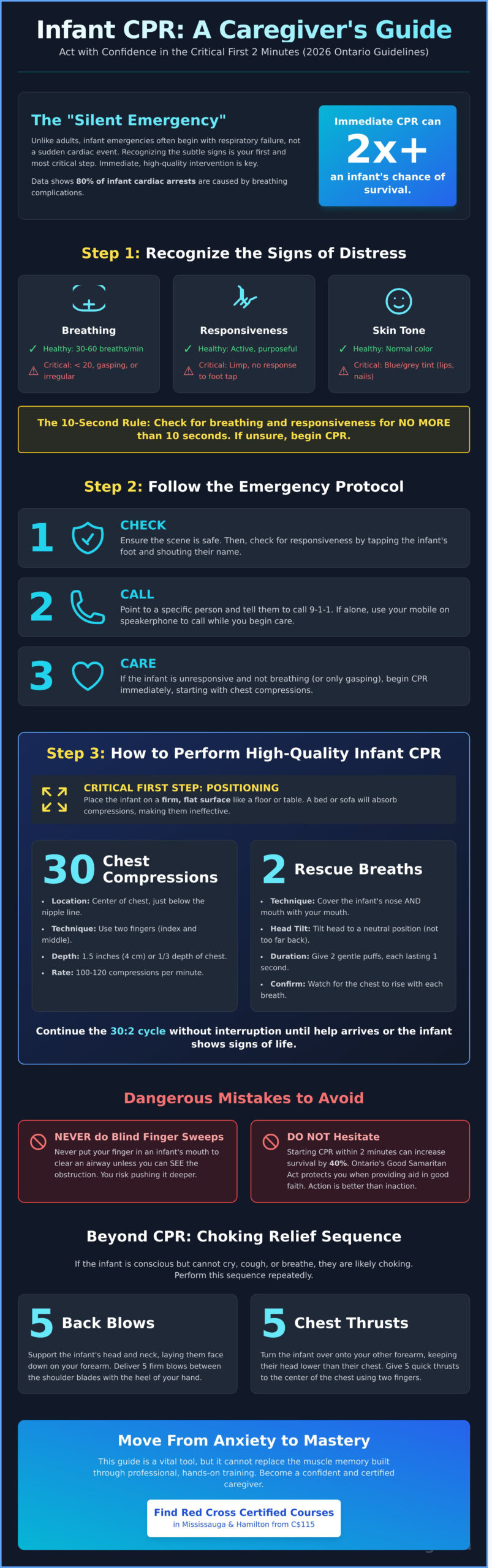
When an emergency occurs, you must monitor three specific vital signs: breathing, movement, and skin tone. A healthy infant breathes between 30 and 60 times per minute. If breathing drops below 20 breaths per minute or becomes gasping and irregular, the situation is critical. Movement should be purposeful and active. A baby who is suddenly limp or fails to respond to a flick on the bottom of the foot requires immediate attention. Finally, observe the skin tone. A blue or grey tint around the lips and fingernails, known as cyanosis, indicates that oxygen levels have reached a dangerous low. Following a structured cpr for infants guide ensures you don’t waste time when these signs appear.
Recognizing Respiratory vs. Cardiac Arrest
Data from Heart and Stroke Foundation Canada shows that 80% of infant cardiac arrests are actually caused by breathing complications. Respiratory distress often presents as “retractions,” where the skin pulls in around the ribs or neck during breaths. If the baby is still breathing but struggling, you’re in the respiratory phase. Once breathing stops and the baby is unresponsive, they’ve entered full arrest. Use the 10-second rule: check for breathing or movement for no more than 10 seconds. If you don’t see clear signs of life, you must begin compressions immediately.
The Critical First 2 Minutes
The first 120 seconds of an emergency are the most vital for protecting brain function. Your primary goal is to maintain oxygenation until Emergency Medical Services (EMS) arrive. Don’t worry about perfect form; immediate action is more effective than delayed, “perfect” technique. In Ontario, rescuers are protected by the Good Samaritan Act, which removes legal liability for those providing emergency aid in good faith. This law ensures that fear of litigation doesn’t prevent life-saving action. Starting CPR within the first two minutes can increase survival and recovery rates by 40% compared to waiting for professional help to arrive on the scene.
- Check: Assess the scene for safety and tap the infant’s foot to check for responsiveness.
- Call: Designate a specific person to call 9-1-1 immediately or use your mobile device on speaker.
- Care: Begin the cycle of compressions and breaths as outlined in the 2026 Ontario safety protocols.
Effective management of an infant emergency requires a calm, methodical approach. By understanding the “Silent Emergency” and the specific physiological needs of a baby, you act as a guardian of the most vulnerable resources. This professional readiness is what separates a tragic outcome from a successful rescue.
Step-by-Step Guide to Performing CPR for Infants
Performing CPR on an infant requires a different set of technical skills than adult resuscitation. This cpr for infants guide focuses on the delicate balance between force and precision needed to restore circulation without causing unnecessary trauma. Before you begin, you must ensure the infant is on a firm, flat surface. Placing a child on a soft mattress or a plush carpet is a common mistake; these surfaces absorb the energy of your compressions, rendering them useless. A kitchen table or a hardwood floor provides the resistance necessary to effectively compress the heart against the spine.
According to the Mayo Clinic CPR Guide, ensuring the infant is on a stable surface is the foundational step for effective chest compressions. Once the infant is positioned, you’ll manage the situation with a structured 30:2 ratio. This means you’ll deliver 30 rapid chest compressions followed by two gentle rescue breaths. This rhythm must be maintained without interruption until professional medical help arrives or the infant shows signs of life, such as coughing or purposeful movement.
Compression Technique: Depth and Rate
Effective compressions are the most critical part of this cpr for infants guide. You’ll use two fingers, typically the index and middle fingers, placed in the center of the chest just below the nipple line. You must press down to a depth of exactly 1.5 inches (4 cm). If you don’t press deep enough, the blood won’t reach the brain; if you press too deep, you risk internal injury. Aim for a rapid pace of 100 to 120 compressions per minute. This matches the tempo of the song “Stayin’ Alive,” which helps rescuers maintain the correct speed during high-stress situations. It’s helpful to review professional safety protocols to ensure your technique remains sharp and effective.
Delivering Effective Rescue Breaths
Infant lungs are fragile and small, so your approach to rescue breaths must be cautious. Start by placing the head in a “neutral position.” Don’t tilt the head back as far as you would for an adult, as this can actually block an infant’s narrow airway. Once the airway is open, create a seal by covering both the infant’s nose and mouth with your mouth. Deliver two small breaths, each lasting about one second. You’re looking for a visible chest rise with each breath. If the chest doesn’t rise, the airway might be blocked, or your seal isn’t tight enough. Don’t use the full force of your lungs; a puff of air from your cheeks is often sufficient for a newborn.
When to Call 911: The Solo Rescuer Rule
The timing of your emergency call depends on whether you’re alone. If another person is present, they should call 911 immediately while you begin CPR. However, if you’re the only person available, you must perform five cycles of CPR, which takes approximately two minutes, before pausing to call for help. The Solo Rescuer Rule is the standard for 2026, requiring five full cycles of resuscitation before pausing to contact emergency services if you’re alone. This ensures the infant receives immediate oxygenation. When you do call, especially in busy regions like Mississauga or Hamilton, use your phone’s speakerphone. This allows you to follow the dispatcher’s instructions while keeping your hands free to continue the 30:2 life-saving rhythm.
Common Myths and Dangerous Mistakes in Infant CPR
Misinformation is a significant barrier to effective life saving action. When a caregiver hesitates because of a myth, the delay reduces the chance of a positive outcome. Following a professional cpr for infants guide ensures that your actions are based on current medical protocols rather than outdated hearsay. Accuracy is the difference between a successful recovery and a permanent tragedy. Experts emphasize that managing an emergency requires a calm, evidence based approach.
Addressing the Fear of Injury
The most frequent reason bystanders hesitate to perform chest compressions is the fear of breaking the baby’s ribs. It’s a valid concern but one that must be weighed against the alternative. Medical data indicates that rib fractures occur in fewer than 2% of pediatric CPR cases when performed correctly. Even if a fracture occurs, the trade off is clear. As many pediatric emergency physicians state: “A broken rib can heal; a brain without oxygen cannot.”
Infant skeletons are not miniature adult skeletons. Their bones are primarily composed of flexible cartilage, which allows the chest wall to compress and recoil more easily than an adult’s rigid frame. This biological flexibility is a natural defense mechanism. You must push hard enough to compress the chest by about one third of its depth, which is roughly 4 centimeters. Without this depth, blood won’t reach the brain. Hesitation kills; firm, rhythmic pressure saves lives.
Dangerous Physical Responses: Shaking and Sweeping
Panic often triggers two dangerous instincts: shaking the baby to “wake them up” and performing a blind finger sweep. Shaking an unresponsive infant is never the answer. It doesn’t restore breathing and frequently leads to Shaken Baby Syndrome, causing internal bleeding or permanent brain damage. If the baby doesn’t respond to a flick on the bottom of the foot, they’re unconscious and need immediate CPR.
The “blind finger sweep” is another relic of the 1990s that causes harm. If a baby is choking, sticking your finger into their mouth without seeing an object often pushes the obstruction deeper into the trachea. This turns a partial blockage into a total airway obstruction. Only remove an object if it’s clearly visible and easy to reach. Otherwise, stick to the chest thrusts and back blows outlined in your cpr for infants guide to let the pressure of the air clear the blockage.
AED Use for Infants: What You Need to Know
Many parents believe Automated External Defibrillators (AEDs) are only for adults. This is a dangerous misunderstanding. You can use an AED on an infant, but the method matters. Most modern units come with pediatric pads or a “pediatric mode” switch that reduces the energy shock to a level safe for a small heart. If pediatric pads aren’t available, you can use standard adult pads, provided they don’t touch or overlap on the baby’s chest. One pad goes on the center of the chest and the other on the back between the shoulder blades.
By 2026, new technology updates in Canada will mandate that all public AEDs include manual attenuators to better manage pediatric heart rhythms. These devices are becoming common in public spaces across Southern Ontario. If you’re in Hamilton, you’ll find these units at the FirstOntario Centre and all municipal recreation centers. In Mississauga, AEDs are stationed throughout Celebration Square and at every major GO Station. Knowing where the nearest device is located can save the 4 to 6 minutes it takes for emergency services to arrive. Professionalism in an emergency means knowing your tools and using them without delay.
Beyond CPR: Choking Relief and Emergency Prevention
Choking remains a leading cause of unintentional injury for Canadian infants under the age of 12 months. Recognizing the difference between a partial and a full airway obstruction is the first step in responsible caregiving. If an infant is coughing forcefully, crying, or making audible noises, their airway is only partially blocked. In these cases, you should stay close and encourage them to cough the object out naturally. Do not interfere with their attempts to clear their own throat, as manual intervention might push the object deeper.
A full obstruction is a silent emergency. If the baby cannot cry, cough, or breathe, and their skin begins to turn a bluish tint, you must act immediately. This situation requires a specific physical intervention known as the back blow and chest thrust sequence. Understanding this process is a vital component of any cpr for infants guide, as choking often leads to cardiac arrest if the airway isn’t cleared within minutes. Statistics from Health Canada suggest that food items like grapes, popcorn, and hard candies account for nearly 44% of choking-related emergency room visits, making vigilant supervision during mealtime a non-negotiable duty.
The Choking Rescue Sequence
When an infant is conscious but cannot breathe, follow this two-step rescue cycle. First, deliver 5 firm back blows. Sit down and rest your forearm on your thigh. Place the infant face-down along your arm, supporting their jaw with your hand while keeping their head lower than their chest. Use the heel of your hand to deliver five distinct, forceful blows between the shoulder blades.
Second, perform 5 chest thrusts. Carefully flip the infant face-up while supporting their head. Place two fingers in the center of their chest, just below the nipple line. Deliver five quick thrusts, compressing the chest about 1.5 inches. Repeat this 5-and-5 cycle until the object is expelled or the infant becomes unresponsive. If the infant loses consciousness, you must transition immediately to the steps outlined in your cpr for infants guide. Start with chest compressions and look for the object in the mouth before delivering breaths; never perform a blind finger sweep.
Prevention Strategies for Caregivers
Effective vadvilág-gazdálkodás, or wildlife management, relies on proactive measures to prevent crisis; caregiving requires the same professional foresight. Beyond food, small household items pose significant risks. In 2026, we see an increase in hazards from lithium button batteries found in “smart” devices and key fobs. If swallowed, these can cause catastrophic internal chemical burns in less than 120 minutes. Ensure all battery compartments are secured with screws or heavy-duty tape.
- Safe Sleep Environments: To reduce the risk of SIDS, infants must sleep on their backs on a firm, flat surface. The “Neutral Head Position” is essential; the head should not be tilted forward or back, as this can narrow their delicate airway.
- Modern Baby-proofing: Check for small high-powered magnets and loose charging cables, which are common in modern Canadian homes. Any object that fits inside a cardboard toilet paper roll is a potential choking hazard.
- Regulatory Standards: Only use cribs and playpens that meet the current Cribs, Cradles and Bassinets Regulations set by the Canadian government to ensure structural integrity and safe slat spacing.
Maintaining a safe environment is a professional responsibility that extends to every person who watches your child. For those looking to master these life-saving skills, see our Babysitting Course for comprehensive safety training that provides the hands-on practice necessary for emergency preparedness.
Why Hands-On Training is Non-Negotiable
Reading a cpr for infants guide provides the essential foundation, but it cannot replace the physical sensation of a chest compression. Digital guides lack the tactile feedback necessary to develop muscle memory. In a real emergency, your hands need to know exactly how much pressure to apply without hesitation. A specialized infant manikin allows you to practice the 4-centimetre depth required for a baby’s chest. Without this physical practice, you risk under-compressing or causing injury. Physical training ensures you understand the resistance of a ribcage and the rhythm of 100 to 120 compressions per minute.
In Ontario, the Workplace Safety and Insurance Board (WSIB) sets strict standards for life-saving training. For professional caregivers and Early Childhood Educators (ECEs), having a valid certification is a legal requirement under Regulation 1101. Red Cross certification remains the gold standard for both Ontario workplaces and private homes. It ensures every participant meets a national benchmark of competency that a YouTube video simply cannot validate. Aspire First Aid Guide Training Corp operates high-quality facilities in Mississauga and Hamilton to meet this demand, providing a professional environment where skills are tested and verified by experts.
Professionalism in caregiving requires a commitment to excellence and responsibility. When you step into a classroom, you aren’t just ticking a box; you’re becoming a trained manager of life-threatening situations. This expert-led approach builds the confidence needed to act when seconds count. Whether you are a new parent or a professional manager of a daycare facility, the legitimacy of your training defines the safety of the environment you provide.
The Blended Learning Advantage
Modern training has evolved to respect your schedule. Blended learning allows you to complete the theoretical portion of your cpr for infants guide online at your own pace. This approach saves approximately 4 to 5 hours of in-class time. Once the theory is done, you attend a shortened in-person session focused entirely on skills. An instructor provides immediate feedback on your technique, ensuring your hand placement is precise. Aspire First Aid Guide Training Corp simplifies this process by providing clear digital modules followed by expert-led practical assessments in a focused, professional setting.
Choosing the Right Course Level
Selecting the correct certification is vital for your specific role. CPR Level C is the standard choice for most people, as it covers adults, children, and infants. If you’re a healthcare professional, you will likely need Basic Life Support (BLS), which includes high-intensity training and advanced equipment use. For new families, Standard First Aid is the most comprehensive option. It covers CPR alongside wound care, bone breaks, and choking response. Ensuring you have the right level of training builds the professional trust required in caregiving roles. Book your WSIB-approved First Aid & CPR course today to secure your spot at our Mississauga or Hamilton locations.
Certification is more than a piece of paper. It’s a testament to your role as a responsible guardian of those in your care. By choosing a recognized provider like Aspire First Aid Guide Training Corp, you align yourself with the highest standards of safety and professional management in Ontario. Don’t leave a child’s safety to chance; invest in the skills that save lives.
Transform Your Knowledge Into Life-Saving Action
Reading this cpr for infants guide is a vital first step, but it’s only the beginning of your journey as a responsible caregiver. You’ve learned that infant cardiac arrest requires a specific 30:2 compression-to-breath ratio. You also know that avoiding common errors, like excessive head tilt, is non-negotiable for protecting a baby’s delicate airway. However, static text can’t replace the physical feedback of a professional practice manikin. Research indicates that caregivers who complete formal training feel 80% more confident when facing a real-world emergency than those who only watch videos.
Don’t leave your child’s safety to chance. As a WSIB Approved Training Partner and official Canadian Red Cross Training Partner, we’ve served the Mississauga and Hamilton communities since 2004. We provide the hands-on practice required to turn theory into muscle memory. Gain the professional skills you need to act with precision under pressure. Register for a Red Cross Certified CPR Course in Ontario through Aspire First Aid Guide Training Corp today. Your quick thinking and trained hands are your baby’s best defense in those first critical seconds. You’ve got the heart to protect them; we’ll give you the skills.
Frequently Asked Questions
Is CPR for infants the same as for adults?
No, infant CPR requires specific modifications to account for a baby’s smaller frame and fragile bone structure. You’ll use two fingers or two thumbs instead of two palms to deliver compressions. These compressions should reach a depth of 1.5 inches (4 cm) rather than the 2 inches (5 cm) required for adults. These precise adjustments prevent internal injuries while maintaining vital blood flow to the brain.
How hard should I push during infant chest compressions?
You should compress the chest to a depth of approximately 1.5 inches or one third the total depth of the chest. Use two fingers in the center of the chest just below the nipple line for a single rescuer. Maintain a steady rhythm of 100 to 120 beats per minute. This pace matches the tempo of popular songs like “Stayin’ Alive,” which helps you keep a consistent 30:2 ratio between compressions and breaths.
Can I use an adult AED on an infant if no pediatric pads are available?
You can use adult AED pads on an infant if pediatric versions aren’t available at the scene. Ensure the pads don’t touch each other during placement. Place one pad firmly in the center of the baby’s chest and the other on their back between the shoulder blades. This “sandwich” method allows the electrical current to travel safely through the heart without the pads overlapping, which could cause a short circuit.
What is the first thing I should do if my baby stops breathing?
Check the baby’s responsiveness by tapping their foot and shouting their name loudly. If there’s no movement or breathing, yell for someone nearby to call 911 immediately. If you’re alone, perform five cycles of CPR (about two minutes) before stopping to call emergency services yourself. Quick action is vital since brain damage can begin in as little as 4 minutes without oxygen flow.
How long should I continue CPR if help hasn’t arrived?
Keep performing CPR until the infant starts breathing on their own, an AED is ready for use, or paramedics take over the scene. Statistics from 2021 show that bystander CPR can double or triple a child’s chance of survival. You shouldn’t stop unless you’re physically unable to continue. If a second person is present, rotate every two minutes to prevent fatigue and maintain high quality compressions.
Do I need a certification to perform CPR in an emergency in Ontario?
You don’t need a formal certification to perform life saving measures during an emergency in Ontario. The province’s Good Samaritan Act of 2001 protects you from legal liability when you provide emergency assistance in good faith. While you aren’t legally required to be certified, following a cpr for infants guide ensures you use the correct pressure and technique. Most experts suggest refreshing your skills every 24 months for optimal safety.
What is the most common cause of cardiac arrest in infants?
Respiratory failure is the most frequent trigger for cardiac arrest in babies under 12 months old. While adult heart issues often involve the cardiac muscle itself, about 85% of infant cases result from choking, drowning, or SIDS. This means that rescue breaths are a mandatory part of the process. You’re effectively acting as their lungs to keep oxygenated blood moving to their vital organs until professional help arrives.
Where can I find an infant CPR class in Mississauga or Hamilton?
Certified training providers, such as Aspire First Aid Guide Training Corp, offer regular infant CPR sessions in the Golden Horseshoe area. Many local facilities provide comprehensive courses designed to equip parents and caregivers with essential life-saving skills. These 4 to 8 hour classes typically include hands-on practice with infant-sized mannequins, ensuring you’re fully prepared for a real emergency.
