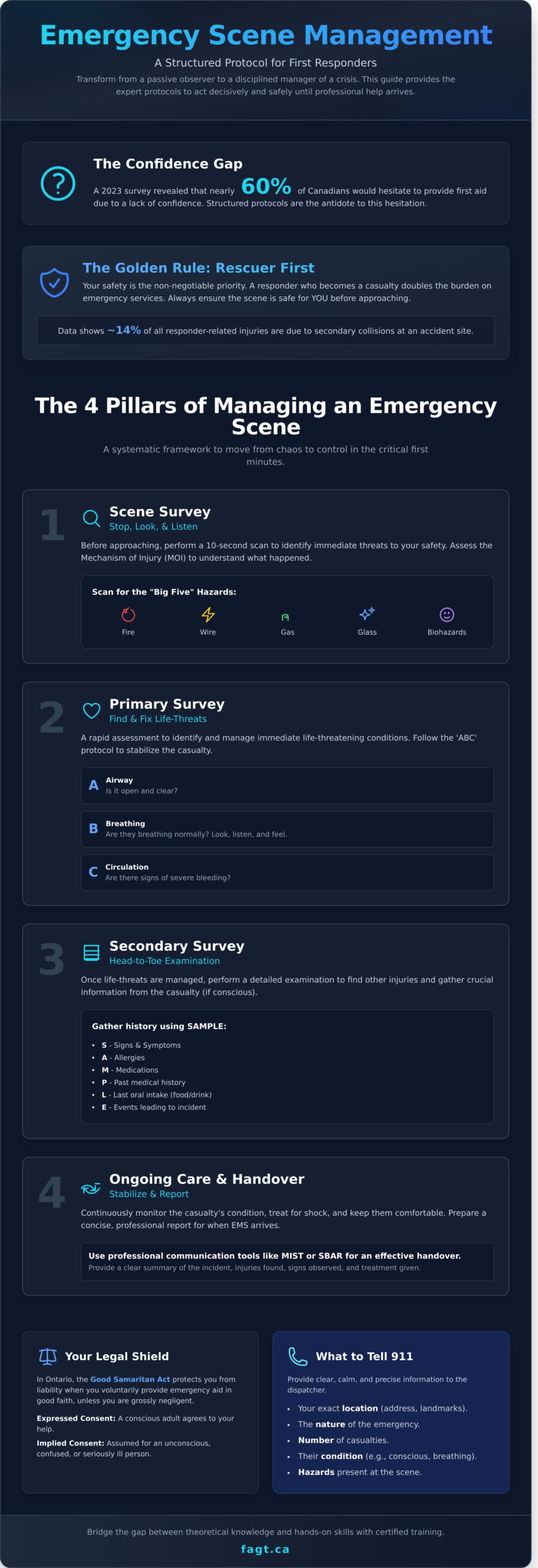
Imagine you’re at a local community center in Hamilton when a bystander suddenly collapses. Your heart races; your palms sweat; and for a split second, you feel completely paralyzed. This hesitation is exactly why managing an emergency scene requires more than just knowing how to bandage a wound. It demands a structured, professional approach that prioritizes safety for everyone involved. In a 2023 survey, nearly 60% of Canadians admitted they would feel hesitant to provide first aid due to a lack of confidence.
This high-stakes decision-making is mirrored in other professional fields, like aviation, where managing complex scenarios is a critical skill. In fact, many pilots learn more about Cirrus Transition Training to master emergency protocols specific to their aircraft.
You likely worry that stepping in might lead to a legal battle or that you’ll confuse the primary and secondary surveys when every second counts. It’s a common concern, but you don’t have to face it unprepared. This guide provides the expert protocols you need to act as a responsible first responder. We’ll break down a clear mental checklist for emergencies, explain how Ontario’s Good Samaritan Act offers you legal protection, and ensure you have the skills to lead a scene until paramedics take over.
Key Takeaways
- Understand why your personal safety is the non-negotiable priority by adopting the “Rescuer First” philosophy and conducting thorough environmental hazard assessments.
- Master the systematic four-pillar protocol for managing an emergency scene, including the life-saving ‘ABC’ check to stabilize casualties quickly.
- Navigate the legal landscape of first aid in Ontario by learning how the Good Samaritan Act protects you and when to rely on implied versus expressed consent.
- Gain insights into handling multi-casualty incidents using the START triage system and professional communication tools like MIST and SBAR reports.
- Discover the benefits of Aspire First Aid Guide Training Corp-certified blended learning to bridge the gap between theoretical knowledge and hands-on emergency response skills.
Table of Contents
- What is Emergency Scene Management (ESM)?
- The 4 Pillars of Managing an Emergency Scene
- Legal Realities: Consent and the Good Samaritan Act in Ontario
- Advanced Dynamics: Triage and Multi-Casualty Incidents
- Mastering ESM with Aspire First Aid Guide Training
What is Emergency Scene Management (ESM)?
Emergency Scene Management (ESM) is the professional standard for stabilizing a crisis through a systematic, organized framework. It’s not merely a set of medical steps; it’s a comprehensive approach to identifying environmental hazards and directing available resources. By applying Emergency Management Principles, a responder transitions from a passive observer to a disciplined manager of the environment. In Canada, where geographical challenges and varying weather conditions can complicate rescue efforts, ESM ensures that every action taken is deliberate and safe. Properly managing an emergency scene requires a tactical mindset that prioritizes order over speed, ensuring that the situation does not escalate into a larger disaster.
The “Rescuer First” philosophy sits at the core of this discipline. This is a non-negotiable priority because a responder who becomes a casualty effectively doubles the burden on incoming professional services. Data from Canadian road safety reports indicate that secondary collisions at the site of an initial accident account for approximately 14% of all responder-related injuries. You must act as a “trained and responsible manager” of your own safety. If the scene is too dangerous to enter, such as a site with downed high-voltage power lines or a suspected chemical leak, your management role involves keeping others away rather than rushing in.
A first aider serves as the vital bridge between the moment an incident occurs and the arrival of professional Emergency Medical Services (EMS). In 2023, average ambulance response times in urban Canadian centers like Toronto or Vancouver ranged from 9 to 12 minutes; in rural areas, this wait can extend significantly. During these critical minutes, ESM provides the psychological scaffolding needed to prevent the “freeze” response. When the human brain is faced with trauma, it can become overwhelmed by choice paralysis. Structured protocols provide a “script” for the brain to follow. This shifts the responder’s mental state from emotional panic to professional execution, allowing for a calm, methodical assessment of the casualty.
The Goals of Effective Scene Management
The primary objective is the preservation of life through organized control. This starts with preventing further injuries to the casualty, bystanders, and yourself. You must establish a clear, professional line of communication with 911 dispatchers, providing precise GPS coordinates or landmarks. Effective managers also transform bystanders from obstacles into useful assets. By giving specific, authoritative commands, you can delegate tasks like directing traffic or meeting the ambulance at a specific C$50 parking lot entrance to guide them to the exact location.
When ESM Begins and Ends
Professional management begins before you even touch a casualty. The “Pre-Arrival” phase involves a “windshield survey” where you assess the environment from a distance to spot leaking fuel or unstable structures. The process only concludes when there is a formal transition of authority to Paramedics or Fire Services. You must provide a concise report of your findings and actions. Post-scene management is the final step; this includes filing necessary incident reports for provincial workplace safety boards and performing a personal “debrief” to ensure your own psychological well-being after managing an emergency scene.
The 4 Pillars of Managing an Emergency Scene
Effective scene management requires a disciplined, professional approach to ensure the safety of both the responder and the casualty. When you’re managing an emergency scene, the first 60 seconds often dictate the outcome of the entire intervention. Responders must move from a state of observation to structured action without succumbing to the chaos of the environment. This process relies on four distinct pillars that transition from environmental safety to clinical assessment and long-term stabilization.
Phase 1: The Scene Survey (Stop, Look, Listen)
Safety is the absolute priority. Before physical contact occurs, a responder must perform a 10-second “Stop, Look, Listen” survey to identify immediate threats. In the Canadian wilderness or urban settings, this involves scanning for the “Big Five” hazards: Fire, Wire, Gas, Glass, and Biohazards. If a downed power line is within 10 meters of a casualty, the scene is not secure and entry must be delayed until utility professionals arrive.
Understanding the Mechanism of Injury (MOI) is equally vital. You need to determine exactly what happened and the level of force involved. A fall from a height of three meters onto a hard surface suggests different internal risks than a trip on level ground. During this phase, utilize bystander mobilization to increase efficiency. Instead of shouting for help generally, point to a specific person and say, “You in the blue jacket, call 9-1-1 and tell them we have an unconscious adult.” This direct delegation is a core component of the Incident Command System, ensuring clear communication and accountability from the start.
Phase 2 & 3: From Life-Saving to Detailed Assessment
Once the environment is secure, the focus shifts to the Primary Survey. This is the “ABC” check: Airway, Breathing, and Circulation. You’re looking for life-threatening conditions that will kill a patient within minutes. A Rapid Body Survey follows, which is a quick, hands-on check from head to toe to find “hidden” bleeds or major fractures that clothing might obscure. In Canada, workplace safety regulations like the CSA Z1210-17 standard emphasize that these steps must be completed before any secondary treatment begins.
The Secondary Survey is a more methodical process. It involves gathering a SAMPLE history to pass on to EMS. This mnemonic stands for:
- S: Signs and Symptoms
- A: Allergies
- M: Medications (especially blood thinners or insulin)
- P: Past medical history
- L: Last oral intake (food or water)
- E: Events leading up to the incident
Monitoring vitals is the next requirement. You must track the Level of Consciousness (LOC) using the AVPU scale (Alert, Verbal, Pain, Unresponsive), alongside breathing rate and skin condition. Pale, cool, or clammy skin often indicates the onset of shock, which requires immediate heat retention and leg elevation if no spinal injury is suspected.
Phase 4: Ongoing Casualty Care
The final pillar involves maintaining the casualty’s condition until professional help arrives. Managing an emergency scene doesn’t end once the bandages are applied. Responders must re-check vitals every 5 minutes for unstable patients or every 15 minutes for stable ones. Emotional support is a clinical necessity; keeping a casualty calm lowers their heart rate and reduces oxygen demand. For those seeking to deepen their field expertise, reviewing professional training resources helps maintain high standards of safety and response readiness. Document every change in the casualty’s status, as this data is critical for the paramedics who take over the scene.
Legal Realities: Consent and the Good Samaritan Act in Ontario
Legal liability is often the biggest concern for bystanders. Many people hesitate to act because they fear a lawsuit if a casualty’s condition worsens. In Ontario, the legal framework is designed to protect those who step forward. Responders must understand their protections and their boundaries to act with confidence. When you’re managing an emergency scene, your primary legal shield is the Good Samaritan Act, 2001. This law ensures that individuals who provide emergency assistance at the scene of an accident aren’t held liable for damages resulting from their actions. This protection is robust, provided the responder acts in good faith and without gross negligence.
The act applies to anyone who provides aid, whether they’re a trained professional off-duty or a civilian with basic knowledge. However, it doesn’t grant total immunity. You must stay within the scope of your training. If you’ve only completed a one-day emergency first aid course, attempting a complex medical procedure could be viewed as gross negligence. Most rescuers find comfort in the fact that there are no recorded cases in Canadian history of a bystander being successfully sued for performing CPR in good faith. Following Ontario’s Good Samaritan Act allows you to prioritize the casualty’s life over the fear of litigation.
Navigating Consent with Casualties
Consent is the first step in any patient interaction. You cannot legally touch a conscious, alert person without their permission. To obtain expressed consent, introduce yourself clearly: “I’m a first aider, can I help you?” A simple nod or a “yes” is sufficient. If a casualty refuses care, you must respect that decision. In these cases, your role shifts to monitoring. You should call 911 and stay nearby, but you shouldn’t touch them. If they lose consciousness while you’re waiting, the law applies implied consent. This principle assumes that if the person were able to speak, they’d want life-saving intervention. Implied consent also applies to unaccompanied minors or individuals who are severely confused due to head trauma or medical emergencies.
Liability and Reasonable Skill
The “Standard of Care” is a vital concept for every responder. It means you’re expected to act as any reasonable person with your level of training would act in the same situation. If you’re managing an emergency scene, you shouldn’t attempt “Hollywood” maneuvers like tracheotomies or resetting broken bones. Stick to the basics: chest compressions, wound pressure, and keeping the airway clear. This professional restraint protects both the casualty and your legal standing. Once you begin care, you’re also bound by abandonment laws. You cannot stop treatment until one of the following occurs:
- Someone with equal or higher medical training (like a paramedic) takes over.
- The scene becomes too dangerous for you to continue.
- You’re physically exhausted and can no longer perform the task.
- The casualty shows signs of life or the situation no longer requires immediate aid.
Documentation is the final piece of the legal puzzle. For workplace incidents, Ontario’s WSIB Regulation 1101 is undergoing significant updates. By January 1, 2026, all employers must transition to modernized first aid record-keeping that aligns with CSA Z1210-17 standards. You must record the date, time, nature of the injury, and the specific treatment provided. These records must be kept for a minimum of 15 years to protect the company and the responder in the event of long-term disability claims. Accurate reporting isn’t just paperwork; it’s a professional requirement for every responsible responder.
Advanced Dynamics: Triage and Multi-Casualty Incidents
When an incident involves multiple victims, your role shifts from a hands-on provider to a strategic coordinator. Managing an emergency scene with three or more casualties requires a mindset focused on the population rather than the individual. This transition is often the most difficult part of crisis management. You’ve got to suppress the urge to fix the first injury you see and instead look at the entire scope of the trauma. In Canada, first responders often face these challenges in remote workplace settings or during transit accidents where professional help might be twenty minutes away. Efficiency isn’t just a goal; it’s a requirement for survival.
Triage Basics for First Responders
The START (Simple Triage and Rapid Treatment) system is the gold standard for managing an emergency scene during a multi-casualty incident. It’s built on a cold, pragmatic logic: doing the greatest good for the greatest number of people. You’ll categorize every victim into four distinct groups using color-coded tags or markers. Immediate (Red) victims have life-threatening issues like airway obstructions or severe bleeding. Delayed (Yellow) patients have serious injuries, such as fractures, but their condition won’t deteriorate in the next hour. Minor (Green) casualties are the “walking wounded” who can move on their own. Finally, Deceased (Black) individuals are those who show no signs of life, and in a resource-scarce environment, they shouldn’t receive care until all others are stabilized.
- Use the ‘Walking Wounded’: Direct those in the Green category to assist. They can hold pressure on wounds or guide arriving vehicles. This keeps them occupied and out of the danger zone.
- 30-Second Rule: Don’t spend more than thirty seconds assessing a single person during the initial triage sweep.
- Positioning: Place casualties in a central “treatment area” if the environment allows, making it easier for paramedics to find the most critical patients.
Interfacing with Professional EMS
When the ambulance arrives, the first 30 seconds of your interaction dictate the success of the next hour. Paramedics don’t need a narrative; they need a MIST report. This stands for Mechanism of injury, Injuries sustained, Signs (vitals), and Treatment given. If you’ve spent ten minutes managing an emergency scene, you’re the most valuable source of data they have. Be ready to hand over this information clearly and step back unless asked to stay. Professional crews in provinces like Ontario or British Columbia operate on strict protocols, and your job is to facilitate their entry and exit without friction.
Logistics are just as vital as medical care. Ensure there’s a clear path for a C$150,000 ambulance to reach the site and a separate way for it to leave. If you’re in a workplace or a gated facility, have someone standing at the entrance to guide them in. Don’t let your own vehicle or equipment block their egress. If the scene is particularly complex, the lead paramedic might ask you to continue assisting with basic tasks like bag-valve-mask ventilation or maintaining spinal immobilization while they prepare for transport.
The “Golden Hour” is a clinical reality that responders must respect. Research from Canadian trauma centers indicates that the probability of survival for critical patients drops by nearly 10% for every ten minutes of delay in reaching a surgical suite. Your ability to lead a group of first aiders and organize a chaotic scene directly impacts these percentages. It’s about professional discipline and clear communication. To ensure your workplace is prepared for these high-pressure scenarios, consult our professional training resources for certified responders.
Mastering ESM with Aspire First Aid Guide Training
Mastering the Emergency Scene Management (ESM) protocol is the cornerstone of effective first aid. At Aspire First Aid Guide Training Corp, we provide Red Cross certified programs that move beyond simple textbook definitions. Real-world managing an emergency scene involves high-pressure decision-making; you cannot learn that through a screen alone. Our hands-on sessions force students to physically assess hazards, direct bystanders, and coordinate with emergency services. This tactile practice ensures that when a real crisis occurs, your response is automatic rather than hesitant. Muscle memory is your greatest asset during the first 10 minutes of a medical crisis.
We recognize that Ontario professionals have tight schedules. Our blended learning options allow you to complete the theoretical portion online at your own pace. You’ll spend about 50% of your time mastering the concepts digitally before arriving at our Hamilton or Mississauga facilities for the practical exam. This hybrid model does not just save time. It ensures you arrive in the classroom with a solid foundation, allowing our instructors to focus entirely on high-fidelity simulations and skill refinement. We’ve optimized this process for over 2,500 students annually, ensuring high retention rates and certification success.
Aspire First Aid Guide Training Corp offers a comprehensive range of certification levels to meet diverse professional needs in the Golden Horseshoe. Whether you are a construction foreman or a student, we have a path for you:
- Emergency First Aid (EFA): A concentrated 8-hour course covering life-threatening emergencies.
- Standard First Aid (SFA): A comprehensive 16-hour deep dive into medical emergencies, trauma, and bone injuries.
- Professional Responder (EMR): Advanced training for those pursuing careers in fire, police, or EMS services.
- Basic Life Support (BLS): High-intensity training specifically designed for healthcare providers and first responders.
Why Choose Aspire First Aid Guide Training Corp for Your Certification?
Our instructors aren’t just teachers; they’re professionals with real-world emergency experience in Ontario’s front-line services. Every course we offer is WSIB-approved, ensuring your workplace stays compliant with Regulation 1101. This regulation requires specific first aid training based on the number of employees at your site. We provide flexible scheduling for individuals and offer group corporate training directly at your location. This approach minimizes downtime for your team while maximizing their collective ability in managing an emergency scene effectively.
Ready to Respond? Book Your Course Today
Understanding the difference between Standard and Emergency First Aid is vital for proper scene management. Emergency First Aid covers the basics, while Standard First Aid provides the depth needed for complex, multi-victim scenarios. For healthcare professionals, our specialized Basic Life Support (BLS) courses focus on high-performance CPR and airway management. Don’t wait for an accident to realize you’re unprepared. Secure your spot and gain the confidence to lead when others can’t. Register for a First Aid Course in Mississauga or Hamilton to start your journey toward becoming a certified responder today.
Take Command of the Crisis
Mastering the four pillars of ESM ensures you act with purpose when seconds count. Understanding the legal protections of the Good Samaritan Act in Ontario gives you the confidence to intervene without fear of liability. Effectively managing an emergency scene requires both technical skill and the ability to triage multiple casualties during high-stress incidents. These skills aren’t just for professionals; they’re essential for anyone who wants to protect their family or colleagues.
Professional training is the only way to bridge the gap between theory and life-saving action. As a Canadian Red Cross Training Partner, Aspire First Aid Guide Training provides WSIB-approved certification that meets Ontario’s workplace safety standards. Our top-rated training centers in Hamilton and Mississauga have already equipped over 10,000 responders with the tools to handle real-world trauma. Don’t wait for an accident to happen before you decide to prepare. It’s better to have these skills and not need them than to need them and not have them.
Book your WSIB-approved First Aid & CPR Certification at our Mississauga or Hamilton locations to gain the credentials you need for your career and your community. You’ve got the potential to save a life today.
Frequently Asked Questions
What is the very first thing you should do when arriving at an emergency scene?
Your first priority is to conduct a scene survey to ensure the area is safe for you and others. You can’t help a victim if you become one yourself. Look for immediate dangers like downed power lines, traffic, or fire. In 2023, workplace safety protocols in Canada emphasized that rescuers must pause for at least 5 to 10 seconds to scan the environment before approaching any casualty.
Can I be sued for performing CPR in Ontario if I accidentally break a rib?
You’re protected from liability under Ontario’s Good Samaritan Act, 2001, as long as you act in good faith and without gross negligence. Broken ribs occur in approximately 30% of CPR cases according to clinical studies. The law encourages bystanders to intervene during life-threatening situations without the fear of legal repercussions. It’s a vital part of managing an emergency scene effectively and safely.
How do I get consent from an unconscious person?
Consent is legally implied when a person is unconscious or unable to respond due to a life-threatening condition. Canadian first aid standards assume that a reasonable person would want life-saving assistance in an emergency. If the person is a minor and no guardian is present, implied consent also applies. Always state your name and training level out loud before you begin your assessment to establish a professional presence for witnesses.
What does ‘SAMPLE’ stand for in first aid?
SAMPLE is a mnemonic used to gather a patient’s medical history during the secondary survey. It stands for Signs and symptoms, Allergies, Medications, Past medical history, Last oral intake, and Events leading to the incident. Responders use these 6 categories to provide 911 dispatchers with a clear picture of the victim’s status. This structured approach ensures no critical health data is missed during the stress of the moment.
How often should I refresh my emergency scene management skills?
You should renew your formal certification every 3 years to remain compliant with Canadian provincial regulations. However, research shows that CPR skills can degrade significantly within 6 months of training. Many professional organizations recommend attending a 4-hour skills refresher annually to maintain proficiency. Staying current ensures you’re prepared for the complexities of managing an emergency scene when every second counts toward a positive outcome.
What is the difference between a primary and secondary survey?
A primary survey focuses on identifying and treating immediate life threats like airway blockages or massive hemorrhaging. This step usually takes less than 60 seconds to complete. The secondary survey is a more thorough head-to-toe physical exam performed only after the patient is stabilized. It identifies injuries like fractures or lacerations that aren’t immediately fatal but require professional medical attention from paramedics or doctors.
Does WSIB require a specific type of first aid training for my office?
WSIB’s Regulation 1101 mandates specific training based on the number of workers per shift. If you have 1 to 5 employees, at least one person must hold an Emergency First Aid certificate. For offices with 6 or more workers, the requirement shifts to Standard First Aid. Employers must also provide a first aid kit that meets CSA Z1210-17 standards, which can cost between C$40 and C$150 depending on the size.
What should I tell the 911 dispatcher when reporting an emergency?
Provide your exact location, the phone number you’re calling from, and a brief description of the situation. Be ready to state the number of victims and their approximate ages. In Canada, 911 dispatchers use the Medical Priority Dispatch System to guide you through life-saving steps. Don’t hang up until the operator tells you to, as they may need to provide instructions for 5 to 10 minutes until paramedics arrive.
