

Misplacing your first aid certification card can be a significant professional setback, especially when a work shift or a job opportunity depends on valid proof of training. The immediate challenge is often compounded by uncertainty: Which organization issued the card? Where is the online portal? How can you recover forgotten login credentials? This confusion can lead to unnecessary stress and potential loss of work.
This guide provides a clear, structured solution to that problem. If you have been searching for an answer to the question, “I lost my first aid card how to get a new one,” you have found the definitive resource for 2026. We will walk you through the essential, step-by-step process for a swift recovery. You will learn how to correctly identify your original training provider, navigate the various digital portals for an instant download, and verify that your certification status meets current WSIB and occupational safety requirements across Canada. For those whose certification has lapsed, we also provide a clear path to recertification, ensuring you remain compliant and prepared.
Key Takeaways
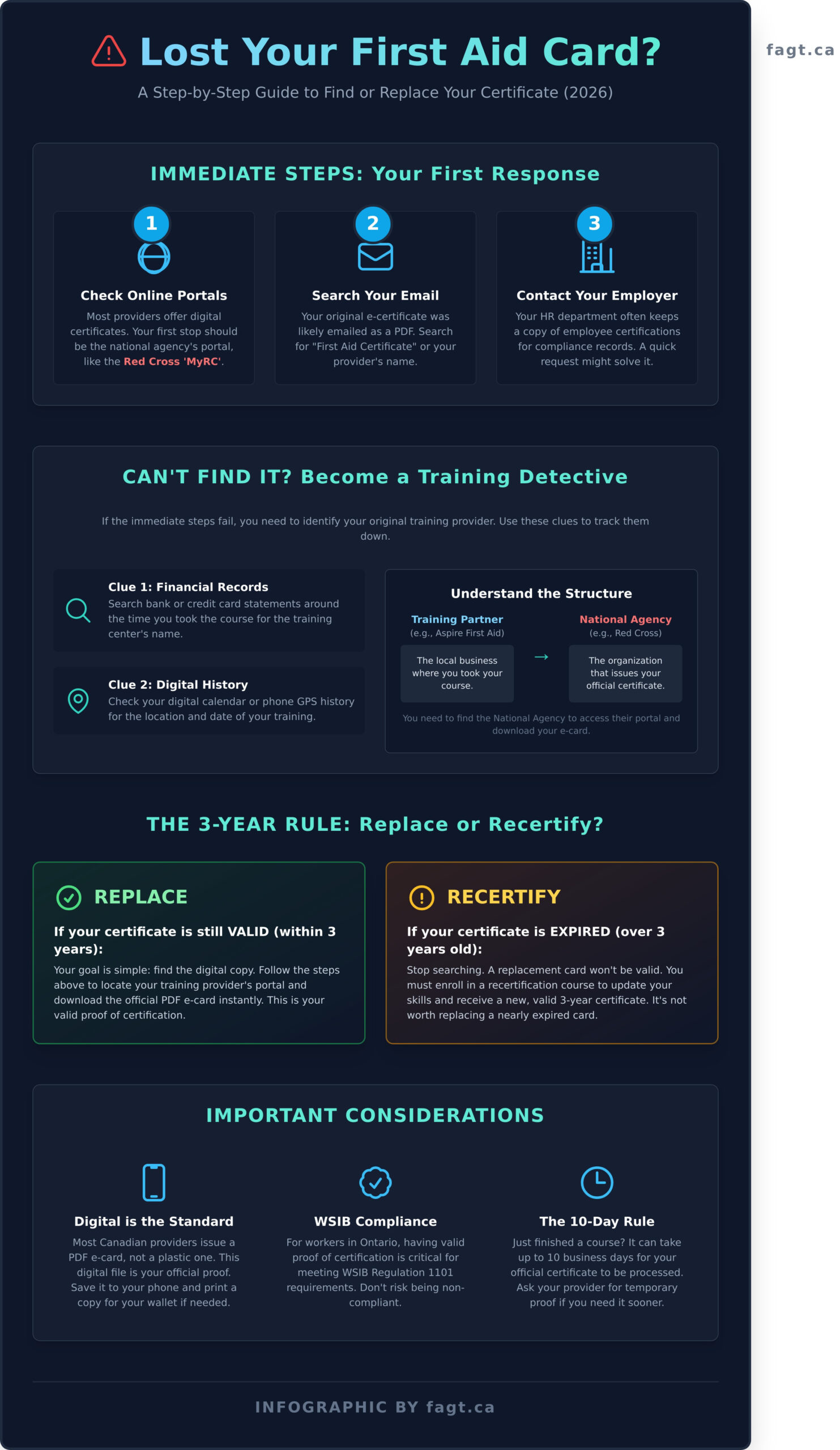
- Most modern Canadian first aid certificates are digital; your first step should always be to check the Red Cross ‘MyRC’ portal for an instant download.
- Can’t find it online? Learn how to become a “detective” by using bank statements or GPS history to identify your original training provider.
- If you’ve lost my first aid card how to get a new one is a critical question for WSIB compliance in Ontario. Understand your responsibilities under Regulation 1101.
- Discover when to stop searching and start recertifying. We explain the 3-year rule and why trying to replace a nearly expired card may not be your best option.
Immediate Steps: What to Do the Moment You Realize Your First Aid Card is Lost
The moment you realize you’ve lost your first aid card, a sense of urgency can set in, especially if you need it for professional compliance. Fortunately, if you’re wondering about your lost my first aid card how to get a new one, the process is often straightforward. Before taking any other steps, it is important to remember that your certification represents critical life-saving skills. To refresh your understanding of these core principles, you can review this comprehensive guide on What is First Aid?. The first step in recovery is not re-taking the course, but systematically checking the most common digital locations where your proof of certification is stored.
While your card is a credential, the skills it represents are what truly matter. This video provides a crucial refresher on one of the most vital first aid techniques.
Before attempting to recover your card, first verify that your certification is still within its 3-year validity period. If it has expired, you will need to complete a recertification course rather than simply request a replacement. If it is still valid, follow these steps in order:
- Check Your Training Provider’s Online Portal: The most efficient step is to log into the online portal provided by your original first aid training provider. Many certification bodies offer a digital platform where you can view, download, or print your e-card instantly.
- Search Your Email Inbox: Perform a thorough search of your email using keywords like “First Aid Certificate” or your training provider’s name, such as “Aspire First Aid Guide Training Corp.” Your original digital certificate was likely sent as a PDF.
- Contact Your Employer’s HR Department: Many employers keep a digital or physical copy of employee certifications for their compliance records. A quick request to your HR department could resolve the issue immediately.
The 10-Day Rule for New Certifications
If you have just completed your training, please be aware that it can take up to 10 business days for your official digital certificate to be processed and appear in your training provider’s certification system. If you need immediate proof for a new job, contact your training provider. At Aspire First Aid Guide Training Corp, we provide all successful participants with temporary proof of completion, which serves as a valid placeholder until the official e-card is issued.
Digital vs. Physical: Which One Do You Actually Need?
Many leading first aid training providers now utilize a digital-only certificate system. You will typically not receive a plastic card in the mail. Your official certification is the PDF file, which can be saved to your phone or computer. For those who prefer a physical copy, you can simply print the PDF and cut out the designated wallet-sized portion. For employers in Ontario and across Canada, this digital certificate is the gold standard for verification.
How to Identify Your Training Provider (The Detective Guide)
Before you can solve the problem of “I lost my first aid card how to get a new one,” you must first identify which organization issued your certificate. This is the most critical step in the replacement process. Think of it as detective work; with a few key clues, you can quickly pinpoint the source of your original training.
Start by examining your financial records. A quick search of your bank or credit card statements from around the time you took the course will often reveal the name of the training centre you paid. If you can’t find a transaction, check your digital calendar or your phone’s GPS history for the date of the training. Finding the address, such as a location in Mississauga or Hamilton, can help you identify the business that operated there.
It’s also essential to understand the difference between a ‘Training Partner’ and a ‘National Agency’. Most likely, you trained with a local partner (like a small business) that was authorized to deliver a course on behalf of a national agency like the Canadian Red Cross, St. John Ambulance, or the Heart & Stroke Foundation. Your certificate is officially from the national agency. National agencies have established procedures for this; for example, the official process to replace your AHA card involves contacting the original Training Center, a standard practice across most certifying bodies. If you believe your provider was a Red Cross partner, you can use their “Find My Certificate” tool to search for your record using your name and email address.
Common Training Partners in Hamilton and Mississauga
In the Hamilton and Mississauga areas, a prominent Canadian Red Cross Training Partner is Aspire First Aid Guide Training Corp. If you recall attending a session at their offices on Dundas St E in Mississauga or MacNab St in Hamilton, they should be your first point of contact. These WSIB-approved providers are authorized to issue the official certificates required for most workplaces, distinguishing them from non-regulated introductory courses.
What if Your Provider Has Closed Down?
If you discover that the specific training partner you used has since closed, do not worry. Your certification is still valid and recorded with the national agency. In this scenario, you must contact the Canadian Red Cross (or other relevant national body) national support line directly. You may be asked to provide secondary proof of training, such as a payment receipt or registration email, to help them locate your file. Be aware that manual record searches can take time; expected wait times for these requests in 2026 can be several weeks.
Ontario WSIB Requirements: Does a Lost Card Affect Your Compliance?
In Ontario, the Workplace Safety and Insurance Board (WSIB) mandates strict compliance with Regulation 1101, which requires employers to ensure a specific number of employees with valid first aid certificates are on-site at all times. If you’ve lost your first aid card, your ability to prove this certification is compromised, directly impacting your employer’s compliance and potentially creating a significant legal risk. The core issue isn’t just about having the training; it’s about having accessible, verifiable proof available for inspection. These provincial rules are part of a broader framework of Workplace first aid requirements that prioritize immediate and qualified care in an emergency.
An employer is legally responsible for verifying the validity of their staff’s certifications. For certifications from providers like the Canadian Red Cross, this is often done through the MyRC online portal. When an employee reports, “I lost my first aid card how to get a new one,” the employer must ensure a valid replacement is secured promptly. The shift towards digital certificates with unique QR codes has greatly simplified this process. During a WSIB audit or inspection, an officer can scan the code on a phone and instantly validate the certificate’s status, reducing reliance on a physical card that can be lost or damaged.
Standard First Aid vs. Emergency First Aid Records
When you start the replacement process, knowing your exact level of certification is crucial. The record-keeping and search process for a comprehensive two-day Standard First Aid & CPR/AED Level C (SFA) course is often more detailed within a training provider’s database than for a more specialized course like Basic Life Support (BLS). It is your responsibility to ensure the replacement card you receive accurately reflects the certification level required for your specific job role under WSIB regulations.
Validation and Authenticity Checks
Your employer doesn’t just take your word for it-they use your unique certificate number to confirm your training status. The Canadian Red Cross ‘Validate Certificate’ tool, for example, allows anyone to instantly confirm a certificate’s authenticity using the unique ID number. This is precisely why a simple screenshot or a photocopy of your old card is often insufficient, especially in high-stakes industries like healthcare, marine, or construction. These sectors require irrefutable, live-verified proof of training that a static image cannot provide, making an official digital or physical replacement essential for compliance.
Step-by-Step: Downloading Your Replacement from My Red Cross
The Canadian Red Cross has implemented a robust and efficient digital system to manage certifications. For anyone asking, “I lost my first aid card how to get a new one,” the My Red Cross (MyRC) online portal is the official and most direct solution. This platform provides immediate, on-demand access to your certification records, eliminating the delays associated with requesting physical reprints. It empowers you to manage your own training history responsibly.
Follow this structured process to download your replacement certificate:
- Step 1: Access the Portal: Navigate to the official website at myrc.redcross.ca. You will be prompted to select your preferred language (English or French) before proceeding.
- Step 2: Log In: Use the email address you provided during your original course registration to sign in. If you have forgotten your password, utilize the ‘Forgot Password’ function to receive a secure reset link to your email.
- Step 3: Locate Your Records: After logging in, you will arrive at your personal dashboard. Find and click on the tab labelled ‘My Certificates’ to view a complete history of your Red Cross training.
- Step 4: Download Your Certificate: All valid certifications will be listed. For each one, you will see options to download a full-page ‘Wall Certificate’ or a compact ‘Wallet Card’. Both are official documents in PDF format.
- Step 5: Secure Your Digital Copy: To prevent future issues, immediately save the downloaded file to a secure cloud storage service like Google Drive, iCloud, or Dropbox. This ensures you have a permanent and easily accessible backup from any device.
Troubleshooting Common Login Issues
Access can sometimes be hindered if the email you are trying does not match the one on file from your training day. Furthermore, if you’ve completed courses with different Red Cross training partners, you may have inadvertently created multiple profiles. To resolve these discrepancies or merge accounts into a single profile, the most effective step is to contact the Red Cross Contact Centre at 1-877-356-3226 for direct, professional assistance with identity verification.
Understanding Fees for Replacement Cards
A primary benefit of the Red Cross system is that digital downloads of your certificates are provided completely free of charge. In contrast, other training agencies in Canada may charge administrative fees, sometimes ranging from C$15 to C$25, for processing and mailing a physical replacement card. Adopting a digital-first approach is the responsible, cost-saving strategy, providing a permanent answer for how to get a new one without any extra expense.
When to Replace vs. When to Recertify
After the initial thought, “I lost my first aid card how to get a new one,” the most important step is to pause and think strategically. Before you request a simple replacement, consider if recertifying is a more cost-effective and valuable decision. The key factor is your certificate’s expiry date.
Standard First Aid & CPR/AED certifications in Canada are valid for three years. If your lost card is already over two and a half years old, spending time and money on a replacement might be inefficient. Furthermore, eligibility for a shorter, less expensive recertification course requires you to hold a current, non-expired certificate from a recognized provider. If your card has already expired, you must take the full course again.
Consider this cost-benefit analysis:
- Card Replacement: Typically involves an administrative fee of C$25 to C$50 for a document that may only be valid for a few more months.
- Recertification Course: Costs more upfront (e.g., C$100-C$150) but provides you with a brand-new certificate valid for a full three years.
If your certification is nearing its end, investing in a renewal course offers significantly better long-term value and is often the best solution when you’ve lost your first aid card and need a new one.
The Fast Path: Booking a Blended Renewal Course
If you decide recertification is the right choice, modern training methods make it faster than ever. Blended learning combines a self-paced online theory component with a single, focused in-class session for practical skills. This efficient model allows you to secure a new, valid certificate quickly, often within the same week. Aspire First Aid offers frequent course availability to meet urgent professional needs. Book your Standard First Aid Recertification in Hamilton or Mississauga to secure your spot.
Upgrading Your Skills While You’re At It
A lost card presents a valuable opportunity to re-evaluate your training needs. Is your current CPR Level C sufficient, or do your career goals-especially in healthcare or emergency services-now require Basic Life Support (BLS)? Taking a full course or an upgrade allows you to align your qualifications with your professional path while resetting your certification for another three years. Aspire First Aid ensures all training meets or exceeds WSIB standards, keeping you compliant and prepared.
Your Path to Regaining Certification and Confidence
Losing your certification card can feel stressful, but it doesn’t have to derail your compliance or confidence. The key is to act methodically: first, identify your original training provider, and then follow their specific replacement process, such as using the My Red Cross portal. This situation also serves as a critical reminder to verify your certificate’s expiry date. Ultimately, the question of ‘I lost my first aid card how to get a new one‘ is often resolved quickly. However, it frequently leads to the more important question of whether it’s time to refresh your life-saving skills.
If your investigation reveals your certification has lapsed or is nearing its renewal date, the clearest path forward is recertification. Ensure you remain WSIB-compliant and ready for any emergency. Found out your card is expired? Book your WSIB-approved recertification today with Aspire First Aid. As an official Canadian Red Cross Training Partner, we provide fully-approved Standard and Emergency First Aid courses at our convenient Hamilton and Mississauga training centres. Don’t let a misplaced card sideline your skills; take action today and stay prepared to help when it matters most.
Frequently Asked Questions
Can I still work if I lost my first aid card but it’s not expired?
Technically, your certification remains valid until its expiry date. However, most provincial and territorial Occupational Health and Safety (OHS) regulations require employers to verify that their designated first aid attendants hold a current certificate. Without a physical or digital card as proof, you may not be permitted to act as the designated first aider. It is your professional responsibility to obtain a replacement promptly to ensure compliance and avoid any workplace interruptions.
How do I find my first aid certificate number?
Your certificate number is a unique identifier for your training record. The most efficient way to locate it is by checking your email for the original digital certificate or course confirmation from your training provider. Many national organizations, like the Canadian Red Cross, also have online portals where you can log in to view your certification details. If these options are unavailable, you will need to contact the training provider directly with your full name and the approximate date of your course.
Is there a central database for all first aid certificates in Canada?
No, there is no single, centralized national database for all first aid certificates in Canada. Each certifying agency, such as the Canadian Red Cross, St. John Ambulance, or the Heart and Stroke Foundation, maintains its own independent records system. To find your record, you must identify which organization issued your original certification and contact either them or the specific training partner who conducted your course. Your search must be directed to the correct issuing body.
What if I lost my first aid card and the training company went out of business?
If the company was an authorized Training Partner for a national organization like St. John Ambulance or the Canadian Red Cross, your record will be stored in the national organization’s database. You should contact the national body directly with your details. If the company was a small, independent provider not affiliated with a national agency, recovering your record may be impossible. In this unfortunate scenario, you will likely need to complete a new first aid course to become certified again.
How much does it cost to get a replacement first aid card in 2026?
Currently, the cost for a replacement first aid certificate in Canada typically ranges from C$15 to C$30, depending on the training provider and whether you require a digital or physical copy. Projecting to 2026, it is reasonable to expect this fee to either remain stable or increase slightly with inflation. For an accurate cost, it is essential to contact the original issuing organization, as they set the official fee structure for all replacement documentation.
How do I add my first aid certificate to my LinkedIn profile?
Adding your certification to LinkedIn enhances your professional profile. Log in and navigate to your profile page. Click the “Add profile section” button, then select “Licenses & Certifications.” Enter the name of the course (e.g., Standard First Aid & CPR/AED Level C), the Issuing Organization (e.g., Canadian Red Cross), the issue and expiration dates, and the certificate number in the “Credential ID” field. This provides verifiable proof of your qualifications to potential employers.
Can I get a new first aid card if I only remember the year I took the course?
Yes, it is often possible. If you’ve found yourself thinking, “I lost my first aid card how to get a new one with limited details,” your best course of action is to contact the training provider directly. Provide them with your full legal name used at the time of the course, the year of completion, and the city or location where you were trained. The more information you can provide, the greater the likelihood they can locate your record in their system and issue a replacement.
Does the Canadian Red Cross mail out physical cards anymore?
The Canadian Red Cross has transitioned to a primarily digital system to improve efficiency and access. Upon successful course completion, you will receive a link to your secure online account where you can view and print a valid digital certificate (e-certificate). While they no longer mail physical wallet cards as a standard practice, some Training Partners may offer the option to print a physical card for an additional fee. The official proof of certification is the digital version.
