
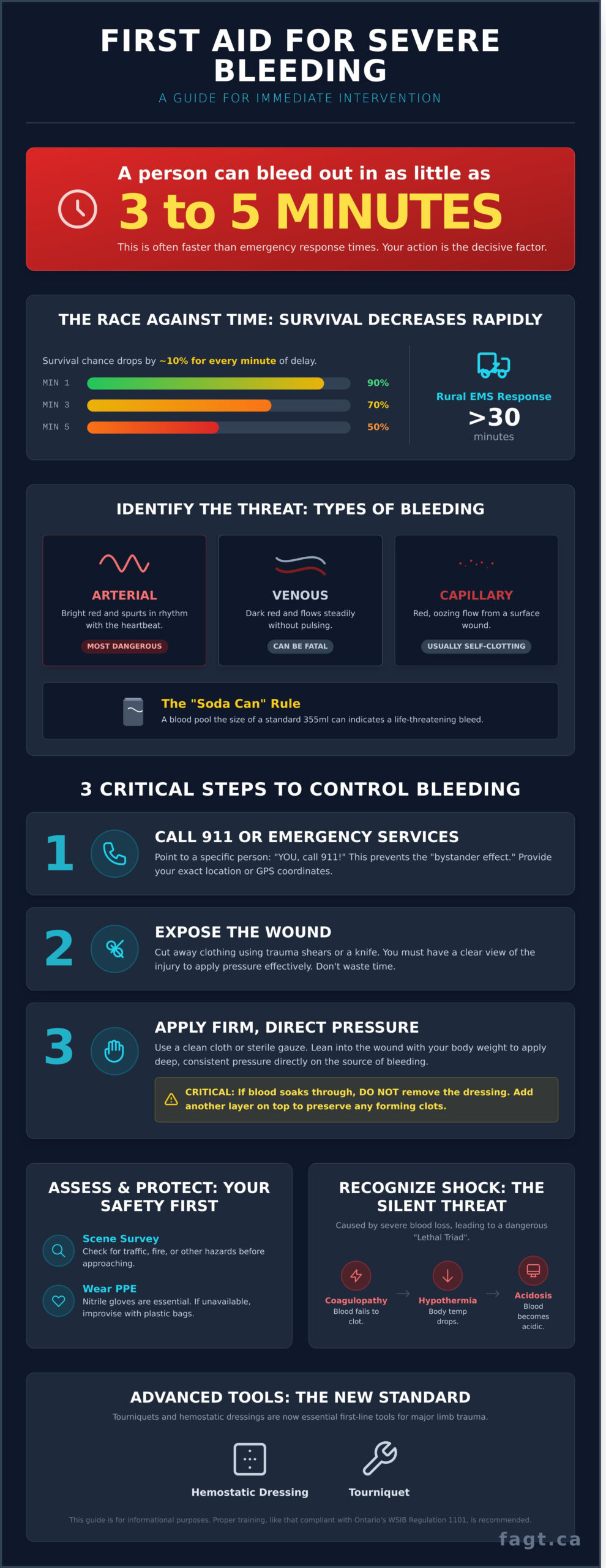
According to 2023 Canadian trauma data, a person can bleed out in as little as 300 seconds, which is often faster than the average emergency response time in rural areas. This narrow window makes your immediate intervention the most decisive factor in a victim’s survival. Mastering first aid for severe bleeding is a professional necessity that transforms a bystander into a responsible first responder. It’s common to feel a paralyzing fear that you might cause more harm than good or contract a bloodborne pathogen while trying to help. You aren’t alone in that anxiety, but hesitation is the only mistake you can’t afford to make.
This 2026 guide promises to provide the professional steps required to identify, treat, and manage life-threatening injuries before the paramedics arrive. You’ll gain the confidence to act through a clear understanding of WSIB-compliant bleeding control and modern medical standards. We’ll examine the specific criteria for wound packing, the exact moment a tourniquet is required, and the essential safety protocols to keep you protected during an emergency.
Key Takeaways
- Learn to distinguish between life-threatening arterial spurts and venous flows to prioritize your emergency response when every second counts.
- Master the essential protocol for first aid for severe bleeding, including how to properly expose a wound and effectively coordinate with emergency dispatchers.
- Discover why tourniquets and hemostatic dressings have evolved from last-resort measures to essential first-line tools for managing major limb trauma.
- Identify the critical symptoms of shock to provide life-saving stabilization and monitoring until professional Canadian paramedics arrive on the scene.
- Understand Ontario’s WSIB Regulation 1101 requirements to ensure your workplace in Mississauga or Hamilton remains compliant and prepared for high-risk incidents.
Identifying Life-Threatening Bleeding: When Every Second Counts
Severe bleeding is a critical medical emergency where the rate of blood loss exceeds the body’s natural ability to form a clot. In a trauma situation, the human body can only compensate for so much volume loss before vital systems begin to fail. Providing effective first aid for severe bleeding requires a professional mindset and the ability to distinguish between manageable injuries and life-threatening crises. You must act with the same precision and responsibility that a trained manager applies to a complex environment. If you don’t intervene within the first three to five minutes of a major arterial breach, the victim’s chance of survival decreases by roughly 10% for every minute of delay.
To assess the situation, you must identify the source and type of the flow. Arterial bleeding is the most dangerous. It appears bright red because it’s highly oxygenated and it spurts in rhythm with the victim’s heartbeat. This high-pressure flow can drain a person’s blood volume rapidly. Venous bleeding is dark red and flows steadily rather than spurting. While it lacks the dramatic pulsing of an artery, a deep venous rupture can be just as fatal if it isn’t addressed. Recognizing these emergency bleeding control methods is the foundation of any successful rescue operation.
Use the “Soda Can” rule as a practical metric for field assessment. If the volume of blood visible on the ground, on clothing, or in a pool equals a standard 355ml Canadian soda can, the situation is life-threatening. Professionals also look for the “Flow vs. Pool” dynamic. Blood that is actively pulsing from a wound or pooling rapidly on a flat surface indicates that the body’s internal sealing mechanisms have failed. In these cases, first aid for severe bleeding must begin immediately to prevent the onset of irreversible shock.
The Physiology of Hemorrhagic Shock
Rapid blood loss leads to a sharp drop in blood pressure, which prevents the heart from delivering oxygen to the brain and other vital organs. This state often triggers the “Lethal Triad” in trauma: hypothermia, acidosis, and coagulopathy. As the body loses blood, it loses the ability to regulate temperature, and cold blood cannot clot effectively, creating a dangerous cycle of decline. Hypovolemic shock is the clinical result of severe fluid loss that prevents the heart from pumping enough blood to the body.
Assessing the Scene and Personal Safety
A responsible responder must conduct a thorough “Scene Survey” before initiating contact. Ensure you don’t become a second victim by checking for environmental hazards like traffic, fire, or unstable structures. In 2026, Canadian safety standards dictate that Personal Protective Equipment (PPE) is a non-negotiable requirement for responders. Nitrile gloves are the preferred barrier against bloodborne pathogens. If PPE is unavailable in your immediate vicinity, use improvised barriers such as heavy-duty plastic bags or multiple layers of clean, non-porous material. Your safety is the priority; you cannot manage a crisis if you’re incapacitated yourself.
- Arterial: Bright red, spurting, high pressure.
- Venous: Dark red, steady flow, lower pressure.
- Capillary: Red, oozing, usually clots on its own.
Step-by-Step First Aid for Severe Bleeding
When an accident occurs in the field, every second counts. A person can bleed to death in as little as 3 to 5 minutes, making immediate action a necessity rather than an option. Your first move is to call 911. If you’re in a group, look at a specific person, point, and command them to make the call. This prevents the “bystander effect” where everyone assumes someone else has acted. Provide the operator with your exact GPS coordinates, especially if you’re in a remote management zone in Northern Canada where response times can exceed 30 minutes.
Once help is on the way, you must expose the wound. Use trauma shears or a sturdy knife to cut through layers of denim, wool, or heavy work gear. You need to see the active site where blood is pulsing or flowing. Don’t waste time trying to preserve clothing; professional first aid for severe bleeding requires a clear view of the injury to be effective. After locating the source, apply firm, continuous direct pressure. Use the cleanest material at hand, such as a sterile gauze pad or a clean cloth. Lean into the wound using your body weight to ensure the pressure is deep and consistent.
If the blood soaks through the initial dressing, place another layer directly on top. Do not lift the original bandage to check the wound. Doing so can tear away the fragile fibrin clots forming at the site, which usually take about 300 to 420 seconds of uninterrupted pressure to stabilize. Maintaining this seal is critical for the victim’s survival until professional paramedics arrive. It’s a matter of staying calm and holding the line, even when the situation feels overwhelming.
The Technique of Wound Packing
Standard surface pressure often fails for deep lacerations in junctional areas like the groin or armpit. In these cases, you must pack the wound. Take a long strip of gauze and feed it into the cavity using your fingers. Stuff the material deep into the wound until the cavity is completely full and the material is level with the skin. This creates internal pressure directly against the ruptured vessel. For those who prioritize safety in the wilderness, reviewing the FTGQ training resources can help you stay prepared for these high-risk scenarios.
Handling Embedded Objects
If a branch, piece of metal, or tool is stuck in the victim, the golden rule is to leave it alone. The object acts as a plug, keeping the pressure on the damaged artery from the inside. Removing it can lead to catastrophic blood loss in less than 60 seconds. Instead, stabilize the object by placing bulky dressings around it, such as rolled-up towels or thick pads, and secure them with tape. The only exception is if the object is obstructing the victim’s airway, making breathing impossible. In all other cases, let the hospital staff handle the extraction.
Advanced Tools: Tourniquets and Hemostatic Dressings
Medical protocols for managing life-threatening injuries have shifted significantly since the 2011 Hartford Consensus. For years, first responders viewed the tourniquet as a desperate measure that guaranteed limb loss. We now know this is a myth. Modern clinical data shows that a commercial tourniquet can remain in place for up to 120 minutes without causing permanent nerve or tissue damage. In any situation involving first aid for severe bleeding from an arm or leg, these devices are now considered first-line tools rather than a final option. Professional-grade equipment like the CAT (Combat Application Tourniquet) or the SOFTT-W is essential for any wilderness or industrial first aid kit in Canada. While a belt or a piece of clothing might seem like a viable substitute, studies indicate that improvised tourniquets have a failure rate exceeding 60 percent. They often fail to provide enough circumferential pressure to stop arterial flow, merely acting as a venous constrictor that can actually increase blood loss.
Applying a tourniquet correctly requires speed and precision. You can find detailed visual steps in this Mayo Clinic guide to severe bleeding, which outlines how to stabilize a patient until paramedics arrive. In high-stress scenarios where the exact source of a wound is hidden by heavy winter clothing or darkness, experts recommend the “High and Tight” rule. This means placing the device as high as possible on the limb, near the armpit or groin area. This ensures all potential arterial breaches are proximal to the strap. It’s a professional standard that prioritizes life over limb preservation in the initial seconds of an emergency. A genuine Gen 7 CAT tourniquet typically retails for C$55 in Canada; avoid cheap C$15 imitations found on discount sites as they often snap under tension.
When and How to Apply a Tourniquet
Identify life-threatening limb bleeding that direct pressure cannot control, such as blood that is spurting or pooling rapidly. Place the tourniquet 2-3 inches above the wound, ensuring it is never positioned directly on a joint like the knee or elbow. Tighten the windlass until the bleeding stops completely and the distal pulse disappears. Use a permanent marker to document the “Time of Application” on the device’s white “TIME” strap. This 24-hour timestamp is critical for surgeons to determine the urgency of vascular repair once the patient reaches a Canadian trauma center.
Hemostatic Agents in 2026 First Aid
Hemostatic agents have seen a similar evolution. By 2026, the industry has moved entirely away from the granular powders used in the early 2000s. Those early products caused thermal burns and were difficult for surgeons to remove during debridement. Modern dressings use kaolin or chitosan-impregnated gauze. These substances accelerate the body’s natural clotting cascade on contact with blood. For wounds in the torso, neck, or groin where a tourniquet cannot be applied, these agents are indispensable. They don’t just soak up blood; they chemically induce a stable clot within 3 minutes of sustained manual pressure. When providing first aid for severe bleeding in “non-tourniquet” zones, you must pack the gauze deep into the wound cavity to ensure contact with the ruptured vessel. This proactive “gestion” of the injury site is what separates a prepared responder from a bystander.
- Kaolin-based (QuikClot): An inorganic mineral that activates Factor XII in the clotting cascade.
- Chitosan-based (Celox): Derived from shrimp shells, it works independently of the body’s natural clotting factors, making it effective even if the patient is on blood thinners.
- Safety Rule: Never use outdated “pour-in” powders; only use impregnated gauze rolls for better control and easier removal.
Responsible first aid management requires the right tools and the training to use them. Whether you’re a professional trapper in the Quebec bush or a safety officer on a job site, having these advanced tools ready is a necessity for modern safety standards.
Managing Shock and Post-Bleeding Care
Shock is a critical physiological collapse that follows major trauma. It isn’t just a state of mind; it’s a life-threatening condition where the circulatory system fails to provide enough oxygenated blood to vital organs. When you provide first aid for severe bleeding, your job doesn’t end once the wound is covered. You must immediately prepare for hypovolemic shock, which typically occurs after a 15% to 30% loss of total blood volume. In an adult, this equates to roughly 750 ml to 1,500 ml of fluid. Without intervention, this leads to organ failure and death within minutes.
Identifying shock requires constant vigilance. You’ll notice the victim’s skin becoming pale, cool, and clammy as the body diverts blood to the core. Their pulse will likely become rapid and weak, often exceeding 100 beats per minute. Watch for shallow, rapid breathing and increasing confusion or agitation. If the victim becomes lethargic or loses consciousness, their condition has reached a critical stage. You need to act before EMS arrives to bridge the gap between injury and professional stabilization.
The “WARM” protocol is a standard tool for managing these victims. It focuses on preventing the lethal triad of trauma: acidosis, coagulopathy, and hypothermia. If a victim’s body temperature drops below 35 degrees Celsius, their blood loses the ability to clot effectively. This condition, known as coagulopathy, makes your previous efforts to stop the bleed less effective. Keep the victim warm by using emergency blankets, coats, or even your own body heat. Position the victim lying flat on their back. If there’s no evidence of a spinal injury, elevate their feet 20 to 30 cm to encourage blood flow toward the heart and brain.
Psychological First Aid for the Victim
Emotional stability is a physiological tool. A panicked victim has a higher heart rate, which increases blood pressure and can worsen a bleed. Use a calm, authoritative voice to command the situation. Employ the “Look, Listen, Link” method: look for urgent needs, listen to their concerns without judgment, and link them to the help coming. Don’t use “medical talk” or graphic descriptions of the wound. Telling a victim they’ve “lost a liter of blood” can trigger a vasovagal response, further dropping their blood pressure. Instead, focus on the steps you’re taking to keep them safe.
Handing Over to Emergency Medical Services (EMS)
When Canadian paramedics arrive, your handover must be precise. Use the “MIST” report format to ensure no details are missed. State the Mechanism of injury (e.g., a C$500 chainsaw accident), Injuries found, Signs and Symptoms observed, and the Treatment given. If you applied a tourniquet, tell the lead paramedic immediately and ensure it’s visible. Don’t cover a tourniquet with blankets. After the victim is transported, prioritize your own recovery. Traumatic events can leave lasting psychological impacts. Seeking a debrief with a professional or a peer support group is a responsible step for any rescuer.
Being prepared means having the right tools and the right training for every situation in the field.
Workplace Compliance and Training in Ontario
Ontario employers must adhere to the Workplace Safety and Insurance Board (WSIB) Regulation 1101. This regulation mandates that every workplace, regardless of size, has at least one person trained in first aid. In Mississauga and Hamilton, where manufacturing and logistics hubs dominate the landscape, these requirements are strictly enforced. For businesses with five or fewer employees on any given shift, at least one worker must hold an Emergency First Aid certificate. However, if your team grows to six or more people, WSIB requires at least one staff member with a Standard First Aid certification on site at all times.
High-risk industries face greater scrutiny due to the potential for traumatic injuries. If your facility operates heavy machinery or handles volatile materials, relying on the bare minimum isn’t enough. Standard First Aid provides the comprehensive training needed to manage life-threatening situations, including first aid for severe bleeding. These skills are critical because a person can bleed out in under five minutes, often before Hamilton or Mississauga paramedics arrive on the scene. Proper training transforms a panicked bystander into a capable responder who can stabilize a victim until professional help takes over.
Legal concerns often stop people from helping, but the Ontario Good Samaritan Act of 2001 provides a robust safety net. This law protects individuals from liability when they provide emergency assistance at the scene of an accident. As long as you don’t act with gross negligence, the law shields you from legal repercussions. This protection is vital for workplace safety cultures, as it empowers employees to use their training without fear of lawsuits. When a colleague suffers a deep laceration, the priority is stopping the blood loss, not worrying about legal paperwork.
WSIB does not recognize “online-only” certifications for workplace compliance. While digital modules are excellent for theory, they cannot replace physical skill sessions. You cannot learn the tactile pressure required for wound packing or the specific torque needed for a combat tourniquet through a computer screen. WSIB standards require an in-person instructor to verify your technique. Aspire First Aid ensures all certifications meet these provincial benchmarks by combining rigorous theory with hands-on practical exams.
Standard First Aid & CPR C: The Gold Standard
Aspire First Aid delivers the Canadian Red Cross curriculum, which is the most recognized training program in Canada. This course goes beyond basic bandages. It focuses on high-intensity scenarios where first aid for severe bleeding is the difference between life and death. Participants practice with real tourniquets and simulated wounds to build muscle memory. This hands-on practice is non-negotiable for industrial workers in the GTHA. You can secure your workplace safety by enrolling in Standard First Aid & CPR/AED Certification to ensure full compliance with Ontario law.
Booking Your Certification in Mississauga or Hamilton
Modern businesses need flexible training solutions that don’t halt operations for days. Blended learning is the most efficient path, allowing employees to complete eight hours of theory online at their own pace followed by a single day of in-class skills training. Aspire First Aid supports local businesses in Mississauga and Hamilton by offering group training sessions directly at your facility. This reduces travel time and allows teams to train in their actual work environment. Don’t wait for an inspection or an accident to verify your compliance. Book your WSIB-approved First Aid course today at fagt.ca and protect your most valuable assets: your people.
Turn Your Knowledge Into Life-Saving Readiness
Preparation is the only barrier between a manageable injury and a tragedy. When an arterial bleed occurs, a person can lose a critical volume of blood in less than 3 minutes. Applying the correct first aid for severe bleeding immediately increases survival rates by over 70% according to 2024 trauma response data. You’ve now learned how to identify life-threatening wounds, use WSIB-standard tourniquets, and manage shock until paramedics arrive. These protocols represent the 2026 benchmarks for workplace safety and personal preparedness in Ontario.
Reading a guide is a vital first step, but hands-on practice builds the muscle memory needed when adrenaline spikes. Our Mississauga and Hamilton facilities provide the high-fidelity simulation you need to act without hesitation. Don’t wait for an emergency to realize you aren’t ready. You can gain the professional expertise required to stabilize a victim and maintain control of a chaotic scene.
Get Certified in Life-Saving First Aid Skills at Aspire First Aid Guide Training Corp. As a WSIB-Approved Training Partner with Canadian Red Cross Certified Instructors, we ensure you leave with the confidence to protect your colleagues and family. You have the power to change the outcome of an accident today.
Frequently Asked Questions
Is it ever okay to remove a tourniquet once it has been applied?
No, you should never remove a tourniquet once you’ve applied it. Only a qualified medical professional in a hospital setting should loosen or remove the device. Removing it prematurely can cause a sudden release of toxins into the bloodstream or lead to renewed, uncontrollable hemorrhaging. Your responsibility as a first responder is to maintain the pressure until the patient is under the care of a trauma team.
Can I use a belt as an improvised tourniquet if I don’t have a commercial one?
You can use a belt as a last resort, but research shows improvised tourniquets fail in up to 75% of cases. Most belts are too stiff and narrow to provide the circumferential pressure needed to stop arterial flow. If you don’t have a commercial Windlass tourniquet, use a wide strip of cloth and a sturdy stick to create a windlass system. This ensures you’re providing effective first aid for severe bleeding while waiting for paramedics.
What is the “Good Samaritan Act” in Ontario and how does it protect me?
The Good Samaritan Act, 2001, protects you from legal liability if you provide emergency assistance at the scene of an accident. As long as you act in good faith and don’t demonstrate gross negligence, you’re shielded from being sued for damages. This law encourages bystanders to intervene during life-threatening situations without fear of legal repercussions. It’s a vital piece of Ontario legislation that supports public safety and immediate crisis intervention.
How long can a tourniquet stay on before permanent damage occurs?
A tourniquet can typically remain in place for up to 120 minutes without causing permanent nerve or muscle damage. Medical studies indicate that complications significantly increase after the 2-hour mark, though limb salvage is often possible even after 6 hours of application. Always write the exact time of application on the patient’s forehead or the device itself. This data helps ER surgeons prioritize treatment and manage the risk of reperfusion injury.
Should I wash a severe wound with water before applying pressure?
No, you shouldn’t wash a severe wound before you’ve successfully controlled the bleeding. Your primary goal is to stop blood loss, and running water can interfere with the body’s natural clotting process. Once the bleeding is managed and if medical help is delayed, cleaning might be considered, but for life-threatening hemorrhages, immediate pressure is the only priority. Focus on the 5 essential steps of first aid for severe bleeding to ensure the patient’s survival.
What should I do if blood soaks through the first bandage?
If blood soaks through your initial dressing, place a second thick bandage directly over the first one and maintain firm pressure. Never remove the original bandage because doing so will tear away the clots that have already started to form. If the second layer also becomes saturated, it’s a sign that direct pressure isn’t working. At this point, you must apply a tourniquet or use hemostatic gauze if available.
Does WSIB require every workplace to have a tourniquet in their first aid kit?
WSIB’s Regulation 1101 doesn’t explicitly mandate a tourniquet for every standard first aid kit, but it requires employers to provide equipment appropriate for workplace risks. For high-risk industries like forestry or construction, adding a C$45 to C$60 commercial tourniquet is a responsible management decision. Employers must ensure kits meet the minimum requirements based on the number of workers per shift. Check the 2024 Ontario health and safety guidelines for your specific sector’s requirements.
How often do I need to renew my First Aid certification in Ontario?
You must renew your Standard First Aid certification every 3 years to remain compliant with Ontario’s Workplace Safety and Insurance Act. Most providers offer a one-day recertification course that costs between C$80 and C$120. However, you can only recertify once; after the second 3-year period, you’ll need to take the full two-day course again. Staying current ensures you’re trained in the latest life-saving techniques and legal standards.
