AED Training for the Office: The Complete 2026 Guide to Workplace Safety & Compliance
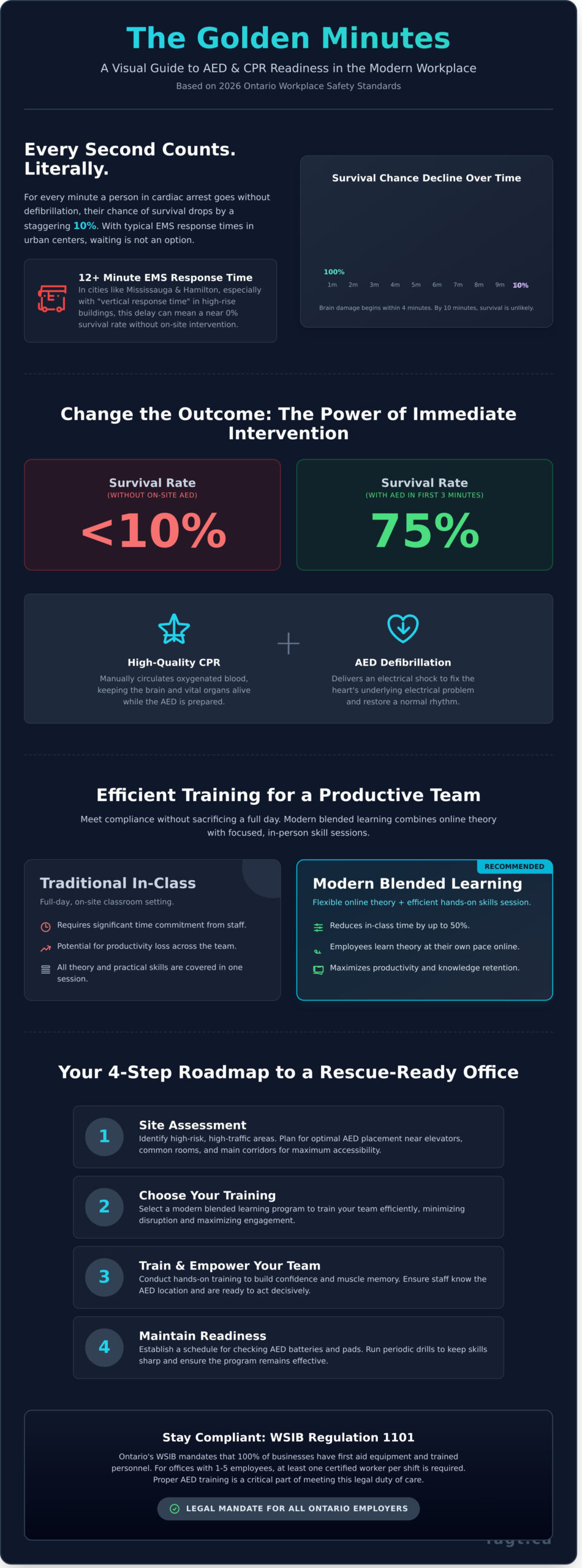
Did you know that for every sixty seconds a person in cardiac arrest goes without defibrillation, their chance of survival drops by 10%? In a typical Ontario workplace, waiting for a 12 minute ambulance response time in Mississauga or Hamilton effectively means a zero percent survival rate without immediate on-site intervention. You likely recognize that protecting your team is a non-negotiable responsibility, but the confusion between diverse provincial workplace safety standards and the array of recognized training certifications often leads to compliance paralysis. It’s frustrating to try and balance these life-saving requirements with the reality of a busy 2026 work schedule.
This guide shows you how to implement aed training for the office that meets every provincial regulation without forcing your staff to sacrifice a full day of productivity. We’ll break down the latest 2026 provincial workplace safety requirements, compare local training options in the Golden Horseshoe, and provide a clear roadmap for a professional, rescue-ready workplace. By the end of this article, you’ll have a pragmatic strategy to ensure your office is both compliant and managed by a team that’s ready to act when it counts.
Key Takeaways
Understand how to navigate WSIB Regulation 1101 to ensure your Ontario workplace meets mandatory safety compliance based on your specific office size.
Discover how modern blended learning models provide efficient aed training for the office by reducing classroom time without sacrificing critical CPR integration.
Learn a professional step-by-step strategy for AED implementation, including site assessments to determine the most accessible placement near elevators and common areas.
Master the “Golden Minutes” approach to mitigate the high-risk delays associated with waiting for EMS in high-rise office buildings.
Explore the advantages of mobile, boardroom-based training in Mississauga and Hamilton to maintain productivity while ensuring your team is fully prepared for emergencies.
Why AED Training is a Critical Investment for Modern Offices
Effective aed training for the office involves much more than learning how to push a green button. It’s about developing situational awareness and the confidence to lead during a medical crisis. Many professionals assume the device does all the work, but a machine cannot clear a crowded hallway or provide the necessary physical coordination to manage a victim. What is an Automated External Defibrillator (AED)? It’s a sophisticated medical tool that requires a human operator to integrate its prompts with high quality CPR. Without this training, the device often stays in its cabinet while employees wait for paramedics to arrive.
Relying on Emergency Medical Services (EMS) is a high risk strategy for modern Canadian workplaces, especially those in high rise buildings. In cities like Toronto or Hamilton, the “vertical response time” can be lethal. Even if an ambulance arrives at the front door in 6 minutes, the time it takes to navigate elevators and security can push the total response time past 10 minutes. Brain damage begins within 4 minutes of a cardiac arrest. Training your team ensures that the “Golden Minutes” are spent delivering life saving shocks rather than waiting in the lobby.
To better understand the signs that precede the use of a defibrillator, watch this helpful video:
Moving from a “checkbox” mentality to a genuine life saving culture changes how employees perceive their workplace. While provincial regulations might mandate safety equipment, the moral duty to protect staff is what builds long term trust. When a company invests in aed training for the office, it demonstrates a commitment to employee welfare that goes beyond avoiding a fine. This visible investment in safety improves morale and makes the office feel like a secure environment for everyone. It shows that the organization views its people as assets worth protecting with professional grade resources.
In today’s digital world, a truly comprehensive safety culture also includes protecting your team from online threats. While preparing for physical emergencies is paramount, understanding digital risks is a key part of modern management. To explore this topic further, you can visit a curated list of essential cybersecurity books.
The Reality of Sudden Cardiac Arrest (SCA) in the Workplace
The Heart and Stroke Foundation of Canada estimates that by 2026, approximately 40,000 cardiac arrests will occur annually outside of hospitals.
Offices are unique environments for these incidents because high pressure deadlines and sedentary work patterns contribute to cardiovascular strain.
Statistics show that when a bystander applies an AED within the first 3 minutes of a collapse, the chance of survival climbs to 75%.
Without immediate intervention, the survival rate for a workplace cardiac arrest is less than 10%.
AED Training vs. CPR: Why You Need Both
CPR and defibrillation are two halves of a single life saving process. CPR keeps the brain viable by manually circulating oxygenated blood through the body. However, CPR alone is rarely enough to fix the underlying electrical problem in the heart. For WSIB certification in Ontario and other provincial safety requirements, employers must provide training that covers both disciplines. Chest compressions maintain the biological foundation of life while the defibrillator delivers the specific electrical intervention required to resume a natural heartbeat.
Understanding WSIB Requirements for Office First Aid and AEDs
Ontario’s Workplace Safety and Insurance Board (WSIB) Regulation 1101 is a legal mandate that every employer in the province must follow. It dictates that 100% of businesses provide first aid equipment, facilities, and trained personnel. For small offices with 1 to 5 employees, at least one worker per shift must hold a valid certificate. As your headcount grows, these obligations become more complex. Implementing aed training for the office is the only way to bridge the gap between owning a life-saving device and actually being prepared to use it.
The legal risks of negligence are high. Storing an AED in a breakroom without training your staff creates a “duty of care” gap. If a cardiac event occurs and the device sits idle because no one knows how to operate it, the employer faces significant liability. Following the OSHA AED Guidelines helps establish a gold standard for workplace safety programs, even if your local inspector focuses on provincial rules. In Ontario, failing to maintain these standards can lead to hefty fines under the Occupational Health and Safety Act (OHSA), which can exceed C$100,000 for corporate entities.
Certification validity is another area where many offices fall behind. WSIB certificates are valid for 3 years; however, cognitive decay starts much sooner. Research shows that CPR and AED skills begin to diminish just 6 months after training. Proactive renewal planning is essential. Waiting until a certificate expires to book a session leaves your office in a period of non-compliance. Smart managers schedule refreshers at the 2.5-year mark to ensure continuous coverage.
Determining Your Office Training Ratios
Your office size dictates the level of training required. For hubs with 1 to 19 employees per shift, Emergency First Aid (EFA) is the minimum requirement. This is a 6.5-hour course covering basic life support. Once your staff reaches 20 or more, Standard First Aid (SFA) becomes mandatory. SFA is a 13-hour, 2-day commitment. If your office spans multiple floors, you must have a trained responder and a first aid kit available on every level. Hybrid work schedules complicate this; you must ensure a certified person is physically present on-site during all operating hours, not just “on the payroll” while working from home.
WSIB Compliance Checklist for 2026
Compliance involves more than just a certificate. By 2026, all Ontario offices should maintain a rigorous documentation process to avoid penalties. Your compliance folder must include:
First Aid Station: A WSIB-approved kit located adjacent to your AED, containing at least 12 adhesive dressings, 4 compress dressings, and 6 triangular bandages for small offices.
Training Logs: A digital or physical record of every employee’s certification date and expiry.
Incident Reports: Form 7 documentation for any workplace injury or use of the AED.
Quarterly Inspections: Signed logs proving the AED battery and pads are unexpired and the first aid kit is fully stocked.
This level of rigorous documentation aligns with the principles found in broader quality management systems. For businesses looking to formalize their commitment to operational excellence beyond specific regulations, firms like Align Quality specialize in guiding companies through the ISO 9001 certification process.
Maintaining these standards ensures your team is ready for an emergency. Choosing the right training provider helps ensure your office remains compliant without the stress of last-minute scheduling. Annual skills refreshers, while not strictly mandated by the WSIB for EFA, are highly recommended to keep response times under the critical 3-minute window required for cardiac arrest survival.
Choosing the Right Format: Blended vs. Traditional In-Class Training
The landscape of emergency response education shifted significantly in 2020 when the Canadian Red Cross accelerated the rollout of blended learning models. This evolution moved the heavy lifting of theoretical knowledge to digital platforms; it effectively stripped away hours of passive listening in a classroom. For a manager, this means the days of losing your entire team for two full consecutive days are over. Modern aed training for the office now utilizes interactive modules that allow staff to complete the “reading” portion on their own schedule before stepping foot in a training room.
Productivity is a primary concern for any Canadian business. A traditional Standard First Aid and CPR-C course typically requires 14 hours of in-class time. In contrast, the blended model splits this into 8 hours of online self-study and only 6 hours of in-person practical assessment. If you’re training a department of 15 people, the blended approach reclaims 120 collective hours of desk time. This efficiency doesn’t sacrifice quality; it ensures that when employees are in the classroom, they’re focused entirely on high-stakes physical skills. To ensure your workplace meets these high standards, consulting the American Heart Association AED Program Guide provides a clear roadmap for establishing a resilient safety culture. This strategic management of time allows for better resource allocation without compromising the management of workplace risks.
Learning retention remains the core objective. You can’t build muscle memory through a screen. AED proficiency requires the physical act of peeling pads, placing them correctly on a manikin, and clearing the area before a shock is delivered. Studies show that 70% of students feel more confident in their ability to act after hands-on practice compared to video-only instruction. The physical session is where the “responsible manager” mindset takes root; it’s where employees transform from passive observers into active lifesavers.
The financial math also favors a strategic approach. Bringing an instructor to your office for a private group of 12 people often costs between C$1,400 and C$1,700. This is frequently more cost-effective than sending 12 individual employees to a public clinic at C$160 per person, especially when you factor in travel expenses and the loss of a full day’s output. Private on-site sessions allow the instructor to tailor the aed training for the office specifically to your floor plan and equipment locations.
This focus on professional, tailored solutions is a hallmark of efficient business management, extending beyond safety training to areas like executive travel. For companies with a footprint in the U.S. Midwest, particularly the Minneapolis–St. Paul region, ensuring high-quality ground transportation is crucial. To see an example of this type of specialized corporate service, you can visit MSP Car Service.
The Advantages of Blended Learning for Corporate Teams
Blended learning is the gold standard for modern teams because it respects the employee’s time. Staff can pause and resume the online theory component at their own pace, which accommodates different learning speeds. This model reduces in-class time by 50% while fully maintaining WSIB-approved certification status. HR managers can use the Red Cross portal to track real-time progress, ensuring every team member has completed their digital modules before the instructor arrives on-site.
When to Choose Traditional In-Class Training
Traditional training still holds value for specific environments. It serves as a powerful team-building exercise, forcing different departments to collaborate on safety drills in real-time. This format is ideal for offices where staff have limited computer access or varying levels of digital literacy. The primary benefit is the immediate, real-time Q&A with a certified instructor. This allows for deep dives into specific workplace hazards that an automated online module might overlook.
How to Implement a Successful AED Program in Your Office
Implementing a life saving initiative requires more than just buying a device and mounting it on a wall. A professional approach ensures that your workplace remains compliant with Ontario’s 2001 Good Samaritan Act while fostering a culture of readiness. Success depends on a structured, five step deployment strategy that prioritizes accessibility and professional competence.
Step 1: Conduct a site assessment. Don’t guess where the device belongs. Use a stopwatch to ensure a person can reach the AED and return to any workstation within 180 seconds. While elevators are common landmarks, breakrooms or central lobbies often serve as better hubs. Data from 2022 suggests that placing units in high traffic kitchens reduces response times by an average of 38 seconds compared to secluded hallway placements.
Step 2: Select a Red Cross Training Partner. Professional aed training for the office must meet WSIB Regulation 1101 standards. Partnering with a recognized provider like Aspire First Aid ensures your team receives instruction that aligns with the latest 2020 ILCOR guidelines. These courses provide the certification necessary to satisfy provincial labor inspectors.
Step 3: Appoint Safety Champions. Relying on a single office manager creates a point of failure. Designate one “Safety Champion” for every 25 employees across different departments. These individuals act as the primary responders and internal advocates for the program.
Step 4: Establish a maintenance schedule. An AED is a medical tool that requires active management. You must track the specific expiration dates for both the lithium batteries and the electrode pads to ensure the device functions during a crisis.
Step 5: Run Mock Drills. Theoretical knowledge fades quickly. Conduct quarterly “unannounced” drills to verify that your office layout supports a rapid response. If your team cannot deploy the trainer unit within 3 minutes, you need to reassess your equipment locations.
AED Maintenance and Signage Best Practices
Visibility is the foundation of a rapid response. Install 3D wall signs that protrude from the surface, ensuring the AED is visible from at least 15 meters in either direction. Office managers should perform a visual status check every 30 days, looking for the green “ready” light on the unit. It is vital to remember that AED pads contain a conductive gel that dries out over time; most pads have a shelf life of 24 to 60 months and must be replaced even if they’ve never been used.
Building Employee Confidence and Reducing Fear
The biggest barrier to a successful program is the fear of doing something wrong. Modern AEDs are designed with sophisticated software that analyzes the heart rhythm; they won’t deliver a shock unless it is medically necessary. This means an employee cannot accidentally shock a colleague who is not in cardiac arrest. In Ontario, the Good Samaritan Act protects anyone who provides emergency assistance from legal liability, provided they aren’t acting with gross negligence. Investing in aed training for the office doesn’t just meet a safety quota. It empowers your staff. You can learn more about how First Aid Certification for Your Career Growth benefits both the individual and the organization.
A professional AED program costs approximately C$2,000 to C$3,500 for initial setup, but the value of a prepared workforce is immeasurable. By following these structured steps, you transform a piece of hardware into a functional life saving system.
Expert AED Training in Mississauga and Hamilton with Aspire First Aid
Aspire First Aid Guide Training Corp is the primary choice for organizations across the Greater Toronto Area and the Golden Horseshoe. We’ve spent over 12 years establishing a reputation for technical precision and reliability. Our instructors have trained more than 15,000 professionals, maintaining a 98% client retention rate. We don’t just teach basic skills; we provide a comprehensive management strategy for workplace safety. This expertise ensures that your aed training for the office isn’t a check-box exercise but a robust life-saving program. We understand the specific regulatory pressures facing Ontario businesses and deliver solutions that satisfy both safety auditors and insurance providers.
Our mobile training model is built for operational efficiency. We bring high-fidelity Prestan mannequins and specialized AED trainers directly to your boardroom. This on-site approach eliminates the logistical headache of employee travel, saving your company an average of 4 hours in lost productivity per staff member. By practicing in the actual environment where an emergency might occur, your team develops better situational awareness. Our instructors utilize the latest 2020 ILCOR guidelines, ensuring every chest compression and pad placement follows the most current clinical evidence. It’s a pragmatic, professional way to build a resilient workforce without disrupting your daily workflow.
As an official Red Cross Partner, we provide certifications that carry national weight. These credentials are recognized by every provincial jurisdiction and meet the strict requirements of WSIB Regulation 1101 in Ontario. This partnership guarantees that your training materials are world-class and your digital certificates are easily verifiable. We recognize that many businesses operate outside the standard 9-to-5 window. To accommodate this, we offer flexible scheduling including evening and weekend sessions. Whether you manage a 24-hour distribution center or a late-night tech hub, our team arrives when your staff is ready to learn.
Serving the Mississauga and Hamilton Business Communities
Our local presence in Mississauga and Hamilton allows us to serve diverse industries with localized expertise. We operate convenient training centers near the Hurontario Street corridor in Mississauga and the downtown Hamilton core for smaller teams. We’ve successfully implemented safety programs for over 300 tech startups and 250 manufacturing hubs across these regions. We tailor our scenarios to your specific floor plan, whether it’s a high-rise office or a sprawling warehouse. For comprehensive scheduling and pricing, visit our Group First Aid Training for Your Organization page to see how we can support your local team.
Next Steps: Booking Your Corporate Training
Securing a custom quote for your team is a streamlined process. We offer preferred pricing for groups of 8 or more, which typically reduces training costs by 15% compared to individual enrollment. Once you approve the quote, our onboarding team takes over the administrative heavy lifting. We handle the registration, provide the digital manuals, and manage the post-course documentation. You won’t have to wait weeks for results; digital Red Cross certificates are issued within 24 hours of successful completion. This speed ensures your compliance records stay up to date without delay.
Sudden cardiac arrest affects approximately 35,000 people in Canada every year, and the first three minutes are critical for survival. Implementing professional aed training for the office isn’t just a safety choice; it’s a necessary step to meet WSIB Regulation 1101 compliance standards. Aspire First Aid acts as an Official Canadian Red Cross Training Partner to deliver WSIB-approved certification directly to your doorstep. We specialize in serving Mississauga and Hamilton businesses with on-site corporate training, which eliminates the need for expensive off-site travel. By choosing a blended learning format, your team can complete the theory online and reduce in-class time by up to 50%. This pragmatic approach ensures your staff remains productive while gaining life-saving skills. Our expert instructors bring real-world experience to every session, ensuring your workplace is ready for any emergency in 2026. Protecting your employees starts with the right preparation and the right partner. Investing in your team’s safety today builds a more resilient and responsible workplace for tomorrow.
AED training is required for any Ontario workplace that must comply with WSIB Regulation 1101. This regulation mandates that at least one employee on every shift is trained in first aid and CPR. While the Defibrillator Registration and Public Access Act, 2020 focuses on device registration, having a trained responder ensures your office manages medical emergencies with professional precision and stays compliant with provincial safety laws.
How long does a typical workplace AED and CPR course take?
A standard aed training for the office session integrated into an Emergency First Aid course takes 6.5 to 8 hours to complete. If your team requires the more comprehensive Standard First Aid certification, expect a 2 day commitment totaling 14 to 16 hours. These sessions provide the hands-on practice needed for staff to act as responsible managers of office safety during a cardiac event.
Can we be sued if an employee uses an AED incorrectly in our office?
You’re protected from liability under Ontario’s Good Samaritan Act, 2001 as long as the responder doesn’t act with gross negligence. This law encourages bystanders to help during cardiac arrests without the fear of legal repercussions. It’s a pragmatic framework that ensures life saving tools like AEDs are used whenever a crisis occurs, regardless of the responder’s professional background.
What is the difference between Level C and BLS CPR for office staff?
Level C CPR is the standard for most office environments because it covers techniques for adults, children, and infants. BLS, or Basic Life Support, is a specialized 4 hour certification designed for healthcare professionals like nurses or paramedics. For 95% of corporate settings, Level C provides the necessary skills for a professional response without the clinical complexity of healthcare provider training.
How many employees do I need to train to be WSIB compliant?
When planning aed training for the office, remember that WSIB Regulation 1101 requires at least one trained staff member for every 50 employees on a single shift. If your office has fewer than 5 workers, the person in charge must hold an Emergency First Aid certificate. Larger workplaces with over 200 staff members often need a dedicated first aid room and multiple certified responders to maintain safety standards.
Do AED pads and batteries really expire, and how often?
AED pads and batteries have strict expiration dates that typically range from 2 to 5 years depending on the manufacturer. Electrode pads use a conductive gel that dries out over 24 to 36 months, making them unable to stick to the chest during an emergency. Batteries generally last 4 years in standby mode; you should check your device’s status indicator every 30 days to ensure it’s ready for use.
Is online-only AED certification valid for Ontario workplaces?
No, online-only AED certification isn’t valid for WSIB compliance in Ontario. Current provincial standards require an in-person, hands-on skills assessment to ensure the trainee can physically perform chest compressions and operate the device correctly. You can use a blended learning model where 50% of the theory is done online, but the final 4 hours must be completed in a classroom with a certified instructor.
What should I do if my office has multiple floors or separate buildings?
You should place an AED so that a responder can retrieve it and return to the victim within 3 minutes. In a multi-story building, this often means having one unit per floor or every second floor near the elevator lobby. A 2017 study showed that survival rates drop by 10% for every minute of delay, so physical proximity is the most important factor in your emergency response plan.