

With the Summer 2026 deadline for new CSA standards fast approaching, the complexities of WSIB compliance can be a significant concern for any Ontario employer. The risk of fines, confusion over changing regulations, and the challenge of scheduling training without disrupting operations are valid pressures. Meeting the requirements for workplace safety and insurance board first aid is more than a legal necessity; it is a fundamental commitment to the well-being of your team and the operational integrity of your business.
This definitive guide is engineered to eliminate that uncertainty. Here, you will master Ontario’s latest WSIB first aid regulations, demystify the new 2026 CSA standards, and discover a clear, structured path to securing full compliance for your workplace. We will provide the expert insights needed to ensure your staff are confidently trained and certified. We’ll also detail how our flexible training options and simplified booking process for our Hamilton and Mississauga locations can help you achieve these critical safety goals with efficiency and peace of mind.
Key Takeaways
- Understand how WSIB Regulation 1101 defines the mandatory first aid training and equipment standards your Ontario business must meet.
- Learn to distinguish between Standard and Emergency First Aid to select the correct, cost-effective certification level for your team’s specific risk environment.
- Prepare your business for the Summer 2026 transition to the new CSA Z1210:24 standards, ensuring your workplace safety and insurance board first aid program remains fully compliant.
- Develop a compliant first aid strategy by correctly calculating the required ratio of certified first aiders to employees for all work shifts.
Understanding WSIB First Aid Requirements and Regulation 1101
In Ontario, workplace first aid is not just a best practice; it is a legal obligation governed by strict standards. These standards are established by the provincial agency responsible for administering workplace compensation and no-fault insurance for employers and their staff. The core of these mandates is found within Regulation 1101 of the Workplace Safety and Insurance Act (WSIA), which defines the minimum requirements for first aid equipment, facilities, and trained personnel that every covered business must maintain.
To better understand the specifics of this regulation, the following video provides a helpful overview:
Compliance with these regulations is non-negotiable. It serves the dual purpose of protecting the health and well-being of every worker while shielding the business from provincial penalties, which can be substantial. The law’s scope is comprehensive, applying to all employees-whether full-time, part-time, or seasonal-and extends to every work site, from a corporate office to a remote construction project. This framework for workplace safety and insurance board first aid ensures a consistent standard of care across the province.
Who Needs First Aid Certification in Ontario?
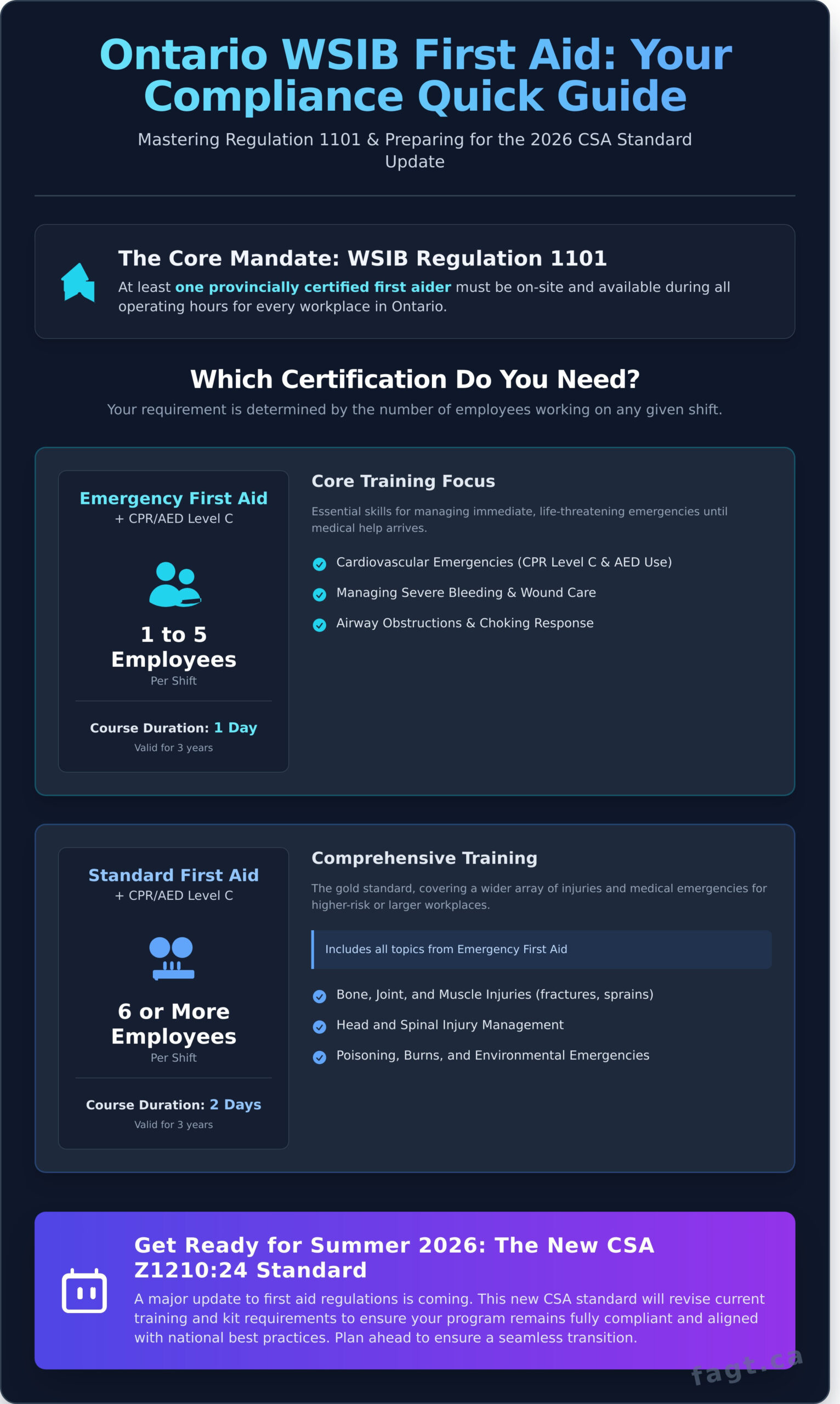
Regulation 1101 legally requires every employer in Ontario to ensure at least one employee with a valid provincially approved first aid certificate is on-site at all times during operating hours. The specific requirements scale based on workplace size and industry risk. For instance, a high-hazard environment like manufacturing or construction demands more extensive first aid provisions than a low-risk office setting. The number of required first aid stations also increases with the number of employees working on any given shift.
In these high-risk sectors, safety compliance often extends beyond first aid to include specialized training for tasks like site management. For example, industry leaders in Australia like Acquired Awareness Traffic Management provide comprehensive courses for construction and infrastructure projects, demonstrating the depth of safety protocols required globally.
The Legal Framework: Regulation 1101 Explained
Regulation 1101 provides a clear blueprint for an employer’s responsibilities. It is a foundational component of effective workplace safety and insurance board first aid management. Key
Choosing the Right Certification: Standard vs. Emergency First Aid
Selecting the appropriate first aid certification is a critical step in ensuring your business is compliant and your employees are safe. The decision is not a matter of preference but is strictly determined by provincial regulations based on the number of employees working on any given shift. For Ontario businesses, the specific requirements for workplace safety and insurance board first aid training are detailed in Regulation 1101. Understanding the difference between the two primary levels of certification is essential for responsible management.
Both Emergency and Standard First Aid certifications approved by the WSIB must include training in Cardiopulmonary Resuscitation (CPR) at Level C and the use of an Automated External Defibrillator (AED).
Emergency First Aid for Small Workplaces
Emergency First Aid is a foundational, one-day course designed for smaller operations. This certification is the minimum requirement for any workplace where there are between one and five employees working at any time. The training focuses on immediate, life-threatening scenarios, equipping a first aider with the essential skills to manage a crisis until professional medical help arrives. Key competencies include:
- Recognizing and responding to cardiovascular emergencies (CPR Level C)
- Managing severe bleeding and wound care
- Clearing airway obstructions for choking victims
- Using an AED
Certification is typically valid for three years, after which a recertification course is required.
Standard First Aid for Larger Organizations
Standard First Aid is the comprehensive, two-day certification mandatory for any workplace with six or more employees on any shift. It is considered the gold standard for workplace safety and insurance board first aid because it provides a more thorough understanding of how to handle a wider array of injuries and medical emergencies. In addition to covering all topics from the Emergency First Aid course, Standard First Aid includes training on:
- Bone, joint, and muscle injuries (e.g., fractures, sprains)
- Head and spinal injuries
- Poisoning and substance abuse emergencies
- Environmental emergencies like heat stroke or hypothermia
- Responding to sudden medical conditions such as seizures or diabetic emergencies
This advanced level of training ensures your designated first aiders are prepared for a much broader range of potential incidents, significantly enhancing overall site safety.
The 2026 Update: CSA Z1210:24 Standards and What They Mean for You
Beginning in the summer of 2026, the Workplace Safety and Insurance Board (WSIB) will launch an updated first aid program, fundamentally changing training requirements across Ontario. This significant update involves aligning provincial standards with the new national standard, CSA Z1210:24, First aid training for the workplace – Curriculum, and quality management for training agencies. The goal is to create a more consistent and modern approach to emergency preparedness, ensuring that the workplace safety and insurance board first aid program reflects the highest national benchmarks for skill and knowledge.
This move towards standardization is a critical step in harmonizing workplace safety protocols across the country, a principle supported by federal bodies like the Canadian Centre for Occupational Health and Safety. For employers, this means a more robust and reliable training framework. One of the most immediate changes you will notice is a shift in terminology. The familiar course names will be updated to align with the CSA standard:
- Emergency First Aid will now be referred to as Basic First Aid.
- Standard First Aid will be known as Intermediate First Aid.
A common concern for businesses is the validity of existing certifications. It is important to note that any first aid certificates issued before the official 2026 program launch will remain valid until their original expiry date. There is no requirement to recertify staff ahead of schedule.
Key Changes in the CSA Z1210:24 Curriculum
The new standard introduces several critical updates designed to improve outcomes in workplace emergencies. Key enhancements include updated protocols for high-performance CPR and modern trauma care, reflecting the latest medical science. The standard also mandates stricter quality management systems for training agencies to ensure consistent, high-quality delivery. Furthermore, there is an enhanced focus on psychological safety, integrating principles of mental health first aid into the core curriculum to better address the full spectrum of workplace incidents.
Managing the Transition for Your Business
To ensure a smooth transition, your primary responsibility is to ensure that any employee requiring new or recertification training after the Summer 2026 launch date enrolls in a course that meets the new CSA Z1210:24 standard. As the date approaches, you must verify that your chosen training provider is officially approved by the WSIB under the updated program. This information will be available on the WSIB website. Continuing to invest in comprehensive, WSIB-approved training remains the cornerstone of a compliant safety program, as detailed in our Standard First Aid & CPR C: Your WSIB-Approved Guide.
Implementing a Workplace First Aid Strategy: Training and Kits
Meeting WSIB requirements goes beyond simply having a first aid certificate on file. It involves creating a functional, responsive system that protects your workforce. An effective strategy hinges on two core components: properly trained personnel and correctly maintained equipment. This requires a systematic approach to the placement of first aid stations, the scheduling of trained staff, and the regular upkeep of supplies. A well-managed workplace safety and insurance board first aid program is a non-negotiable aspect of responsible business operations.
First aid stations must be highly visible, clearly identified with appropriate signage, and immediately accessible to all workers. For multi-shift operations, the critical calculation is ensuring at least one WSIB-certified first aider is present and available for every shift, not just during standard business hours. This ensures consistent coverage and compliance around the clock.
Optimizing Training with Blended Learning
The blended learning model represents the most efficient method for achieving WSIB certification. It combines self-paced online theory with a condensed, in-person skills session. This modern approach reduces employee time away from operational duties by up to 50% while maintaining the integrity of the training. The hands-on skills assessment is mandatory, as it provides the practical, life-saving experience that online modules cannot replicate. To ensure success, employers should provide dedicated time and a quiet space for staff to complete the online portion without interruption.
First Aid Kit Compliance and Inspections
Under Regulation 1101, first aid kits must contain specific items and be regularly inspected. A designated employee should conduct monthly checks to ensure the kit is fully stocked and all items are within their expiry dates. WSIB-compliant refill supplies are readily available from major Canadian safety equipment providers.
- Monthly Checklist: Verify the integrity of the kit’s container.
- Check Supplies: Confirm quantities of bandages, gauze, antiseptic wipes, and other required items.
- Review Expiry Dates: Replace any expired products immediately.
- Restock: Replenish any items used since the last inspection.
- Signage: Ensure prominent signs clearly direct all employees to the nearest first aid station.
Implementing a rigorous inspection schedule is a key part of your due diligence and commitment to a safe workplace. For further guidance on developing responsible management practices, consult with industry professionals or visit fagt.ca.
Why Aspire First Aid is Your Partner for WSIB Compliance in Ontario
Choosing a first aid training provider is a critical decision that impacts your team’s safety and your company’s legal standing. Meeting your workplace safety and insurance board first aid obligations requires more than just a certificate; it demands high-quality, reliable training from a recognized expert. Aspire First Aid Guide Training Corp is a distinguished Canadian Red Cross Training Partner, fully approved by the WSIB to deliver certified training that keeps your business compliant and your employees safe.
Our courses are led by expert instructors with extensive, real-world experience in emergency response. This background ensures that your team learns practical, life-saving skills in a dynamic environment, not just theoretical knowledge from a textbook. We are also fully prepared for the future, with a firm commitment to integrating the upcoming 2026 CSA standards into our curriculum, guaranteeing your business a seamless and compliant transition.
Localized Training in Mississauga and Hamilton
Convenience is key to maintaining a well-trained workforce. With modern training facilities in Mississauga and Hamilton, we proudly serve businesses across the Greater Toronto Area and the Golden Horseshoe. For maximum flexibility, we also offer on-site group training, bringing our WSIB-approved classroom directly to your facility. We specialize in helping local businesses navigate Ontario-specific safety regulations, making compliance straightforward and accessible.
The Aspire First Aid Guide Training Corp Advantage: Quality and Reliability
Our commitment to excellence is evident in every aspect of our service. We believe that effective workplace safety and insurance board first aid compliance is a partnership between employer responsibility and expert training. At Aspire First Aid Guide Training Corp, we uphold our end of that partnership by providing:
- Expert-Led Instruction: Learn from seasoned professionals who bring practical, on-the-job emergency experience into the classroom.
- Modern Training Environments: Our facilities are equipped with high-quality, up-to-date training manikins and AEDs to simulate realistic scenarios.
- Simplified Certification Management: We take the administrative burden off your shoulders by tracking your team’s certification renewal dates and notifying you when it’s time to recertify.
Protect your team and your business with a training partner you can trust. Book your WSIB-approved first aid course in Hamilton or Mississauga today.
Secure Your Compliance and Empower Your Team
Navigating the landscape of WSIB compliance is a foundational responsibility for every Ontario employer. As we’ve explored, this involves a clear understanding of Regulation 1101 and proactive preparation for the new CSA Z1210:24 standards arriving in 2026. A robust safety strategy is not merely about regulatory adherence; it is about cultivating a prepared and resilient workforce. Ensuring your team has the correct certification and resources for workplace safety and insurance board first aid is the most critical investment you can make in your people.
Don’t leave your team’s well-being and your company’s compliance to chance. Aspire First Aid is your dedicated partner in achieving and maintaining the highest safety standards. As a WSIB-Approved Provider and a Canadian Red Cross Training Partner, we deliver expert-led courses at our convenient Hamilton and Mississauga locations. Take proactive steps today to protect your employees and your business. Secure Your Workplace Compliance-Book Your WSIB First Aid Course Now and build a safer tomorrow.
Frequently Asked Questions About WSIB First Aid
Is first aid training mandatory for all businesses in Ontario?
Yes, under Ontario’s Regulation 1101 of the Workplace Safety and Insurance Act, first aid training is a mandatory requirement for almost all provincially regulated workplaces. The specific level of training and equipment needed is determined by the number of employees working per shift. Ensuring compliance is a fundamental responsibility for all employers in the province, as it is essential for protecting worker health and providing immediate care in an emergency.
How many first aiders does my business need per shift?
The required number of certified first aiders is based on your workforce size per shift. For workplaces with one to five employees, you must have at least one worker with an Emergency First Aid & CPR/AED certificate. For workplaces with six or more employees on any shift, at least one worker must hold a valid Standard First Aid & CPR/AED certificate. These minimums ensure that qualified assistance is always available to your team.
How long is a WSIB-approved first aid certificate valid?
A WSIB-approved Standard First Aid or Emergency First Aid certificate is valid for three years from the date it was issued. To maintain certification, an individual must complete a recertification course before the original certificate expires. It is the employer’s responsibility to track these dates and ensure their designated first aiders always hold a valid certification to remain in compliance with provincial regulations.
Can I get my WSIB first aid certification entirely online?
No, you cannot obtain a WSIB-approved first aid certificate through a course that is 100% online. The Workplace Safety and Insurance Board first aid standards require a hands-on, practical skills component that must be evaluated in person by a certified instructor. While some providers offer blended learning (online theory, in-person practice), a fully online course will not meet Ontario’s regulatory requirements for workplace certification.
What is the difference between Emergency and Standard First Aid?
The main difference lies in the course duration and the depth of the curriculum. Emergency First Aid is typically a one-day (8-hour) course focused on critical life-saving skills for common emergencies like choking, CPR, and severe bleeding. Standard First Aid is a more comprehensive two-day (16-hour) course that covers all Emergency First Aid topics plus additional subjects, including head injuries, fractures, and environmental emergencies, providing a broader skill set.
What happens if a business fails a WSIB first aid inspection?
Failing a WSIB first aid inspection can lead to serious consequences. An inspector will typically issue a compliance order detailing the violations and providing a deadline for correction. Failure to comply with this order can result in significant financial penalties, stop-work orders until the issues are resolved, and potential prosecution under the Occupational Health and Safety Act. Proactive compliance is the most effective way to avoid these outcomes.
Does WSIB recognize out-of-province first aid certificates?
Generally, first aid certificates from other provinces are not automatically recognized for workplace compliance in Ontario. To be valid, the certification must be from a WSIB-approved provider who delivers training that meets the specific standards of Regulation 1101. An employee with an out-of-province certificate will typically need to complete a WSIB-approved course in Ontario to ensure your business meets its legal obligations.
How do the 2026 CSA updates affect my current first aid certificate?
The upcoming CSA Group standard updates, expected for adoption around 2026, will likely modify training curriculum and first aid kit contents. However, your current WSIB-approved certificate remains valid until its three-year expiry date. When you recertify after the new standards are officially implemented by the WSIB, your training program will reflect the updated CSA guidelines. It is advisable to monitor official WSIB communications for definitive timelines.
