
Is BLS just another name for CPR? Do you really need it for your nursing program, or is a standard first aid course enough? For many healthcare professionals and students across Canada, navigating the requirements for bls certification can be a confusing and anxious process. Choosing the wrong course can mean wasted time and money, and the thought of high-pressure, hands-on scenarios adds another layer of stress.
This guide is designed to provide clear, authoritative answers. We will demystify the entire process, explaining exactly what Basic Life Support (BLS) training entails and how it differs from other life-saving courses. You’ll gain a complete understanding of the advanced skills you will master-from high-performance CPR to team-based resuscitation. We’ll help you determine if BLS is the right credential for your specific career path and show you how to find a legitimate, recognized provider, ensuring you can confidently meet the requirements for your job, license, or school admission.
Decoding BLS: How It Differs from Standard CPR
Many people are familiar with CPR, but for healthcare professionals, the standard is higher. Think of Basic Life Support (BLS) as the professional-grade evolution of CPR, designed specifically for clinical and pre-hospital environments. While standard CPR courses equip the general public with foundational life-saving skills, a bls certification provides the advanced techniques required for high-stakes medical emergencies. To put it simply: if CPR is like learning basic driving, BLS is the advanced defensive driving course for professional responders.
To visualize the core techniques that form the foundation of both CPR and BLS, this video provides a clear demonstration:
This advanced training moves beyond the single-rescuer scenario common in public settings. It emphasizes high-performance teamwork, clear communication, and the proficient use of specialized equipment. In Canada, the leading providers for BLS certification are the Heart & Stroke Foundation and the Canadian Red Cross, both of which set rigorous, evidence-based standards for the nation’s healthcare professionals.
Key Differences at a Glance: BLS vs. CPR Level C
While both courses teach essential life-saving skills, they are tailored for distinctly different providers and contexts. Here’s a breakdown of the primary distinctions:
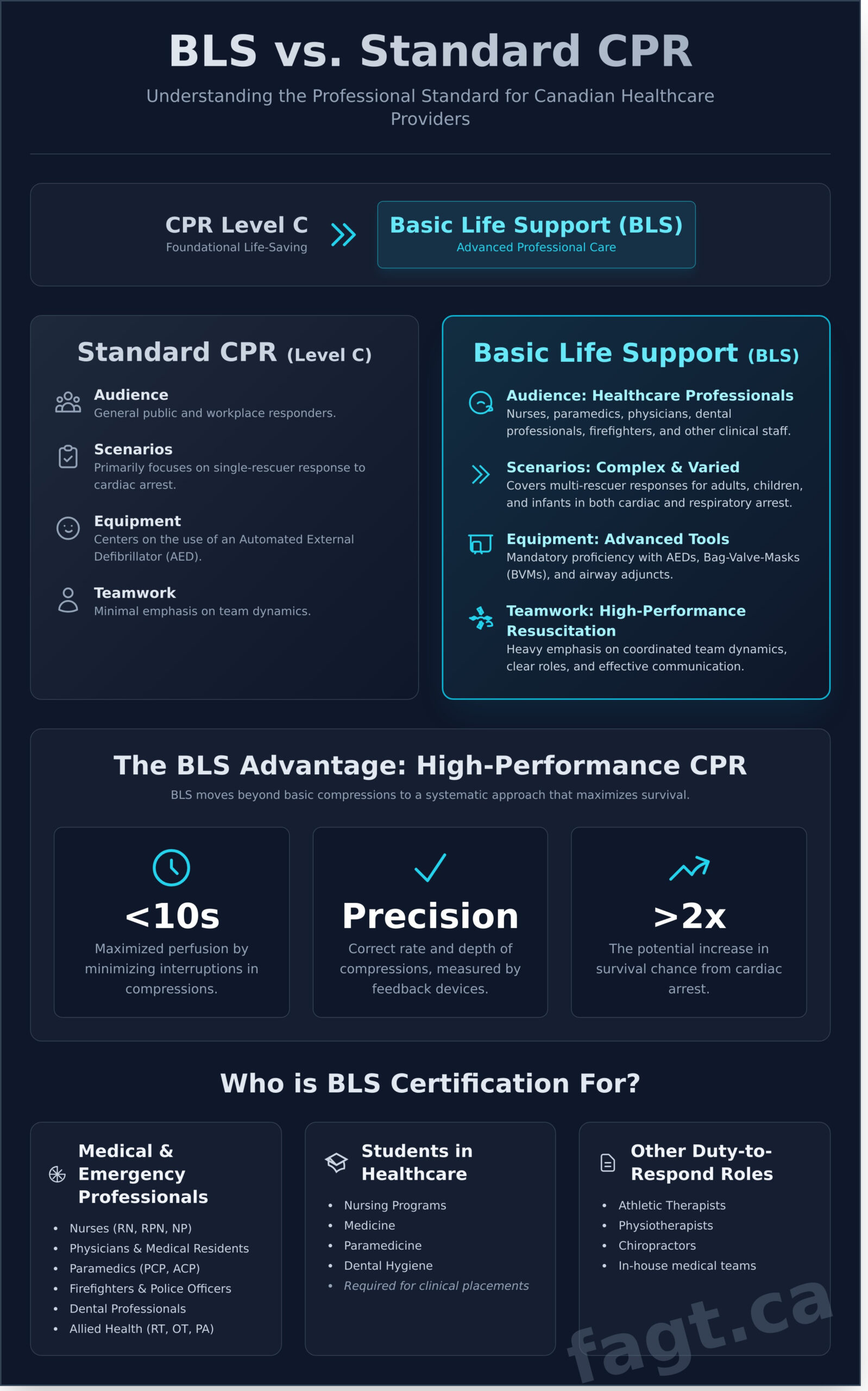
- Audience: CPR Level C is designed for the general public and workplace responders. BLS is exclusively for current and aspiring healthcare professionals, such as nurses, paramedics, dental professionals, and physicians.
- Scenarios: CPR-C typically focuses on single-rescuer responses to cardiac arrest. BLS training covers complex, multi-rescuer scenarios common in hospitals and clinics, including both respiratory and cardiac arrest in adults, children, and infants.
- Equipment: Standard CPR training centers on using an Automated External Defibrillator (AED). BLS incorporates AEDs but adds mandatory proficiency with Bag-Valve-Masks (BVMs) and an introduction to advanced airway adjuncts.
- Teamwork: BLS places a heavy emphasis on coordinated team dynamics, establishing clear roles and responsibilities for each member of a high-performance resuscitation team.
The Importance of ‘High-Performance’ CPR
A core principle taught in any modern bls certification program is ‘high-performance’ CPR. This is not just about performing compressions; it is a systematic approach to optimizing every second of a resuscitation attempt to maximize blood flow to the brain and heart. The training focuses on achieving the correct compression rate and depth while minimizing interruptions to less than 10 seconds. Rescuers learn to work as a synchronized team, often using real-time feedback devices during training to measure performance. The evidence is clear: high-quality, team-based CPR can more than double a person’s chance of survival from cardiac arrest.
Who Needs BLS Certification? A Requirement for Your Healthcare Career
Far more than just a training course, Basic Life Support (BLS) is a foundational and often mandatory professional credential for anyone working in or entering the healthcare field in Canada. Provincial licensing bodies, employers, and academic institutions require a valid bls certification to ensure practitioners can respond effectively in a medical emergency. The skills taught in a BLS certification course, such as high-performance CPR and advanced airway management, are considered the minimum standard of care. While the need for this credential is widespread, it is crucial to always confirm the specific requirements with your employer, college, or professional association.
Medical and Emergency Response Professionals
For front-line professionals who routinely face life-threatening situations, BLS is a non-negotiable requirement for practice. This certification is designed for those who provide direct patient care in a wide variety of settings. Key groups include:
- Nurses and Physicians: Registered Nurses (RN), Registered Practical Nurses (RPN), Nurse Practitioners (NP), Physicians, and Medical Residents.
- Pre-Hospital Responders: Paramedics (PCP, ACP), Firefighters, and Police Officers.
- Dental Professionals: Dentists, Dental Hygienists, and Dental Assistants who may need to manage medical emergencies in the clinic.
- Allied Health Professionals: Respiratory Therapists, Occupational Therapists, and Physician Assistants.
Students in Healthcare Programs
If you are pursuing a career in healthcare, securing your BLS provider card is one of the first steps. It is a common prerequisite for admission into competitive clinical programs like nursing, medicine, and paramedicine. Schools require proof of current certification before students can begin their mandatory hands-on placements in hospitals or clinics, and you will be expected to maintain this credential throughout your studies.
Other Professionals with a Duty to Respond
The requirement extends beyond traditional hospital and pre-hospital settings. Professionals in private practice often have a duty to respond if a client experiences a medical emergency on-site. This includes practitioners such as athletic therapists, physiotherapists, and chiropractors, whose scope of practice involves close physical contact and the potential for adverse events.
Ready to meet your professional requirements? Check our BLS course schedule for upcoming dates in Mississauga & Hamilton.
Core Skills You’ll Master in a BLS Course
A professional bls certification course is far more than a lecture; it is an intensive, hands-on training program designed to build muscle memory and clinical confidence. The curriculum is structured to guide you systematically through a cardiac arrest scenario, from initial discovery to the application of life-saving interventions. This practical approach ensures you can perform effectively under pressure, whether you are in a hospital ward or a community setting. The skills are specifically adapted for adults, children, and infants, recognizing the critical physiological differences between these patient populations.
Rapid Assessment and Scene Management
The first moments of any emergency are critical. BLS training begins with teaching you how to rapidly and safely assess a scene. You will master the initial sequence: ensuring scene safety, checking for patient responsiveness, and simultaneously looking for normal breathing while feeling for a pulse. A key component is learning how to activate the appropriate emergency response system with precision, whether that involves calling 911 in the community or activating a “Code Blue” or Medical Emergency Team within a clinical facility. This section emphasizes your role in the Chain of Survival, differentiating the protocols for in-hospital versus out-of-hospital cardiac arrests.
Advanced CPR and AED Techniques
This is the cornerstone of any BLS course. You will move beyond basic theory to master the psychomotor skills of high-quality cardiopulmonary resuscitation. Training focuses on delivering chest compressions at the correct depth and rate (100-120 per minute) with full chest recoil. You will practice both 1-rescuer and 2-rescuer CPR scenarios, learning to coordinate tasks and switch roles efficiently to minimize fatigue and interruptions. A crucial skill is the seamless integration of an Automated External Defibrillator (AED) as part of a team response, as outlined in curricula like the Red Cross BLS certification program. The goal is to function as a proficient member of a resuscitation team.
Airway Management and Rescue Breathing
Maintaining a patent airway is essential for survival. This module provides extensive hands-on practice with airway management techniques appropriate for a BLS provider. You will learn the proper use of a Bag-Valve-Mask (BVM) to deliver effective ventilations to a non-breathing patient, a skill that requires significant practice to perfect. The course also provides comprehensive training on relieving foreign-body airway obstructions (choking) in conscious and unconscious adults, children, and infants. While the course may introduce the concept of advanced airway adjuncts, the focus remains on mastering the fundamental skills you are certified to perform.
The BLS Certification Process: From Registration to Card in Hand
Earning your bls certification is a structured and manageable process designed for the demanding schedules of healthcare professionals. Understanding the steps involved, from choosing a course to receiving your card, removes any uncertainty and empowers you to get certified with confidence. This guide outlines the clear, professional pathway to achieving and maintaining your life-saving credentials.
Choosing Your Course Format: Blended vs. In-Class
To accommodate diverse learning preferences and schedules, training providers offer two primary formats. The traditional in-class format is a comprehensive, single-session course where all theory and practical skills are covered on the same day. The more modern blended learning format splits the course into two parts: a self-paced online module covering theory, followed by a shorter, in-person session focused exclusively on hands-on skills practice and assessment. For busy professionals, the blended model offers unparalleled flexibility, allowing you to complete the knowledge portion when it best suits your schedule.
What to Expect on Training Day
The in-person component of your training is highly practical and interactive. You will not be sitting in a lecture hall; instead, you’ll be actively engaged in skill development. Expect to work with a variety of professional-grade equipment, including:
- Adult, child, and infant manikins for realistic CPR practice.
- Automated External Defibrillator (AED) training units.
- Bag-valve masks (BVMs) and other airway adjuncts.
Instructors will guide you through team-based scenarios that simulate real-life cardiac emergencies, reinforcing critical thinking and effective communication. The day culminates in a two-part evaluation: a written knowledge test and a practical skills assessment where you must demonstrate your competency to the instructor.
Certification Validity and Renewal
In Canada, a BLS certification issued by the Canadian Red Cross or the Heart & Stroke Foundation is valid for one year from the date of issue. This annual requirement ensures that your skills remain sharp and aligned with the most current resuscitation guidelines. To maintain your credentials, you must complete a BLS recertification course before your current card expires.
This renewal course is typically shorter than the initial certification, focusing on skill refinement and reviewing any updated protocols. Staying current is a professional responsibility, ensuring you are always prepared to provide the highest standard of care. Don’t let your certification lapse.
Ready to get certified? Register for your BLS course today.
Your Next Step: Securing Your Essential BLS Certification
In essence, Basic Life Support is the professional standard of care, equipping healthcare providers with advanced resuscitation skills that surpass standard CPR. For anyone in or entering the medical field, this credential is not just a recommendation-it is a core requirement for ensuring patient safety and professional readiness. Mastering these techniques through a structured course provides the confidence to act decisively and effectively during a life-threatening emergency.
When you’re ready to take this vital step, choosing a trusted, accredited provider is crucial. As an official Canadian Red Cross Training Partner, we deliver WSIB-approved training that meets the highest industry standards. We offer flexible learning to fit your demanding schedule, with both blended learning and fully in-class options available at our convenient locations in Mississauga and Hamilton. View our WSIB-approved BLS course dates and register online.
By earning your certification, you are not only advancing your career but also reinforcing your commitment to providing the highest level of care. Take the definitive step to become a more capable and confident healthcare provider today.
Frequently Asked Questions About BLS Certification
How long does a BLS certification course take to complete?
A standard in-person BLS provider course is designed to be comprehensive yet efficient, typically taking approximately 4 hours to complete. For healthcare professionals seeking to renew their credentials, a recertification course is often shorter, lasting around 2 to 3 hours. Blended learning formats, which combine online theory with a mandatory in-person skills session, are also available. The hands-on portion for a blended course usually requires 1 to 2 hours of dedicated time with an instructor.
Is BLS certification difficult to pass?
The BLS course is designed to be challenging but achievable for its intended audience of healthcare professionals. Success depends on active participation, understanding the theoretical concepts, and demonstrating practical competence. The final assessment includes a multiple-choice written exam and a hands-on skills test covering high-quality CPR and AED use. Reputable training providers ensure participants are well-prepared, and with proper focus and study of the course materials, most candidates pass successfully.
Can I get my BLS certification entirely online in Canada?
In Canada, a recognized BLS certification cannot be earned entirely online. Major governing bodies, including the Heart and Stroke Foundation of Canada, mandate a hands-on skills assessment. This practical component is critical for demonstrating correct technique in chest compressions, ventilations, and AED operation under the direct supervision of a certified instructor. While you can complete the knowledge portion online via a blended learning program, final certification is only awarded after passing the in-person evaluation.
What is the difference between BLS and ACLS (Advanced Cardiovascular Life Support)?
Basic Life Support (BLS) is the foundation of emergency cardiovascular care, focusing on immediate intervention like high-quality CPR, AED use, and choking relief. It is a prerequisite for ACLS. Advanced Cardiovascular Life Support (ACLS) is a more advanced course for healthcare professionals who manage complex cardiopulmonary events. ACLS builds on BLS skills and includes advanced protocols such as ECG rhythm interpretation, pharmacology, advanced airway management, and post-cardiac arrest care, requiring a higher level of clinical decision-making.
How much does a BLS certification course typically cost?
In Canada, the cost for a BLS certification course generally ranges from C$70 to C$100. The final price can vary depending on the training provider, the specific region or city, and whether you are taking a full provider course or a shorter recertification course. This fee typically includes the official provider e-manual and your certification card upon successful completion of the course requirements. Always confirm the total cost and what it includes with your chosen training provider.
My standard CPR-C is still valid. Do I still need to take a full BLS course?
Yes, you must take a full BLS course. While CPR-C is an excellent standard for the general public, BLS is the required level of training for healthcare professionals. The BLS curriculum covers critical skills not included in CPR-C, such as two-rescuer CPR scenarios, use of a bag-valve-mask (BVM), and working as part of a professional response team. Healthcare employers and regulatory bodies in Canada specifically mandate a current BLS certification to meet the standards of a clinical environment.
