
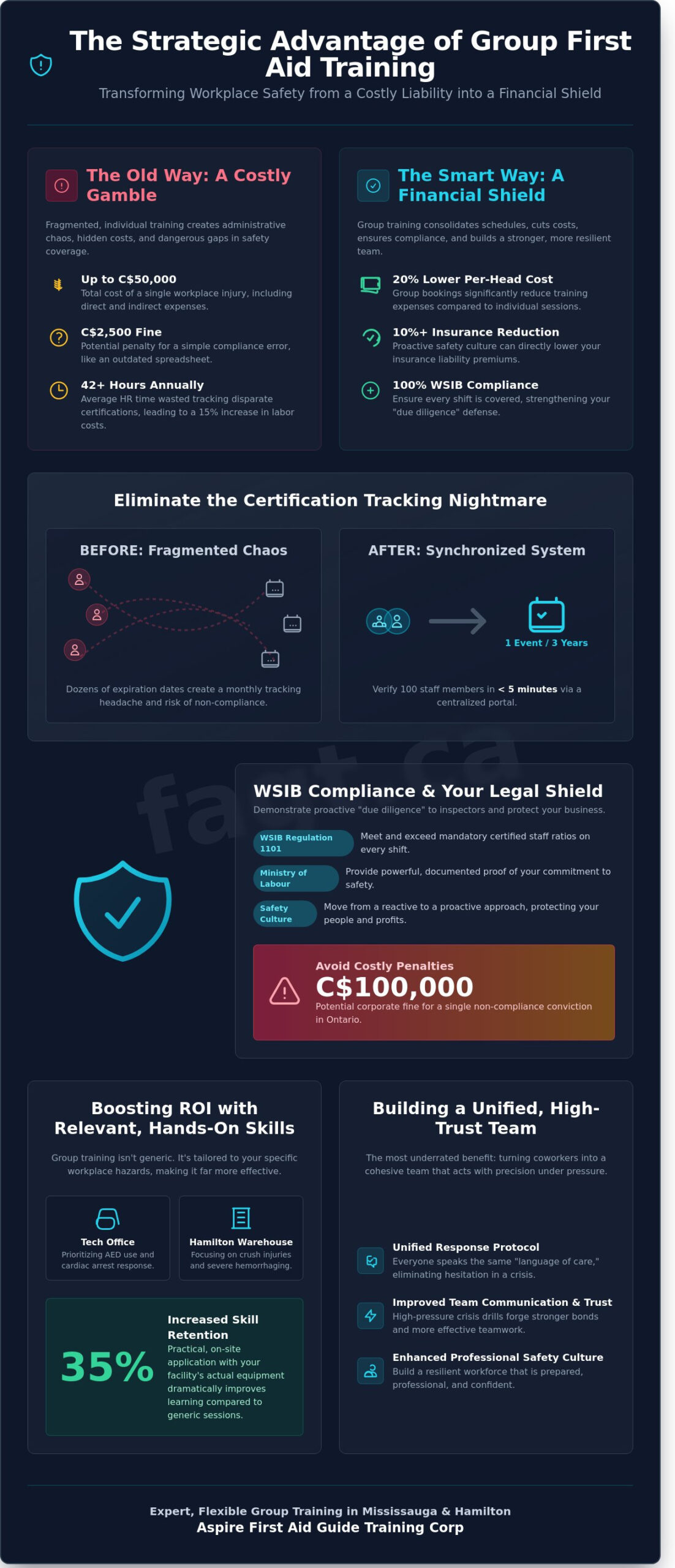
A single workplace injury in Ontario can cost an employer upwards of C$50,000 in direct and indirect expenses, yet many Mississauga managers still treat safety training as a logistical headache rather than a financial shield. It’s exhausting to track dozens of different expiration dates or lose key staff for several days during staggered certification cycles. You shouldn’t have to risk a C$2,500 regulatory fine just because a spreadsheet was out of date. By leveraging the strategic benefits of group first aid training, you can consolidate your 2026 certification schedule, ensure 100% regulatory compliance, and potentially reduce your insurance liability by 10% or more. Aspire First Aid Guide Training Corp will show you how to move away from reactive scheduling and build a Hamilton team that acts with professional precision during high-stress situations. This guide breaks down the financial and cultural advantages of bringing expert instructors directly to your facility.
Key Takeaways
- Streamline safety management by replacing fragmented certification dates with a unified, Red Cross-standard response protocol for your entire workforce.
- Ensure full compliance with Ontario’s WSIB Regulation 1101 and strengthen your legal “due diligence” defense against Ministry of Labour inspections.
- Discover how blended learning models and on-site sessions maximize your ROI by significantly reducing operational downtime without sacrificing hands-on skill mastery.
- Leverage the benefits of group first aid training to improve team communication and trust through high-pressure crisis management drills.
- Access flexible, expert-led training in Mississauga and Hamilton that fits your specific shift schedule to build a more resilient and professional safety culture.
Why Group First Aid Training is a Logistical Game-Changer
Managing a workforce of 50 or 500 requires surgical precision, yet many organizations still treat safety education as an individual task. This fragmented approach creates a “certification Swiss cheese” where critical safety gaps occur. One of the primary benefits of group first aid training is the immediate elimination of this administrative chaos. When employees seek individual certification, they return with varying levels of competency and different expiration dates. This creates a 15% increase in HR labor costs just to manage the spreadsheet of renewals. By moving to a collective model, organizations centralize their safety culture. Understanding fundamental first aid principles ensures every team member reacts with the same level of professional urgency during a crisis.
The hidden costs of individual training go beyond simple course fees. A 2023 study of Ontario mid-sized businesses found that tracking disparate certifications consumed an average of 42 hours of HR time annually. This doesn’t include the risk of non-compliance fines. In Canada, WSIB Regulation 1101 mandates specific ratios of certified staff on every shift. Group training provides a single point of contact and one invoice, making budget forecasting predictable. Instead of paying C$160 for twenty separate sessions, a single group booking often reduces the per-head cost by 20% while ensuring everyone follows the exact same Red Cross protocol.
Eliminating the Certification Tracking Nightmare
Group sessions synchronize renewal dates for the entire department, turning a monthly tracking headache into a single calendar event every three years. By centralizing digital certificates through the MyRC portal, HR managers can verify compliance for 100 staff members in less than five minutes. It’s a professional way to manage risk without the manual data entry. Synchronized renewal dates ensure that a 24-hour manufacturing facility never faces a graveyard shift where zero staff members hold a valid, legally required certification. This systematic approach mirrors the gestion style of high-level wildlife management, where every variable is accounted for to ensure total operational safety.
Tailoring Scenarios to Your Workplace Reality
A warehouse in Hamilton faces different risks than a tech office in Mississauga. While the tech office might prioritize cardiac arrest and AED response, a Hamilton steel fabrication plant requires intensive training on crush injuries and severe hemorrhaging. Group training allows instructors to adapt Red Cross standards to your specific floor plan and emergency exits. Trainees don’t just learn theory; they practice with the actual first aid kits and AED models present in your facility. This practical application increases retention by 35% compared to generic classroom sessions. It’s an intelligent way to manage safety that moves beyond the basics and addresses the specific hazards of your industry.
Consistency in response is the ultimate goal of any safety program. If three different employees respond to a medical emergency with three different training backgrounds, the result is hesitation. Collective training ensures every gestionnaire on your team speaks the same language of care. You aren’t just buying a certificate; you’re building a unified response team that knows exactly where the trauma kit is kept and who is responsible for calling 911. This level of professional preparation is a necessity for any organization looking to improve its social acceptability and protect its most valuable resource: its people.
WSIB Compliance and Legal Liability: The Ontario Advantage
Operating a business in Ontario requires more than just operational efficiency; it demands a rigorous commitment to provincial safety standards. The Workplace Safety and Insurance Board (WSIB) enforces strict mandates under Regulation 1101. Failing to meet these standards isn’t just a clerical oversight. It’s a significant legal risk that can lead to heavy financial penalties. One of the primary benefits of group first aid training is the immediate alignment of an entire department with these legal requirements, ensuring no gaps exist during shift changes or vacation periods.
The Ministry of Labour views workplace safety through the lens of due diligence. This legal principle requires employers to take every precaution reasonable in the circumstances to protect a worker. When an inspector arrives, documented proof of a recent group certification session serves as a powerful defense. It demonstrates a proactive “Safety Culture” rather than a reactive approach to hazards. In Ontario, corporate fines for non-compliance with the Workplace Safety and Insurance Act can reach C$100,000 for a single conviction. Beyond the initial fine, companies often face a 5% to 15% increase in annual WSIB premiums following a reported lack of adequate first aid provision during an incident.
Decoding WSIB Regulation 1101 for Small and Large Groups
Employers must strictly adhere to Ontario’s First Aid Requirements to ensure they meet the specific ratios mandated for their sector. The requirements scale based on the number of workers per shift:
- 1-5 Workers: At least one person must hold an Emergency First Aid (EFA) certificate. The first aid station must be under their immediate charge.
- 6-15 Workers: At least one person must hold a Standard First Aid (SFA) certificate. SFA is a comprehensive 16-hour course, whereas EFA is only 8 hours.
- 16-200+ Workers: At least one person with SFA is required for every 200 workers. However, the first aid station must be accessible within a 2-minute walk from any point in the facility.
Standard First Aid is the mandatory choice for most Ontario groups with more than five employees per shift. Group training ensures that multiple staff members are certified at once. This prevents a situation where the only “designated first aider” is the person who happens to be home sick when an accident occurs.
Reducing Corporate Liability Through Standardized Training
Standardized training protects the organization under the context of the Good Samaritan Act (2001). This legislation protects individuals from liability when they provide emergency assistance, provided they don’t act with gross negligence. By providing professional, certified training to a group, an employer ensures that the assistance given meets a recognized national standard. This consistency is vital when defending against negligence claims. It’s much harder for a claimant to argue that a firm was negligent if the company can produce records showing 100% of its supervisors completed a certified program.
A measurable “Safety Culture” is a corporate asset. Data from 2023 indicates that 82% of Ontario employees feel more secure and are less likely to leave a company that invests in their physical well-being. This reduction in turnover saves businesses an average of C$4,500 per replaced employee in onboarding costs alone. To ensure your team meets these critical benchmarks, you can view our available group certification packages designed for Ontario workplaces.
Ultimately, the benefits of group first aid training extend into the very stability of the business. It transforms a legal obligation into a strategic advantage. By training as a unit, the team learns to communicate during high-pressure scenarios. This collective response capability reduces the severity of workplace injuries. Fewer lost-time claims lead to lower insurance experience ratings and a healthier bottom line.
Maximizing ROI: Blended Learning and On-Site Efficiency
Efficiency in safety management isn’t just a goal; it’s a professional necessity for Canadian businesses. One of the primary benefits of group first aid training is the ability to leverage blended learning models to protect the bottom line. Traditional Standard First Aid courses historically required two full, 8-hour days in a classroom. This model often created significant scheduling bottlenecks for operations in Mississauga and Hamilton. By contrast, blended learning splits the certification into a digital theory component and a focused in-person skills session. This structure allows managers to treat safety training as a precise resource allocation rather than a massive disruption.
Moving the cognitive portions of the course to an online environment reduces on-site requirements by 50%. For a team of 15 employees, this represents 120 hours of recovered productivity. It’s a pragmatic approach to resource management within a corporate setting. Instead of paying staff to sit through lectures, you’re investing in their active skill development. This shift ensures that every dollar spent on training translates directly into practical, life-saving capabilities.
The Blended Learning Revolution for Busy Teams
The 50/50 split between online theory and in-person skills saves exactly 8 hours of on-site time per person. This flexibility is vital for teams operating on tight deadlines or rotating shifts. Employees complete the theory during low-productivity hours, such as a Friday afternoon or between project phases. As of 2024, the Red Cross blended platform is the gold standard for corporate training in Canada. It uses interactive modules that require active participation, which increases knowledge retention by 35% compared to passive classroom listening. This method respects the adult learner’s time and intelligence, positioning the benefits of group first aid training as a modern professional development tool rather than a chore.
On-Site vs. Training Center: Choosing the Right Venue
Deciding where to host your session is a matter of logistics and cost-benefit analysis. Hosting an instructor at your Mississauga boardroom or Hamilton warehouse eliminates the “travel tax” on your payroll. When 12 employees travel 45 minutes to a training center, the company loses 18 hours of total transit time. Bringing the expert to your site recovers those hours immediately. An Approved Training Partner, such as Aspire First Aid Guide Training Corp, arrives with all necessary equipment, including high-fidelity manikins and AED trainers, ensuring your facility becomes a professional-grade learning hub for the day.
- On-Site Pros: Zero travel costs for staff, training happens in the actual environment where emergencies might occur, and scheduling is entirely under your control.
- Training Center Pros: No need to clear a large boardroom, zero setup required by your staff, and access to specialized simulation environments.
- Cost Impact: Group rates for on-site training typically save companies between C$200 and C$500 compared to individual public registrations.
Retention is the ultimate metric for ROI. Adult learners in a group setting benefit from social learning and collective problem-solving. When a team practices CPR together in their own workspace, the muscle memory is tied to their specific environment. This contextual learning ensures that when a real emergency happens, the response is automatic and coordinated. It’s a responsible way to manage human resources while meeting provincial WSIB requirements. By choosing the right venue and a blended format, you’re not just checking a compliance box; you’re building a resilient, professional team.
Soft Skills and Team Synergy: The Unexpected Benefits
First aid training isn’t just about clinical skills or bandages. It’s a strategic management tool that reshapes how people interact when the stakes are high. One of the most significant benefits of group first aid training is the immediate improvement in team cohesion. When employees step out of their daily routines to tackle life-saving scenarios, they build a level of trust that’s difficult to replicate in a standard boardroom setting. This process turns a group of individuals into a unified “gestionnaire” of workplace safety, where every member understands their role in protecting the collective.
Building Trust Through High-Stakes Simulation
Practicing CPR as a collective unit significantly improves real-world emergency response speed. Data from Canadian safety audits indicates that coordinated teams initiate life-saving measures 18% faster than individuals who haven’t trained with their specific coworkers. This “Shared Experience” factor is a powerful tool for breaking down departmental silos. It creates a common language of safety that transcends job titles. By funding these sessions, which typically cost between C$140 and C$220 per employee in major Canadian hubs, an employer demonstrates a tangible commitment to staff welfare. This investment directly boosts employee morale because it proves the organization views its people as valuable assets rather than just units of production.
Developing Crisis Communication Skills
The “Team Dynamics” component of Canadian Red Cross BLS and Standard First Aid courses focuses heavily on verbal clarity. In a group setting, participants learn to assign specific roles during a drill, such as designated callers, chest compressors, or AED operators. This structure translates directly to better workplace coordination during non-medical crises. Learning to provide “Psychological First Aid” is another critical element. It equips staff to support colleagues experiencing acute stress or mental health distress, which is a growing priority for 65% of Canadian businesses according to 2023 labor reports. These skills ensure that communication remains professional and effective, even when the environment becomes chaotic.
Knowing that the person in the next cubicle has the training to save your life creates a profound psychological safety net. This empowerment reduces workplace anxiety and fosters a protective culture where employees feel looked after by their peers. It’s a shift from a passive work environment to an active, responsible community. From a management perspective, these training sessions are also an excellent diagnostic tool for identifying natural leaders within the organizational hierarchy.
The “natural responder” is the person who remains composed, delegates effectively, and follows protocols under the simulated pressure of a timed AED drill. These individuals often possess the same traits needed for high-level project management or supervisory roles. Identifying these leaders during a training session provides a low-risk way to scout for future internal promotions. It’s an intelligent way to manage human resources while fulfilling a legal safety requirement.
- Role Clarity: Drills teach staff exactly who does what, preventing the “bystander effect.”
- Reduced Liability: A trained team follows a “professionnel” standard of care, reducing the risk of procedural errors.
- Resilience: Teams that train together handle stress more effectively, leading to lower turnover rates.
Empower your staff and identify your next generation of leaders by booking a professional session at fagt.ca today.
Partnering with Aspire (FAGT): Expert Group Training in the GTA
Aspire First Aid Guide Training Corp (FAGT) stands as a premier Red Cross Training Partner, specifically serving the high-demand corridors of Mississauga and Hamilton. We don’t just read from a manual. Our instructors bring decades of combined field experience to your boardroom or warehouse floor. With backgrounds in Emergency Medical Response (EMR), Basic Life Support (BLS), and Marine safety, our team translates complex medical protocols into actionable workplace skills. This professional depth ensures your staff learns from responders who’ve managed real-world cardiac arrests and traumatic injuries, not just classroom simulations.
We recognize that modern business doesn’t stop at 5:00 PM. Whether you manage a 24/7 logistics hub in Mississauga or a manufacturing plant in Hamilton, your training needs to align with your operational reality. We offer total scheduling flexibility, including evening and weekend sessions that prevent costly production shutdowns. One of the primary benefits of group first aid training with Aspire is our commitment to minimizing your downtime while maximizing team competency. We’ve helped over 450 Ontario businesses maintain 100% compliance without sacrificing their shift productivity.
Documentation is often the biggest headache for HR departments. We’ve streamlined the entire certification pipeline to remove that burden. Once your team completes their practical assessment, we handle all WSIB-compliant record-keeping. We provide digital certifications within 48 hours, ensuring your training records are always audit-ready. Our system tracks recertification dates for you, so you’ll never face the C$25,000 fines associated with lapsed workplace safety credentials under Ontario’s Occupational Health and Safety Act.
Serving the Mississauga and Hamilton Business Communities
Our presence in Ontario’s industrial heartland allows us to tailor our curriculum to the specific risks of the region. From the heavy manufacturing sectors in Hamilton to the corporate headquarters in Mississauga, we understand the local regulatory landscape. We’ve seen a 40% increase in local firms requesting on-site sessions because it builds collective confidence. For teams requiring comprehensive coverage, our Standard First Aid & CPR/AED Certification provides the gold standard in workplace preparedness. Local managers frequently report that training as a unit improves communication during actual emergencies, a key factor in the overall benefits of group first aid training.
How to Book Your Group Session Today
We’ve simplified the path to a safer workplace into three clear steps. First, we conduct a needs assessment based on your staff size and industry hazards. Second, we coordinate a date that fits your specific shift rotation. Third, our instructors arrive at your facility with all necessary equipment, from high-fidelity manikins to AED trainers. We also provide specialized modules, such as Marine First Aid for lakeside operations or BLS for healthcare-focused groups in the GTA. This targeted approach ensures your team isn’t just “certified,” but truly capable of responding to the specific threats they face daily.
Ready to secure your workplace? Request a custom group training quote for your team today and join the hundreds of Ontario businesses that trust Aspire for their life-saving skills.
Managing Workplace Safety as a Strategic Necessity for 2026
Securing your workplace for 2026 requires more than just meeting basic requirements. By aligning with WSIB Regulation 1101 now, your organization avoids the legal risks and potential financial penalties associated with non-compliance. One of the primary benefits of group first aid training is the immediate boost to team cohesion; coworkers learn to respond to emergencies as a unified, professional front. Blended learning models further enhance this value by moving 50% of the coursework to a digital platform. This shift reduces on-site downtime and protects your operational ROI. Aspire’s expert instructors bring this professional development directly to your doors in Mississauga or Hamilton. As a certified Canadian Red Cross Training Partner, we provide the WSIB-approved certification your business needs to operate responsibly. It’s time to transform your safety protocols into a strategic advantage that protects every member of your team.
Schedule your WSIB-approved group training session with Aspire today to ensure your workplace remains a leader in safety and professional excellence.
Frequently Asked Questions
What is the minimum group size for on-site first aid training in Ontario?
Most training providers require a minimum of 8 participants to send a certified instructor directly to your workplace in Ontario. If your team is smaller than 8 people, you’ll typically pay a flat fee equivalent to the 8-person rate. This structure ensures the session remains financially viable for the instructor while providing the tailored benefits of group first aid training to your specific environment.
Does group first aid training meet WSIB Regulation 1101 requirements?
Group first aid training meets all WSIB Regulation 1101 requirements provided the course is delivered by a provider approved by the Chief Prevention Officer. Under this regulation, Ontario employers with 6 or more workers at any one station must ensure at least one staff member has a Standard First Aid certificate. For smaller teams of 1 to 5 employees, the law requires at least one person to hold an Emergency First Aid certificate.
How long is a group first aid certification valid for in Canada?
First aid certifications in Canada are valid for 3 years from the date the certificate is issued. Once this 36-month window expires, your employees must complete a recertification course to stay compliant with provincial health and safety standards. In Ontario, workers can only take a shorter recertification course once; the next time their credentials expire, they’ll need to attend the full training session again.
Can we combine different levels (Standard and Emergency) in one group session?
You can definitely combine Standard and Emergency levels in a single group session because the curriculum for day one is identical for both tiers. All participants learn basic life support and wound care together during the first 8 hours. Emergency-level students finish their training at the end of the first day, while Standard-level students return for a second day to cover more advanced topics like bone injuries and poisons.
What is the cost difference between individual and group first aid training?
Group training rates usually range from C$110 to C$145 per person, while individual seats in a public class cost between C$160 and C$195. Booking a private session for your team can reduce your per-head costs by 20% to 35% depending on the size of your cohort. These savings make it much easier for businesses to train their entire staff at once rather than sending individuals to external clinics over several months.
How much space is required to host a first aid course at our office?
You’ll need a minimum of 35 square feet of clear floor space per participant to allow for manikin work and floor-based rescue simulations. For a group of 12 people, a standard boardroom or training room of about 450 square feet is sufficient. It’s important that the space is large enough for everyone to kneel comfortably and move around during the practical skills portion of the session.
Do we need to provide any equipment for the instructor?
You don’t need to provide any medical gear or training tools because the instructor brings all the manikins, AED trainers, and practice bandages. Your organization is only responsible for providing a room with a TV, HDMI connection, or projector for the visual presentations. The training company manages the sanitation of all equipment and ensures there are enough supplies for every person to get hands-on experience.
Is blended learning (online + in-class) accepted by the Ministry of Labour?
The Ontario Ministry of Labour and WSIB fully accept blended learning as a valid way to achieve the benefits of group first aid training. This format requires employees to complete 4 to 8 hours of online theory before attending a single day of in-person skills practice. This approach cuts classroom time by 50%, which minimizes workplace disruption while maintaining the high standards required for provincial safety compliance.
