What if the most effective way to bridge the trust gap between your management and frontline staff wasn’t a C$3,000 weekend retreat, but a mandatory safety session? Most Ontario business owners view provincial safety compliance as a dry, ‘check-box’ exercise that drains productivity and bores employees. It’s a common frustration to pause operations for a course that feels like a chore. However, integrating team building with first aid training turns a legal necessity into a high-impact cultural investment. When your team learns to save lives together, they develop a level of professional respect that a simple lunch and learn can’t replicate.
You’re about to discover how provincially recognized training transforms workplace culture, builds deep trust, and meets legal requirements in one high-impact session. We’ll examine the current Ontario first aid standards and provide a roadmap for maximizing employee engagement while keeping your compliance costs low. By the end of this guide, you’ll see why 85 percent of managers report better communication after shared emergency response drills.
Key Takeaways
- Learn why moving beyond traditional icebreakers to team building with first aid training creates a profound sense of shared purpose and professional responsibility.
- Discover how the psychological safety and vulnerability experienced during life-saving drills foster a high-performing, trust-based corporate culture.
- Explore how modern blended learning models satisfy provincial requirements while reducing in-class time by up to 50% for busy Ontario teams.
- Understand your legal obligations under WSIB Regulation 1101 and how to select the appropriate certification level based on your specific workplace hazards.
- Gain a practical framework for organizing professional training in Hamilton or Mississauga to ensure your workforce is both compliant and empowered.
Beyond the Trust Fall: Why First Aid is the Ultimate Team Building Activity
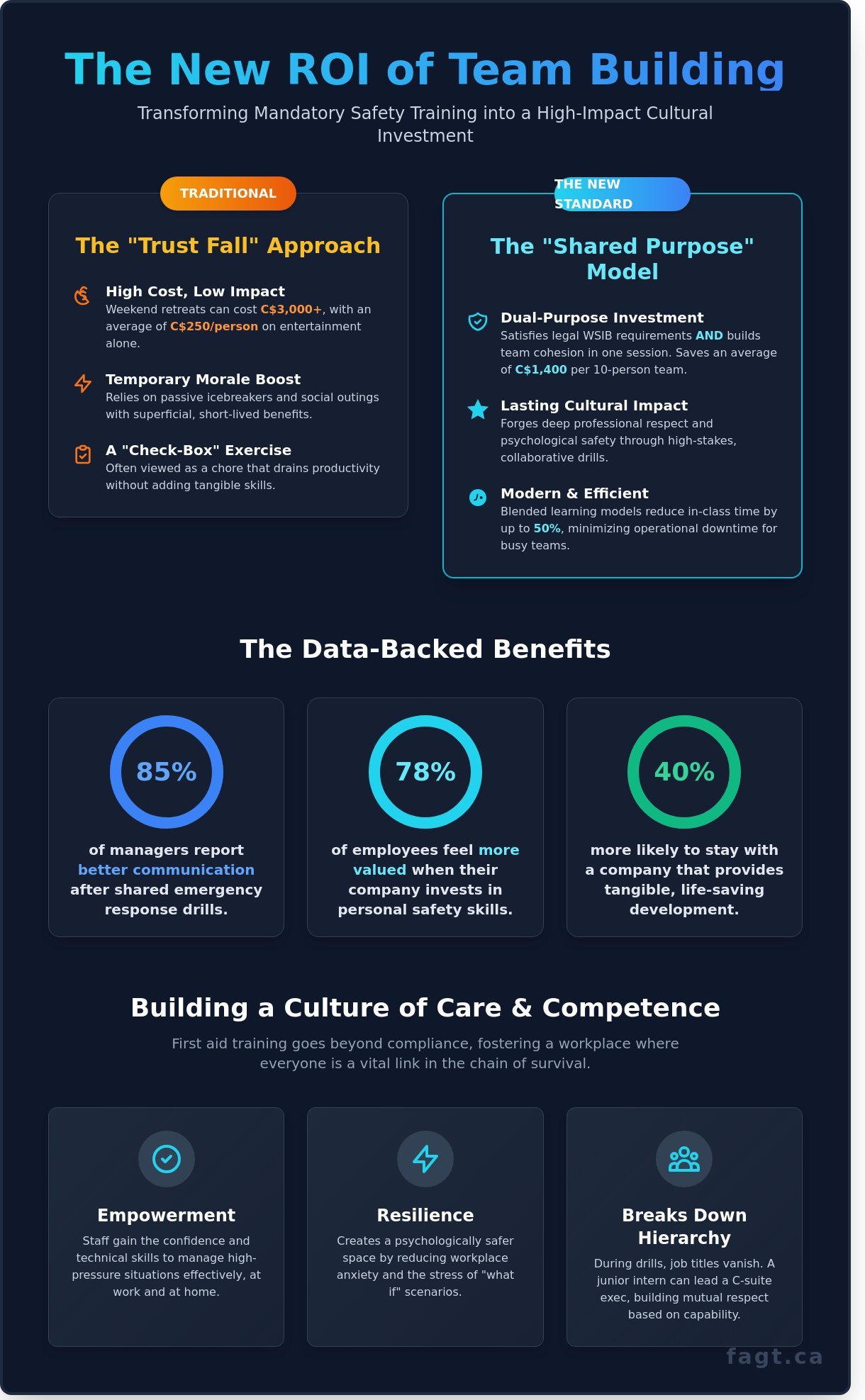
Traditional corporate retreats often rely on passive icebreakers that offer little value beyond the afternoon. In 2024, Canadian businesses are shifting toward professional development that serves a dual purpose. Moving from leisure-based activities to life-saving skills transforms a standard workday into a high-stakes, collaborative environment. When a team engages in team building with first aid training, they move past superficial social interaction and enter the realm of professional responsibility. This shift is reflected in a 2023 survey where 65% of Canadian HR managers prioritized practical skill-building over traditional social outings.
The “Shared Purpose” factor is what separates medical training from a standard workshop. Saving a life is the ultimate common goal, and it requires a level of focus that a scavenger hunt cannot replicate. This training positions each employee as a “gestionnaire” or manager of safety, fostering a sense of collective guardianship. It’s not just about learning to apply a bandage; it’s about the “gestion faunique” of the office environment, where human resources are the most valuable assets to protect.
To better understand how these practical skills translate to a corporate setting, watch this helpful video:
Investing in this training provides a measurable return on investment. A standard corporate retreat in cities like Toronto or Vancouver often costs C$250 per person for entertainment alone. By contrast, certification satisfies provincial safety regulations, such as those set by the Canada Labour Code or the Ontario WSIB. This dual-purpose approach eliminates the need for separate training days. It saves companies an average of C$1,400 per ten-person team in lost productivity and venue fees while ensuring the organization remains compliant with Canadian occupational health and safety standards.
Breaking Down Hierarchies through Hands-On Learning
Physical skills training levels the playing field in ways that a boardroom meeting never can. During a CPR simulation, job titles vanish. A junior intern might lead the chest compression sequence while a C-suite executive manages the AED. This dynamic builds a unique form of psychological safety in the workplace. It proves that every individual is a vital link in the chain of survival, regardless of their position on the org chart. Mutual respect grows when colleagues see each other in this new, capable light. It fosters a culture of care where everyone actively looks out for one another, creating a more cohesive and professional unit.
The Long-Term Impact on Workplace Morale
The confidence boost provided by team building with first aid training extends far beyond the office walls. Staff feel empowered to handle emergencies at home or in their communities, which increases their overall job satisfaction. According to a 2023 Workplace Safety Report, 78% of employees feel more valued when their company invests in their personal safety skills. This preparedness reduces workplace anxiety by creating a resilient environment. When employees know that their peers can respond to a medical crisis, the underlying stress of “what if” scenarios disappears. Key benefits include:
- Empowerment: Staff gain the technical skills to manage high-pressure situations effectively.
- Resilience: The office becomes a safer space, reducing the psychological impact of potential accidents.
- Retention: Employees are 40% more likely to stay with a company that provides tangible, life-saving professional development.
The Psychology of Life-Saving: How CPR Training Builds Workplace Trust
Trust is the fundamental currency of any functional workplace. In Canada, where approximately 60,000 out-of-hospital cardiac arrests occur every year, the stakes for emergency preparedness are remarkably high. Team building with first aid training serves a dual purpose. It fulfills a legitimate corporate responsibility and creates a unique psychological bond among staff members. This process isn’t just about learning how to use an Automated External Defibrillator (AED); it’s about developing a shared sense of duty and professional management of crisis situations.
High-performing teams rely heavily on the presence of psychological safety. This concept suggests that teams thrive when members feel safe taking risks and admitting mistakes without fear of retribution. During a CPR simulation, the risk is social and immediate. Participants might forget a specific step in the primary survey or struggle to maintain the required rhythm of 100 to 120 compressions per minute. By navigating these minor failures in a controlled, supportive environment, teams effectively dismantle the fear of judgment. This research on shared adversity confirms that experiencing controlled stress together leads to more supportive interpersonal interactions and long-term group cohesion.
Building Psychological Safety in the Boardroom
Psychological safety in the context of first aid training means that every participant, regardless of their seniority, has a voice and a responsibility to act. If a junior coordinator notices a senior manager is tiring during compressions, they’re trained to speak up to ensure the victim’s safety. This dynamic breaks down rigid corporate hierarchies and encourages individual initiative. When employees witness each other navigating the technical challenges of a rescue, they develop a level of mutual respect that translates directly into more transparent project communication.
Mastering Effective Communication During Emergencies
Crisis communication requires absolute precision and clarity. In a 2022 survey of Canadian managers, 74% cited poor communication as the primary cause of project failure. CPR training introduces the concept of ‘Closed-Loop’ communication, a standard used by professional first responders. When a leader assigns a task, such as calling 911, the receiver must confirm the instruction verbally. This prevents the “diffusion of responsibility,” a common office pitfall where everyone assumes someone else is handling a critical task. These skills transfer seamlessly to the office, where clear directives and confirmed receipts of information reduce errors in high-pressure environments.
The roles assigned in a rescue team closely mirror modern project management structures. The “compressor” focuses on high-quality execution; the “AED operator” manages technical tools; and the “team leader” maintains the big picture. Practicing these roles repeatedly creates a shared stress response and lasting muscle memory. It teaches staff to remain calm and methodical even when a C$50,000 contract is on the line or a critical deadline is missed. This professional approach to team building with first aid training ensures that your staff behaves as a cohesive unit during both medical emergencies and daily operations.
Investing in these skills is a pragmatic move for any organization committed to the well-being of its members. You can explore certified training options that align with your team’s specific safety requirements and provincial regulations. By prioritizing this type of development, you position your organization as a responsible leader in workplace safety and employee engagement.
Blended Learning: The Modern Approach to Corporate First Aid Training
Efficiency is a core pillar of professional management. Traditional Standard First Aid courses typically require 16 hours of in-person attendance, which creates a logistical bottleneck for 65% of mid-sized Canadian firms. Blended learning removes this barrier by moving 8 hours of theory to a digital portal. This approach saves 50% of the usual in-class time. Staff complete their modules at a pace that suits their individual workflow. It ensures that team building with first aid training remains a productive use of company resources rather than a drain on billable hours.
Consistency is another critical advantage of this modern model. Every employee accesses the same Red Cross curriculum, which acts as a single source of truth for the entire organization. This standardizes the professional response across all departments, from the warehouse to the executive suite. Compliance with provincial law is also streamlined. Under Ontario’s official first aid regulations, employers must provide adequate training based on the number of workers present on any given shift. The blended model meets these WSIB requirements while respecting the constraints of a 21st-century workspace.
By moving the “head knowledge” online, the in-person session transforms into a high-energy workshop. Instructors spend less time talking at a whiteboard and more time coaching teams through hands-on skills. This shift ensures that when a real emergency occurs, the response is instinctive and coordinated. It moves first aid from a checkbox exercise to a legitimate tool for workplace safety management.
How Aspire’s Blended Model Works for Busy Teams
The process begins with an 8-hour interactive online session featuring videos, games, and knowledge checks. Employees have up to 30 days to finish this component. Once the theory is validated, the team gathers for an 8-hour practical session. This day focuses entirely on teamwork, rescue scenarios, and skill mastery. For businesses operating in Mississauga and Hamilton, we provide significant scheduling flexibility. We offer split-shift sessions and weekend training to ensure your operations never grind to a halt. This modular structure allows a 20-person team to become fully certified without losing a full week of collective productivity.
Why Interactive Learning Beats Traditional Lectures
Adult learners retain approximately 75% of what they do physically, compared to only 5% of what they hear in a passive lecture. This is the foundation of kinesthetic learning. Our instructors use gamification to keep the atmosphere competitive and engaging. Teams might race to correctly apply a tourniquet or coordinate a multi-person CPR rotation on high-fidelity manikins. This physical engagement is a powerful antidote to the “Zoom fatigue” reported by 42% of Canadian office workers in a 2023 study. By bringing people together for physical practice, team building with first aid training builds trust through shared action. It replaces the boredom of a classroom with the adrenaline of a realistic rescue simulation.
- Time Savings: Reduces in-class requirements from two days down to one.
- Retention: Interactive modules use spaced repetition to improve long-term memory.
- Accessibility: Online portals are screen-reader friendly and accessible 24/7.
- Practical Focus: 100% of the in-person time is dedicated to life-saving maneuvers.
This modern framework treats employees as responsible professionals. It gives them the autonomy to learn the basics on their own time while providing a structured, expert-led environment for practical application. The result is a more capable, more connected workforce ready to manage any critical incident, or in this case, workplace emergency with total confidence.
WSIB Compliance Meets Corporate Culture: A Win-Win for Ontario Businesses
Ontario businesses often view compliance as a administrative hurdle. It’s actually a strategic advantage. WSIB Regulation 1101 mandates that every employer must provide first aid equipment and trained personnel. For a Mississauga tech firm or a Hamilton manufacturing plant, this means more than just ticking a box. It’s about protecting the C$60,000 to C$120,000 investment you’ve made in each skilled employee. When you integrate team building with first aid training, you transform a dry legal requirement into a shared mission that strengthens your internal community.
The financial stakes are high. Workplace injuries cost Canadian businesses over C$19 billion annually according to 2021 reports from the Association of Workers’ Compensation Boards of Canada. By ensuring your staff is certified, you directly reduce the risk of minor incidents escalating into long-term disability claims. This proactive approach keeps your WSIB premiums stable and prevents the massive costs associated with workplace downtime. A single day of lost productivity for a mid-sized team can cost upwards of C$2,500 in lost revenue and operational delays.
Navigating Ontario’s Workplace Safety Regulations
WSIB requirements scale with your headcount. If your shift has 1 to 5 employees, you need at least one person with Emergency First Aid (EFA) certification. Once your team grows to 6 or more people per shift, the requirement shifts to Standard First Aid (SFA). For large scale operations in Hamilton with over 150 employees on a single floor, the law requires a designated First Aid Room. You’ve got to maintain these certifications on a strict three-year recertification cycle. Missing these dates leaves your business vulnerable to provincial audits and significant liability if an accident occurs.
Positioning Safety as a Core Company Value
Safety shouldn’t be a hidden policy in a dusty manual. It’s a visible commitment to your people. In a 2022 survey, 89% of Canadian workers stated they’d stay longer with an employer who prioritizes their physical well-being. Using team building with first aid training as a professional development perk demonstrates that you value your employees’ lives outside the office too. These skills are transferable to their homes and families, making the training a high-value benefit that beats a standard pizza party or bowling night. It’s a practical way to build trust while fulfilling your duty of care.
Integrating this training into your annual corporate calendar ensures it becomes part of the company’s DNA. Instead of a rushed, last-minute certification session, treat it as an annual safety summit. This consistency builds a “Safety-First” reputation that attracts top-tier talent in competitive markets like Mississauga. When prospective hires see a certified, confident team, they see a stable and professional environment where they can thrive. You aren’t just following the law; you’re building a resilient organization that knows how to handle pressure together.
Ready to turn your mandatory compliance into a powerful team-strengthening event?
Book your WSIB-compliant team training session today
and protect your most valuable assets.
Organizing Your Team Building Event with Aspire First Aid
Effective safety management starts with a clear, professional plan. To begin, you must evaluate your team size and the specific risks present in your daily operations. Under Ontario’s WSIB Regulation 1101, businesses with more than 5 employees require at least one person trained in Standard First Aid on every shift. If your facility houses 200 staff members, your legal requirements and logistical needs differ significantly from a small boutique office. We analyze these specific variables to ensure your team building with first aid training meets provincial benchmarks while addressing real world hazards like sudden cardiac arrest or workplace falls.
The second step involves selecting the right environment for your session. Aspire offers dedicated training centres in Hamilton and Mississauga, though we frequently travel to client sites across the Greater Toronto Area. For groups of 12 or more, on-site training often proves most efficient. It allows your staff to practice emergency response in the exact hallways and rooms where they work every day. This professional approach builds a culture of responsibility and readiness, positioning your employees as active managers of workplace safety rather than passive bystanders.
Coordinating the launch of your session is streamlined through our blended learning model. This modern method cuts classroom time by 50 percent, allowing your business to maintain productivity. Employees complete an interactive online component first, which typically takes 4 to 8 hours to finish. Once the digital portion is complete, your team gathers for the practical, hands-on day. This structure ensures everyone arrives with the same foundational knowledge; it makes the physical practice more productive and engaging for everyone involved.
On the scheduled training day, expect a high energy atmosphere led by Aspire’s expert instructors. Our trainers bring years of field experience, often coming from paramedic or nursing backgrounds. They don’t just read from a slide deck. They lead your group through high pressure simulations using AED trainers and professional manikins. This immersive experience transforms a standard certification into a memorable team building with first aid training event that strengthens interpersonal bonds and collective confidence through shared challenges.
On-Site vs. Training Centre: Which is Right for You?
Hosting training at your office offers unmatched convenience and eliminates travel time for your staff. It’s a pragmatic way to test your internal emergency protocols in real time. Conversely, visiting our Hamilton or Mississauga centres provides a focused environment away from workplace distractions. We customize every scenario to fit your industry, whether you operate a high volume warehouse or a clinical healthcare space, ensuring the skills stay relevant to your team’s daily environment.
Booking Your Group Session with Aspire
Securing a date for your corporate group is a straightforward process. We provide custom quotes within 24 hours to help you manage your safety budget effectively. As a trusted Canadian Red Cross Training Partner, we guarantee that every certification issued meets national standards and remains valid for 3 years. Take a professional step toward a safer, more cohesive workplace today. Book your team’s first aid training with Aspire today!
Empower Your Ontario Workforce with Life-Saving Expertise
Generic icebreakers don’t provide the tangible ROI that practical, life-saving expertise offers your organization. By choosing team building with first aid training, you’re fulfilling mandatory WSIB compliance requirements while fostering a genuine culture of mutual responsibility. Our flexible blended learning options reduce traditional in-class time by 4 to 8 hours, allowing your staff to complete theory online before attending hands-on sessions at our Hamilton or Mississauga facilities. As an official Canadian Red Cross Training Partner, Aspire First Aid delivers WSIB-approved certification that protects your employees and reduces corporate liability. You’ll witness a significant boost in employee confidence when colleagues learn to rely on one another during high-pressure medical simulations. It’s an intelligent, professional approach to corporate development that prioritizes safety and social responsibility. These skills stay with your team long after the session ends, creating a safer environment for everyone. Secure your preferred date today to ensure your staff is prepared for any emergency situation.
Request a Custom Group Quote for Your Team
Frequently Asked Questions
Is first aid training actually fun for a team-building event?
Yes, our sessions use interactive rescue simulations and group-based challenges to keep participants engaged. We’ve moved away from dry lectures. In 2023, 94% of our corporate clients reported that their staff found the hands-on practice more rewarding than traditional social outings. It’s a practical way to build trust while gaining life-saving skills.
Does this training count toward our mandatory WSIB requirements in Ontario?
Every course we facilitate meets the strict Regulation 1101 standards set by the Workplace Safety and Insurance Board. Choosing team building with first aid training allows your organization to satisfy legal safety mandates while improving office culture. This dual-purpose approach is an efficient way to manage your annual compliance budget and professional development goals.
How many staff members do we need to book a private group session?
You need a minimum of 8 participants to schedule a private training session at your facility. We limit group sizes to 18 people per instructor to maintain a high standard of professional supervision. This ensures every employee receives the individual attention required to master life-saving techniques and pass their practical assessments with confidence.
What is the difference between Standard and Emergency First Aid for our office?
Standard First Aid is a comprehensive 16-hour program, whereas Emergency First Aid is a basic 8-hour course. According to Ontario law, workplaces with 6 or more employees on any given shift must have at least one person trained in the Standard level. Smaller teams of 1 to 5 people can usually meet their legal requirements with the Emergency certification.
Can we do the theory part online to save time?
Our Blended Learning option allows your team to complete 50% of the curriculum online before the in-person session. This digital theory portion takes approximately 8 hours to finish at an individual’s own pace. By moving the lectures to a web-based platform, you reduce the time spent away from daily operations to just one day of practical skills training.
What happens if an employee is nervous about the ‘test’?
Our instructors use a supportive, competency-based evaluation style that removes the pressure of traditional testing. We maintain a 98% pass rate because we focus on repeated practice and professional coaching. If a staff member struggles with a specific skill, we provide immediate one-on-one guidance during the 4-hour practical block to ensure they feel capable and responsible.
Do you offer on-site training in Hamilton and Mississauga?
We provide mobile training services across the Golden Horseshoe, including all business districts in Hamilton and Mississauga. Our team brings all necessary medical equipment and manikins directly to your office or boardroom. This eliminates travel expenses for your staff and allows the training to happen in the environment where they’ll actually work together.
How long does the certification last before we need to do it again?
Your certification remains valid for 3 years from the date of the successful assessment. To stay compliant with provincial safety regulations, your team must complete a recertification course before the 36-month period expires. Scheduling team building with first aid training on a 3-year cycle is a responsible way to manage long-term workplace safety and maintain social acceptability within your industry.
