
Navigating the landscape of professional certification can be a challenge. You know you need training, but the terminology itself-Standard, Emergency, Basic, Intermediate-often creates more questions than answers. Which level does your workplace require? How much time must you commit? Choosing incorrectly can mean wasted time and a certification that isn’t recognized. This confusion is a common and valid concern when selecting from the many available first aid courses.
This guide is designed to provide clarity and confidence. We will break down the essential differences between Standard and Emergency First Aid, demystifying the requirements for each. We’ll cover the key distinctions in training hours, the specific topics and skills learned, and the type of WSIB-approved certification you’ll earn. By the end, you will be equipped to make an informed decision, selecting the perfect course to meet your professional obligations and feel genuinely prepared to respond in a medical emergency.
Emergency First Aid & CPR/AED Level C: The One-Day Essential
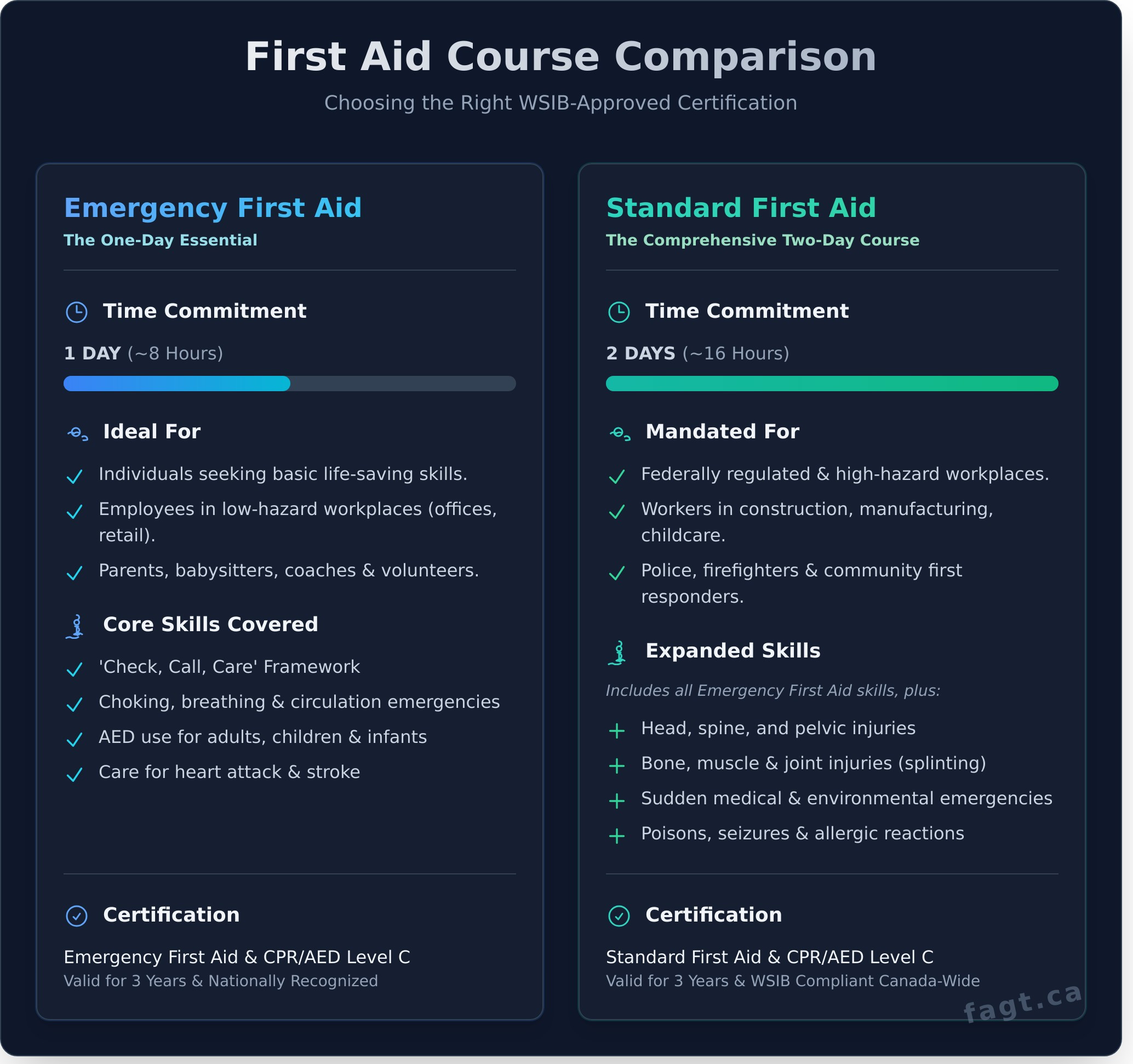
When considering your training options, the Emergency First Aid & CPR/AED Level C course serves as the foundational, single-day program designed to equip you with essential life-saving skills. Its primary focus is on immediate intervention for life-threatening emergencies, providing the critical knowledge needed to act decisively when seconds count. This course establishes a solid understanding of what first aid is by concentrating on the most urgent scenarios you might face at home, in public, or at work. For many smaller, low-hazard workplaces in Canada, this certification is the minimum requirement for compliance and employee safety.
To better understand the scope of these programs, this video provides a helpful overview:
Who is this course for?
This course is structured for a broad audience, providing a comprehensive yet accessible entry point into emergency response. It is the responsible choice for:
- Individuals seeking fundamental life-saving skills for personal preparedness and family safety.
- Employees in low-hazard environments such as offices, retail stores, and restaurants.
- Parents, new babysitters, coaches, and community volunteers who have a duty of care for others.
- Anyone who wants a quick, effective, and certified introduction to first aid principles.
What You’ll Learn: Core Life-Saving Skills
The curriculum of Emergency First Aid is streamlined to focus on the highest-priority skills. Participants in these types of first aid courses gain confidence in managing critical incidents through hands-on practice. Key learning outcomes include:
- Systematic emergency response using the ‘Check, Call, Care’ framework.
- Managing choking, breathing, and circulation emergencies for adults, children, and infants.
- Confident and correct use of an Automated External Defibrillator (AED).
- Recognizing the signs of, and providing appropriate care for, heart attack and stroke.
Course Duration and Certification
Efficiency is a key feature of this program, allowing participants to become certified without a lengthy time commitment. The details are straightforward:
- Duration: The course is typically completed in a single day, comprising approximately 8 hours of instruction and practical assessment.
- Certification: Upon successful completion, you receive a certificate in Emergency First Aid and CPR/AED Level C.
- Validity: This certification is nationally recognized, valid for 3 years, and meets WSIB requirements for workplaces in Ontario.
Standard First Aid & CPR/AED Level C: The Comprehensive Two-Day Course
When a workplace requires more than just the fundamentals, Standard First Aid & CPR/AED Level C is the definitive training solution. This comprehensive, two-day program is widely recognized as the standard for Canadian workplaces, building on the foundation of Emergency First Aid to equip participants with the skills to manage a wider spectrum of injuries and medical emergencies. It is specifically designed for those in medium-to-high-hazard environments where the ability to respond to both immediate life threats and secondary injuries is a critical responsibility.
Who needs this comprehensive training?
This level of certification is not just recommended but often mandated for professionals in higher-risk roles. Many industries must adhere to strict workplace safety regulations that specify this exact level of training. This is one of the most essential first aid courses for:
- Employees in federally regulated workplaces (e.g., transportation, telecommunications).
- Workers in industries like construction, manufacturing, oil and gas, and childcare.
- Police officers, firefighters, and other community first responders.
- Anyone desiring a thorough and confident understanding of first aid principles.
Expanded Topics: Beyond the Basics
While including all content from the Emergency First Aid course, the Standard First Aid program dedicates significant time to secondary assessments and injuries that are serious but not immediately life-threatening. This expanded curriculum ensures a responder can manage an incident from start to finish, covering topics such as:
- Detailed procedures for managing head, spine, and pelvic injuries.
- Assessment and treatment of bone, muscle, and joint injuries, including practical splinting techniques.
- Response protocols for sudden medical emergencies such as seizures, diabetic shock, and severe allergic reactions.
- Knowledge of environmental emergencies, including heat stroke and hypothermia.
Course Duration and Certification
Achieving this certification requires a commitment to in-depth learning. The course is structured to provide both theoretical knowledge and extensive hands-on practice, ensuring every participant leaves with confidence.
- Duration: A two-day course, typically lasting 14-16 hours.
- Format: Often available in a blended learning format, with an online theory component followed by a one-day in-class practical session.
- Certification: Graduates receive a certificate for Standard First Aid and CPR/AED Level C.
- Validity: The certification is valid for three years and is fully compliant with provincial WSIB requirements across Canada.
Side-by-Side Comparison: Emergency vs. Standard First Aid
Choosing between Emergency and Standard First Aid depends entirely on your workplace requirements, personal goals, and the types of situations you are likely to encounter. Both comprehensive first aid courses provide critical skills, including how to manage choking and perform life-saving CPR techniques. However, they differ significantly in duration, depth, and the range of injuries covered. This direct comparison will help you make an informed and responsible decision.
At a Glance: Feature Comparison Table
| Feature | Emergency First Aid & CPR/AED | Standard First Aid & CPR/AED |
|---|---|---|
| Duration | 1 Day (approx. 8 hours) | 2 Days (approx. 16 hours) |
| Content Focus | Immediate, life-threatening emergencies: CPR, AED use, severe bleeding, shock, and choking. | All Emergency First Aid topics plus comprehensive care for a wide range of injuries and illnesses. |
| Ideal For | Individuals seeking basic skills, parents, or employees in low-hazard workplaces. | Designated first aiders, federal employees, coaches, and anyone in a higher-risk environment. |
| WSIB Regulation (Ontario) | Meets requirements for workplaces with 5 or fewer employees working on any one shift. | Required for workplaces with 6 or more employees working on any one shift. |
Content Deep Dive: What’s Added in Standard First Aid?
Standard First Aid builds upon the foundation of the emergency course, equipping you with the knowledge to manage a much broader spectrum of medical situations. While the one-day course focuses on immediate threats to life, the two-day program provides the skills needed to handle injuries until professional medical help arrives. The additional topics are critical for creating a truly comprehensive emergency response plan.
Key skills covered in Standard First Aid that are not in the Emergency course include:
- Head, neck, and spinal injuries
- Bone, muscle, and joint injuries, including how to properly apply splints and slings
- Sudden medical emergencies (e.g., seizures, diabetic shock)
- Environmental emergencies such as hypothermia, heat stroke, and frostbite
- Management of poisons, bites, and stings
Imagine a coworker falls from a short ladder. With Standard First Aid training, you would know not only how to check for breathing but also how to immobilize their head and neck to prevent a potential spinal injury and how to splint a suspected fracture while waiting for paramedics.
Recertification Requirements
Both Emergency and Standard First Aid certifications are valid for three years from the date of issue. To maintain your certification, you must complete a recertification course before your current certificate expires. These renewal courses are shorter-typically one day for Standard First Aid-and focus on refreshing your skills and updating you on any new protocols. Please note that you must present a valid, unexpired certificate to be eligible for recertification. Expired certificates require you to retake the full course. Check our schedule for upcoming recertification courses.
How to Choose the Right First Aid Course for You
Selecting the right certification depends on your specific needs, whether they are driven by professional regulations, personal preparedness, or career goals. Understanding your primary motivation is the first step toward making a confident and responsible choice between the available first aid courses. This guide breaks down the decision based on common scenarios to help you determine the appropriate level of training.
For Workplace Requirements (WSIB)
For most individuals, the primary driver for certification is workplace compliance. Provincial regulations, such as those set by Ontario’s WSIB, typically mandate specific training levels based on the number of employees and the level of risk at a worksite.
- Check First: Always confirm the exact requirements with your employer or HR department before enrolling.
- Standard is the Standard: Most workplaces with more than five employees require at least one person with a Standard First Aid & CPR/AED certificate.
- Exceptions Exist: Smaller or lower-risk environments may only require Emergency First Aid.
Rest assured, both the Standard and Emergency First Aid certifications we provide are fully approved and meet federal and provincial requirements, ensuring your certificate is recognized across Canada.
For Parents, Caregivers, and Personal Skills
When your priority is protecting loved ones at home, the comprehensive nature of Standard First Aid is highly recommended. This course provides in-depth training on topics crucial for family safety, including specific protocols for infants and children. You will learn to manage common household emergencies like burns, falls, allergic reactions, and poisoning. While Emergency First Aid is a valuable starting point, the Standard course equips you with a broader, more confident skill set for peace of mind.
For Students and Career Development
A first aid certificate is a powerful asset for your professional profile. Many Canadian post-secondary programs, especially in healthcare, education, and social services, list Standard First Aid as a mandatory prerequisite for admission or co-op placements. Beyond fulfilling a requirement, this certification demonstrates responsibility and preparedness to potential employers, making your resume stand out. It is a fundamental life skill that signals competence and care, regardless of your chosen career path.
Getting Your WSIB-Approved Certification with Aspire First Aid
Understanding the difference between Standard and Emergency First Aid is the first step. The next is choosing a training provider that delivers expert instruction and a certification that is recognized and respected. At Aspire First Aid, we simplify the process of getting your WSIB-approved certification, ensuring you leave with the skills and confidence to act decisively in an emergency.
As a Canadian Red Cross Training Partner, we are committed to providing the highest standard of training. Our streamlined registration and flexible course options make it easy to find a program that fits your schedule and learning style.
Flexible Training Options: Blended and In-Class
We recognize that everyone learns differently. That’s why we offer blended learning for our first aid courses, allowing you to complete the theoretical portion online at your own pace. This minimizes your time in the classroom, which is then dedicated entirely to practical, hands-on skills development. For those who prefer a traditional setting, our fully in-person classes provide a comprehensive, instructor-led experience from start to finish.
What to Expect on Your Training Day
Your training day is an engaging and interactive experience. You will be guided by certified Canadian Red Cross instructors who are experts in the field. The focus is on practical application, using professional equipment like manikins and AED trainers to work through realistic emergency scenarios. We foster a supportive environment where questions are encouraged, ensuring you feel comfortable and capable. Upon successful completion, you will receive your official, nationally recognized digital certificate.
Why Choose a Red Cross Training Partner?
Partnering with a recognized Canadian Red Cross provider like Aspire First Aid offers significant advantages. It guarantees that your training and certification meet the latest first aid and CPR guidelines and are accepted by employers across Canada.
- Nationally Recognized: Your certification is valid and respected in every province and territory.
- Up-to-Date Curriculum: Training content is based on the latest scientific evidence and best practices in emergency care.
- Expert Instruction: Learn from certified instructors who adhere to the highest teaching standards.
Take the final step toward becoming a certified first aid provider. Equip yourself with life-saving skills from a trusted source. Book Your First Aid Course in Mississauga or Hamilton Today!
Secure Your Certification and Be Prepared
Choosing between Emergency and Standard First Aid ultimately depends on your specific needs and regulatory requirements. The one-day Emergency course equips you with the fundamental skills for immediate, life-threatening situations, while the comprehensive two-day Standard course provides a deeper knowledge base for a wider range of injuries and illnesses. Making an informed decision is the first step toward responsible preparedness.
At Aspire First Aid, we make that decision simple. As an official Canadian Red Cross Training Partner, we offer WSIB-approved first aid courses led by expert, certified instructors. With flexible blended and in-class options in Mississauga and Hamilton, you can gain the skills and confidence needed to respond effectively in any emergency.
Don’t wait for an incident to happen. Be ready to act. Find Your WSIB-Approved First Aid Course in Mississauga or Hamilton and take the definitive step toward becoming a certified first responder today.
Frequently Asked Questions About First Aid Courses
How long is a first aid certificate valid for in Ontario?
In Ontario, a Standard First Aid & CPR/AED certificate is valid for three years from the date of issue. This validity period is recognized by the Workplace Safety and Insurance Board (WSIB) and aligns with provincial occupational health and safety regulations. To maintain a valid certification for employment or other requirements, individuals must complete a recertification course before their current certificate expires. This ensures skills and knowledge remain current with established protocols.
What is the difference between CPR Level A and CPR Level C?
The primary distinction between CPR Level A and CPR Level C lies in the scope of training. CPR Level A focuses exclusively on resuscitation techniques for adults. In contrast, CPR Level C provides a more comprehensive certification, covering emergency procedures for adults, children, and infants. It also includes training for two-rescuer CPR scenarios, making it the required standard for professionals such as early childhood educators and lifeguards who may encounter emergencies involving all age groups.
Are online-only first aid courses recognized by WSIB?
No, first aid courses delivered entirely online are not recognized by Ontario’s WSIB for workplace certification. WSIB regulations mandate that all approved training must include a hands-on, in-person component where a certified instructor can evaluate a participant’s practical skills. While blended learning formats-combining online theory with an in-class skills session-are acceptable, a course without this practical evaluation does not meet the legislative requirements for workplace first aid in Ontario.
Can I take a Standard First Aid course if I’ve never taken first aid before?
Yes, the Standard First Aid course is a comprehensive, foundational program with no prior training prerequisites. It is the appropriate choice for individuals seeking their first certification or for those whose previous certificate has expired. The curriculum covers a wide range of topics, including CPR, AED use, and managing various medical emergencies, providing all the necessary knowledge and skills for a new participant to become a certified first aid provider in compliance with workplace regulations.
What is a first aid recertification course and who is eligible?
A first aid recertification course is a condensed program designed to refresh skills and update knowledge for individuals who hold a current, valid Standard First Aid certificate. To be eligible, a participant must present a certificate that has not yet expired, typically from the same original training provider. It is critical to note that an expired certificate is not eligible for recertification; in such cases, the individual must retake the full Standard First Aid course to be certified again.
Do I get my certificate on the same day as the course?
Upon successful completion of the course, including both the practical skills evaluation and the written examination, participants often receive temporary proof of completion on the same day. The official, permanent certificate is generally processed and issued electronically via email within a few business days. This procedure allows for proper record-keeping and verification by the training agency, ensuring the certification is officially registered and recognized according to national standards.
