
Standard, Emergency, BLS, Blended… trying to choose the right first aid certification can feel as overwhelming as an actual emergency. If you’re feeling confused by the different course names, unsure which certificate your Ontario workplace requires for WSIB compliance, or nervous about the hands-on skills test, you’ve come to the right place. Finding the right Red Cross First Aid course shouldn’t be a challenge, and our goal is to provide a clear, responsible path to getting you certified with confidence.
This complete guide is designed to eliminate the guesswork. We will break down the exact differences between each level of certification, detail what you can expect from both the online and in-class training, and provide the expert information you need to feel prepared. By the end of this article, you will be able to confidently select the right course for your needs, understand the certification and renewal process, and walk into your training session ready to succeed.
Why Choose a Canadian Red Cross First Aid Course?
When selecting first aid training in Canada, the Canadian Red Cross is the nation’s foremost provider, setting the standard for quality and reliability. Their comprehensive programs are meticulously designed to meet and often exceed federal and provincial/territorial occupational health and safety regulations, including standards mandated by organizations like the Workplace Safety and Insurance Board (WSIB). This unwavering commitment to regulatory compliance ensures that your certification is not just valid, but highly respected across all industries.
To get a better sense of the practical, hands-on training involved, watch this brief overview of what to expect:
The core of the Red Cross methodology is its focus on hands-on skills and confidence-building. Through realistic, practical scenarios, you don’t just learn the steps-you develop the muscle memory and composure to act decisively when it matters most. Furthermore, Red Cross programs are dynamic, undergoing continuous updates to reflect the latest scientific guidelines and best practices in emergency care. This ensures your training is always current and built upon the proven foundational principles of first aid.
The Value of a Red Cross Certificate
Holding a Canadian Red Cross certificate offers significant advantages, serving as a powerful credential in both professional and personal contexts. It is recognized and respected nationwide and internationally, providing tangible proof of your life-saving capabilities. The value extends far beyond simple compliance:
- Demonstrates a High Standard: It signifies you have been trained to a rigorous, evidence-based curriculum trusted by millions.
- Meets Professional Requirements: It fulfills the certification needs for a vast range of jobs, from childcare and construction to healthcare and corporate safety teams.
- Offers Digital Convenience: Modern digital certificates are easily accessible through your online profile, simplifying verification, tracking, and sharing with employers.
- Builds Genuine Confidence: The learner-centered training methodology is specifically designed to prepare you to respond effectively and calmly in a real emergency.
Red Cross vs. Other Training Providers
While numerous first aid training options are available, the Canadian Red Cross sets the definitive benchmark for curriculum development, instructor qualification, and educational integrity. Their unwavering focus on scientifically proven protocols ensures every technique you learn is effective and up-to-date. When you enroll with an official Red Cross Training Partner, you are guaranteed an authentic and approved red cross first aid course. In contrast, other providers may follow different standards or offer certifications with less widespread recognition, potentially limiting their utility and acceptance in the workplace.
Decoding the Core Red Cross Courses: Which One is Right for You?
Selecting the right Red Cross first aid course can seem complex, but the choice is typically guided by clear factors: your workplace requirements, personal preparedness goals, or your professional field. Each course offers a different level of training, balancing time commitment with the depth of skills covered. To make an informed decision, it’s essential to understand the specific workplace first aid requirements that may apply to you, as these often dictate the minimum level of certification needed. Below, we break down the most common courses to help you identify the one that best fits your needs.
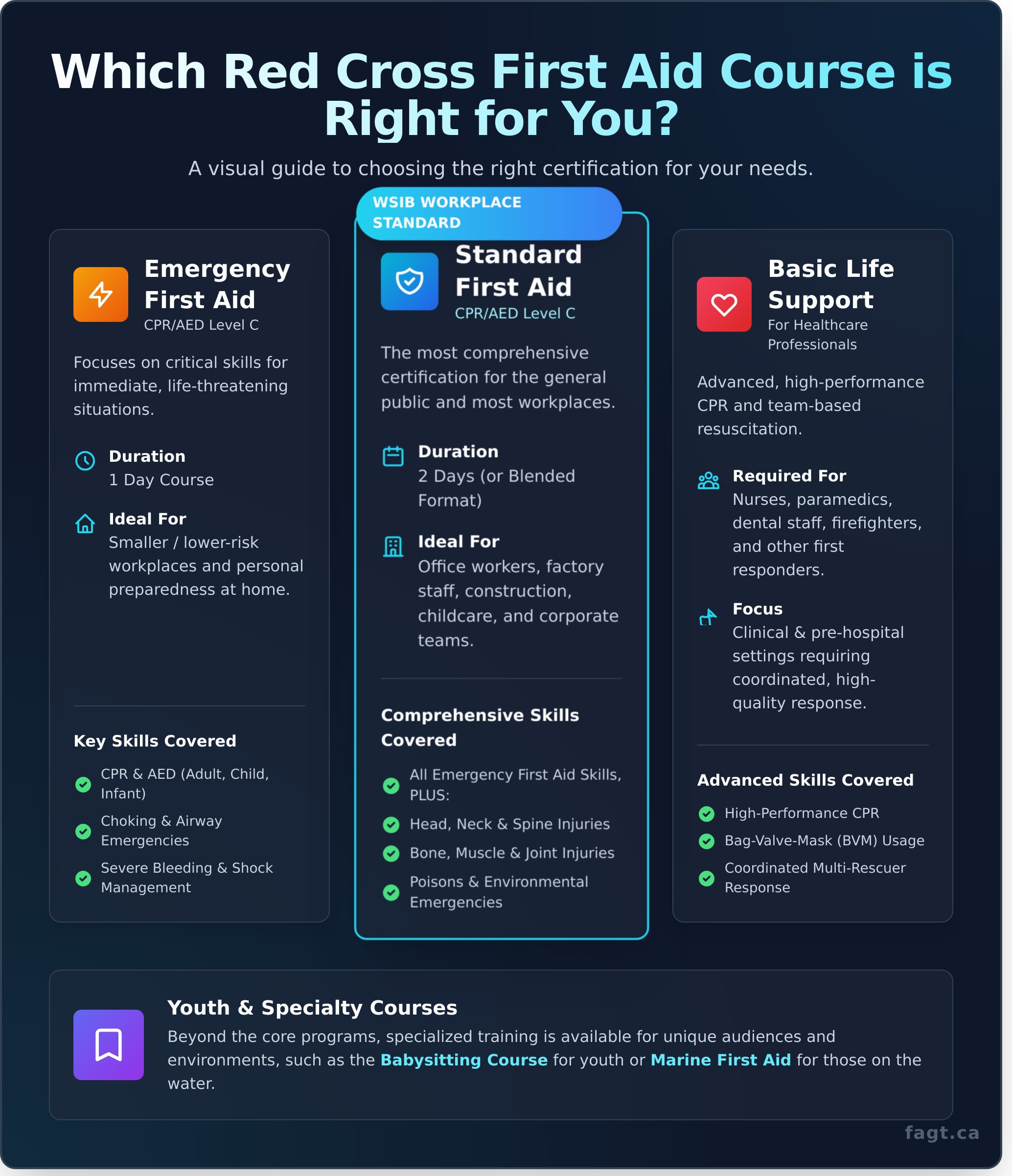
Standard First Aid & CPR/AED Level C
This is the most comprehensive certification for the general public and is the standard for most workplace safety boards in Canada, including WSIB in Ontario. Delivered over two days (or a blended online/in-class format), it covers a wide range of topics from major medical emergencies to specific injuries like head, spine, and bone trauma. It is the ideal choice for office workers, factory staff, and anyone seeking thorough first aid knowledge. Certification includes CPR and AED for adults, children, and infants (Level C).
Emergency First Aid & CPR/AED Level C
As a one-day course, Emergency First Aid focuses on the most critical skills needed to respond to immediate, life-threatening situations. The curriculum prioritizes essentials like CPR/AED (Level C), managing severe bleeding, addressing choking, and responding to shock. This certification is often suitable for workplaces with fewer employees or those identified as lower-risk environments. It also serves as an excellent starting point for individuals wanting essential life-saving skills for personal preparedness at home.
Basic Life Support (BLS)
Basic Life Support (BLS) is an advanced level of CPR training designed specifically for Healthcare Professionals (HCPs) and first responders. Unlike a general red cross first aid course, this program emphasizes high-performance, team-based resuscitation in a clinical setting. It covers skills like using a bag-valve-mask (BVM) and working as part of a coordinated response team. BLS certification is a mandatory requirement for professionals such as nurses, paramedics, dental staff, and firefighters.
Youth & Specialty Courses
Beyond the core programs, the Red Cross offers specialized training tailored to specific audiences and environments. Courses like the Babysitting Course provide youth with the skills and confidence to care for children safely. For those working on the water, Marine First Aid addresses the unique challenges of that environment. It is always critical to verify the exact certification you need before enrolling. See our full list of Red Cross courses in Mississauga & Hamilton to explore all available options.
The Training Experience: What to Expect in Your Course
The Canadian Red Cross has refined its training methodology to be engaging, practical, and effective. Forget long, passive lectures; the modern red cross first aid course uses a blended learning model that combines flexible online theory with essential in-person skills practice. This approach respects your time and is structured to build genuine confidence, not just check a box. The focus is on developing practical, life-saving abilities in a supportive, stress-free environment, which is crucial for preparing individuals to respond effectively in real-world emergencies.
Step 1: The Online Learning Component
Your training journey begins at home with a comprehensive online module. This self-paced component allows you to absorb the foundational knowledge of first aid principles whenever it fits your schedule. The material is presented through a dynamic mix of videos, interactive scenarios, and quizzes that reinforce key concepts. You must complete this online portion before attending your in-class session.
- Flexible Learning: Study at your own pace, on any device.
- Engaging Content: Interactive modules make learning complex topics manageable and memorable.
- Time Commitment: Expect to spend approximately 4-8 hours, depending on the specific course (e.g., Standard vs. Emergency First Aid).
Step 2: The In-Class Skills Session
This is where theory transforms into skill. The in-class session is entirely dedicated to hands-on practice under the direct guidance of a certified Red Cross instructor. In a small group setting, you will work with industry-standard equipment, including CPR manikins and AED training devices. The instructor will lead you through realistic simulations, such as responding to choking, managing severe bleeding, and performing CPR. This practical application is vital, as it builds the muscle memory required to act decisively, underscoring the value of first aid in the workplace and in the community. This is your opportunity to ask questions and receive personalized feedback to perfect your technique.
The Final Test and Certification
To complete your red cross first aid course, you will need to demonstrate your understanding and competency. This involves two key parts: a multiple-choice knowledge evaluation to confirm your grasp of the theory, and a practical skills demonstration where you apply what you’ve learned. Instructors are committed to your success and create a supportive atmosphere for the evaluation. Upon successful completion, you will receive a nationally recognized digital certificate, typically within 24-48 hours, valid for three years.
Understanding Your Red Cross Certification
Upon successful completion of your training, you will earn a Canadian Red Cross certification. This is more than just a document; it is verifiable proof of your competence and readiness to respond effectively in an emergency. The Red Cross issues all certificates in a secure digital format, providing a convenient and environmentally friendly way to access and share your credentials whenever you need them.
Certificate Validity and WSIB Compliance
Knowing the details of your certification is essential for ensuring you remain compliant for workplace or personal requirements. Each certificate has a specific validity period to ensure your skills remain sharp and your knowledge aligns with the latest life-saving protocols.
- Standard, Emergency & Child Care First Aid & CPR/AED: Certificates are valid for 3 years from the date of issue.
- Basic Life Support (BLS): This advanced certification is valid for 1 year, reflecting the high-performance standards required for healthcare and emergency service professionals.
All of our courses are recognized nationally and meet the specific requirements of Ontario’s Workplace Safety and Insurance Board (WSIB) Regulation 1101. For easy verification, your digital certificate includes a unique QR code that employers or organizations can scan to instantly confirm its authenticity.
The Recertification Process
To maintain your credentials, the Red Cross requires periodic recertification. This process is designed as an efficient way to refresh your skills, practice hands-on techniques, and learn any updated guidelines without having to repeat the entire program. To qualify for a shorter recertification class, you must hold a valid, unexpired certificate from a full red cross first aid course. This streamlined option is a convenient way to ensure your life-saving abilities remain at their peak. To help you stay on track, we provide courtesy email reminders to our students before their certificate is set to expire.
Accessing Your Certificate on MyRC
Your official training records are permanently stored in MyRC (myrc.redcross.ca), the official Canadian Red Cross online portal. This platform serves as your personal, secure hub for all certifications you achieve.
Through the MyRC portal, you can view, download, or print your certificate at any time. It is crucial to ensure your full name and email address are correct upon registration, as this information is used to create your profile. This single source of truth provides you with 24/7 access to your training history, simplifying everything from employment verification to personal record-keeping. For more resources on professional training and certification, you can visit fagt.ca.
How to Find the Best Red Cross Training Partner in Ontario
While the Canadian Red Cross sets the national standard for first aid curriculum, the quality of your training experience is delivered by their official Training Partners. The choice of provider directly impacts how well you learn and retain life-saving skills. Not all partners offer the same level of instructor expertise, facility quality, or learning support. Selecting a reputable and professional partner is the most important step in ensuring you get the maximum value from your red cross first aid course.
Choosing the right partner means you’ll leave feeling confident and prepared to act in an emergency, not just with a certificate in hand. Look for a provider with a strong community reputation and convenient locations to make your training journey both effective and accessible.
What to Look for in a Provider
When evaluating potential training partners in Ontario, focus on these key indicators of quality. A top-tier provider will consistently deliver on the following points, creating a supportive and professional learning environment:
- Experienced Instructors: Your instructor should be more than just a lecturer. Look for professionals who are engaging, supportive, and use real-world scenarios to make the material memorable and practical.
- Clean, Modern Facilities: Effective hands-on learning requires the right tools. A quality provider will have clean, well-lit training spaces equipped with up-to-date manikins, AED trainers, and first aid supplies.
- Positive Online Reviews: Testimonials from past students are a powerful indicator of a provider’s commitment to excellence. Check for consistently high ratings and positive feedback on platforms like Google.
- Flexible Scheduling: Life is busy. A reliable partner will offer a variety of course dates, including weekend and evening options, to fit your schedule.
Why Train with Aspire First Aid?
At Aspire First Aid, we are proud to be an official Canadian Red Cross Training Partner that exceeds these standards. We are committed to empowering individuals and organizations with the skills and confidence to respond effectively in emergencies. With convenient training centres in both Mississauga and Hamilton, we make it easy to access premier first aid education. Our expert instructors are dedicated to fostering a positive and encouraging atmosphere where every participant can succeed. We offer a full range of WSIB-approved courses, from Standard First Aid & CPR/AED to specialized programs for professional responders. When you choose Aspire, you are choosing a partner dedicated to your success.
Ready to gain the skills that can save a life? Book your Red Cross course with us today!
Take the Next Step: Become a Certified First Aider
Navigating the path to certification is a clear and rewarding journey. As we’ve explored, the key is to choose the program that aligns with your specific needs, understand what to expect during your hands-on training, and recognize the value your certificate holds. Investing in a red cross first aid course is more than just a credential; it is a commitment to the safety and well-being of those around you, empowering you to respond with confidence and skill when it matters most.
When you are ready to gain these critical skills, choosing the right provider is paramount. As an Official Canadian Red Cross Training Partner, we are dedicated to delivering the highest standard of instruction. Our courses are WSIB-Approved for Ontario Workplaces, ensuring your certification meets regulatory standards. With convenient training centres in Mississauga and Hamilton, getting certified has never been more accessible.
Don’t wait for an emergency to happen. Be prepared to make a difference. View our course schedule and register for a Red Cross course today!
Frequently Asked Questions About Red Cross First Aid Courses
How long is a Red Cross first aid certificate valid for in Canada?
In Canada, most Canadian Red Cross first aid and CPR/AED certifications, including Standard First Aid, are valid for three years from the date of issue. However, some specific workplaces or regulatory bodies may require annual recertification for certain skills, such as CPR. It is the certificate holder’s responsibility to be aware of any specific requirements mandated by their employer or professional association and to ensure their skills remain current and their certification remains in good standing.
What is the difference between CPR Level C and Basic Life Support (BLS)?
CPR Level C is designed for the general public, workplace responders, and lay rescuers. It covers CPR and choking procedures for adults, children, and infants, as well as two-rescuer CPR. Basic Life Support (BLS), formerly known as HCP (Health Care Provider), is a more advanced level of training intended for healthcare professionals. BLS curriculum includes all CPR C skills plus advanced techniques such as bag-valve-mask (BVM) use, team-based resuscitation, and advanced airway management.
Can I take a Red Cross first aid course entirely online?
No, you cannot obtain a full certification entirely online. The Canadian Red Cross utilizes a “Blended Learning” model, which combines an online theory component with a mandatory in-class, instructor-led skills session. While you can complete the knowledge portion at your own pace online, a fully certified Red Cross first aid course requires practical, hands-on training and evaluation. This ensures you can competently perform critical life-saving skills like CPR and bandaging before being certified.
What should I wear and bring to my in-class first aid training session?
Participants should wear comfortable, non-restrictive clothing suitable for practical exercises, which involve kneeling, bending, and lying on the floor. Closed-toe shoes are mandatory for safety. Please bring a government-issued photo ID for verification purposes, a notebook and pen for taking notes, and any required pre-course materials. You may also wish to bring a water bottle and snacks for breaks, as the training days can be physically and mentally demanding.
How do I renew my Red Cross first aid certification if it has expired?
Once your Red Cross first aid certification has expired, you are no longer eligible to take a shorter recertification course. To be certified again, you must register for and successfully complete the full, original course. Recertification courses are only available to individuals who hold a current, non-expired certificate. It is essential to track your certification’s expiry date and schedule a recertification course before it lapses to maintain continuous and valid credentials.
Are Red Cross courses WSIB approved in Ontario?
Yes, Canadian Red Cross Standard First Aid & CPR/AED courses meet the legislative requirements set by Ontario’s Workplace Safety and Insurance Board (WSIB). These programs are recognized under Regulation 1101 for workplace first aid compliance. Completing a WSIB-approved Red Cross first aid course ensures that your workplace meets its mandatory safety and training obligations within the province of Ontario, providing employees with the necessary skills to respond to workplace emergencies effectively.
