
Maintaining your Heart and Stroke Basic Life Support (BLS) certification is a critical responsibility for healthcare professionals and first responders across Canada. As the 2026 renewal period approaches, navigating the specific requirements, locating a convenient course, and ensuring compliance can become a source of professional stress. The process doesn’t need to be complicated, and ensuring there is no lapse in your qualifications is paramount for both your career and your ability to respond effectively in an emergency.
This definitive guide is engineered to provide clarity and direction. We will detail the complete Heart and Stroke BLS renewal process, provide a direct comparison with Canadian Red Cross standards to address questions of equivalency, and help you identify the most suitable recertification course for your needs. By the end of this article, you will have a clear, actionable plan to successfully renew your certification, confidently manage your professional credentials, and continue your vital work without interruption.
Understanding Heart and Stroke BLS Certification and Its Importance
In Canada, the Heart and Stroke Foundation stands as the definitive authority on resuscitation science and training, setting the national standard for life-saving skills. For healthcare professionals, their Basic Life Support (BLS) certification is not just a requirement-it is the bedrock of emergency patient care. This certification validates a provider’s ability to promptly recognize life-threatening emergencies, deliver high-quality chest compressions, provide appropriate ventilations, and ensure early use of an automated external defibrillator (AED).
At its core, BLS is the essential level of medical care for patients experiencing cardiac arrest, respiratory arrest, or an obstructed airway. You can learn more about What is Basic Life Support (BLS)? to understand its foundational principles. The heart and stroke BLS course is specifically designed for the dynamic environment of professional healthcare, emphasizing a systematic and team-based approach to resuscitation.
To see how to recognize one of the most common medical emergencies, watch this video from Heart & Stroke:
The curriculum focuses on critical skills, including high-performance CPR for adults, children, and infants, effective AED application, and managing airway obstructions. A significant emphasis is placed on team dynamics, ensuring seamless communication and role clarity during a resuscitation attempt. Due to the perishable nature of these skills, Heart and Stroke BLS certifications are valid for only one year, making annual renewal essential to maintain proficiency and ensure the highest standard of patient safety.
Who Needs a Heart and Stroke BLS Certification?
This certification is a mandatory credential for a wide range of regulated and non-regulated healthcare professionals. It is vital for maintaining professional standing and is often a prerequisite for more advanced training, such as Advanced Cardiovascular Life Support (ACLS).
- Nurses (RNs, RPNs, LPNs)
- Paramedics and First Responders
- Physicians and Medical Students
- Dental Professionals (Dentists, Hygienists, Assistants)
- Respiratory Therapists
- Pharmacists
The Standard Heart and Stroke Renewal Process
The renewal process is managed through the official Heart and Stroke resuscitation portal. Providers must first locate an affiliated instructor or training company offering a BLS renewal course. These courses are typically shorter than the initial certification and focus on a fast-paced review and hands-on skills assessment. The format requires an in-class session to demonstrate competency in CPR and AED use, confirming your readiness to respond effectively in a crisis.
Exploring Equivalency: Canadian Red Cross BLS as a Top Alternative
While the Heart and Stroke Foundation is a leading provider of BLS certification in Canada, it is essential for healthcare professionals to understand that equivalent, nationally recognized options are available. The Canadian Red Cross stands as a co-leader in first aid and resuscitation training, offering a Basic Life Support program that is widely accepted as a direct equivalent for professional recertification needs.
The reason for this interchangeability is simple: both organizations are committed to the same high standard of care. They do not create their own independent medical guidelines but instead adhere to a unified, evidence-based global consensus. This ensures that a healthcare provider trained by either organization is equipped with the same life-saving skills, creating a consistent standard across the country.
What is ILCOR and Why Does It Matter?
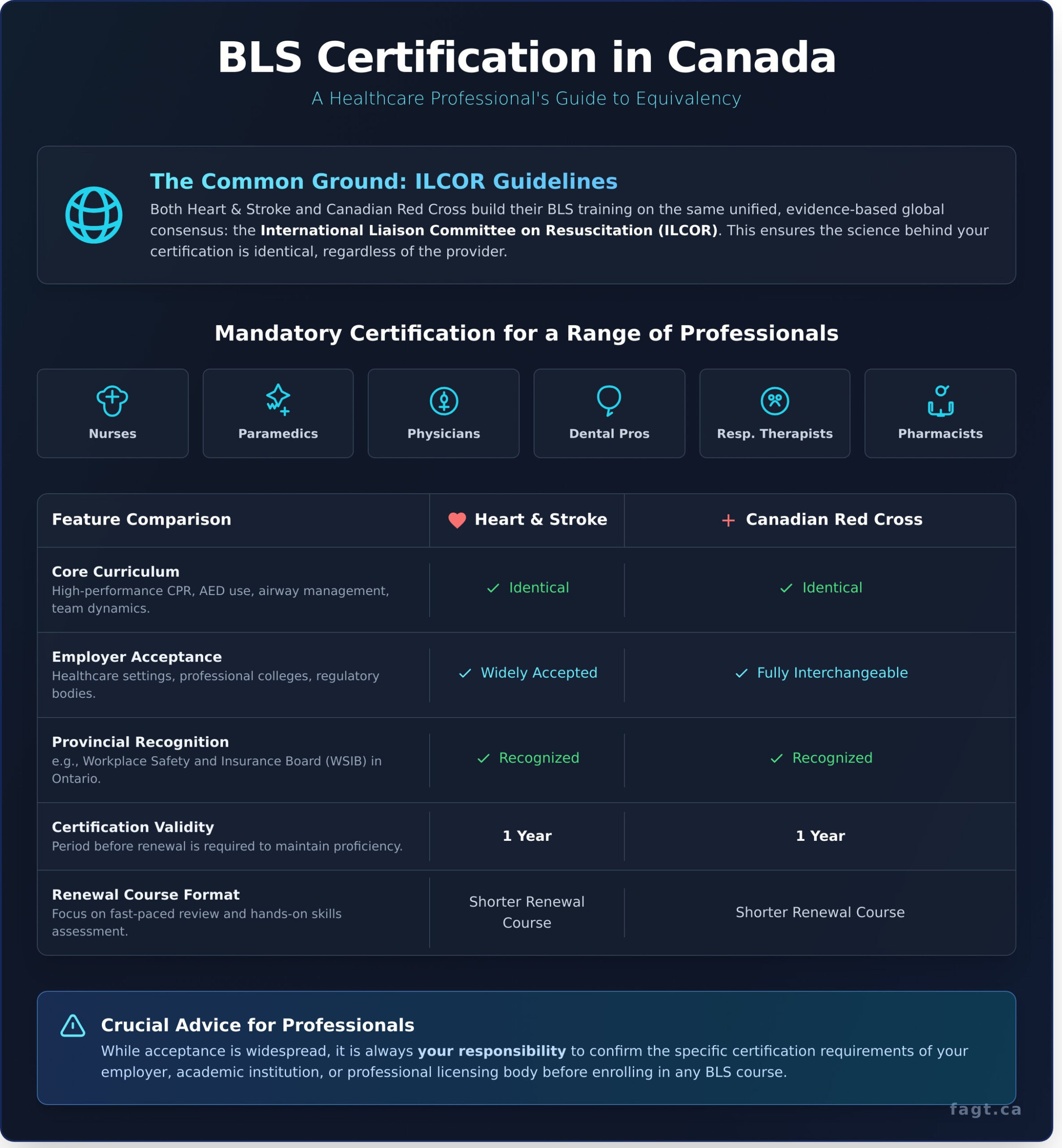
The foundation of modern resuscitation science is the International Liaison Committee on Resuscitation (ILCOR). This global body brings together the world’s leading resuscitation councils to continuously review scientific evidence and create consensus treatment recommendations. Both the heart and stroke foundation and the Canadian Red Cross build their BLS curricula directly upon these ILCOR guidelines. This ensures that the core skills-from chest compressions to AED use-are standardized and based on the latest, most effective science, such as the principles found within the 2025 AHA Guidelines for BLS. Ultimately, the logo on your card is different, but the science behind your training is the same.
Employer and Regulatory Acceptance
For the vast majority of healthcare settings, professional colleges, and regulatory bodies across Canada, a Canadian Red Cross BLS certificate is fully accepted and interchangeable with a Heart and Stroke BLS certificate. Organizations understand that the core competencies are identical due to the shared ILCOR foundation. In provinces like Ontario, both certifications are recognized by the Workplace Safety and Insurance Board (WSIB) for meeting workplace requirements.
Crucial Advice: While acceptance is widespread, it is always the professional’s responsibility to confirm the specific certification requirements of their employer, academic institution, or professional licensing body before enrolling in a course.
Heart and Stroke BLS vs. Canadian Red Cross BLS: A Detailed Comparison
When selecting a Basic Life Support (BLS) provider in Canada, healthcare professionals typically choose between two nationally recognized organizations: the Heart and Stroke Foundation and the Canadian Red Cross. While both certifications are widely accepted and respected, understanding their subtle differences in delivery and format can help you select the program that best fits your professional needs and schedule.
Curriculum and Skills
The most critical point of comparison is the curriculum itself. Both the heart and stroke BLS and the Canadian Red Cross BLS programs are built upon the same international guidelines from the International Liaison Committee on Resuscitation (ILCOR). This ensures that the core competencies you acquire are standardized and evidence-based. Participants in either course will master:
- High-performance CPR for adults, children, and infants.
- Proper use of an Automated External Defibrillator (AED).
- Effective ventilation with bag-valve-masks (BVMs).
- Rapid response for choking emergencies.
- Team dynamics and communication during resuscitation events.
The fundamental goal of both programs is to equip providers with the confidence and skills to perform effective resuscitation. The physiological principles behind these actions are universal, as detailed in comprehensive medical resources like this CPR Overview from NIH, which forms the scientific backbone of all modern BLS training.
Course Format and Flexibility
A key differentiator often lies in the delivery format. While traditional in-class courses are available, many professionals prefer the modern blended learning model. This format allows you to complete the theoretical portion online at your own pace, significantly reducing in-class time to focus purely on hands-on skills practice and evaluation. The Canadian Red Cross, through its extensive network of Training Partners, excels in offering this flexibility, making it easier for busy professionals to fit recertification into demanding schedules. See our flexible BLS course schedules in Mississauga and Hamilton.
| Feature | Heart and Stroke Foundation | Canadian Red Cross |
|---|---|---|
| Core Curriculum | ILCOR-compliant; high-performance CPR, AED, BVMs. | ILCOR-compliant; high-performance CPR, AED, BVMs. |
| Certification Validity | 1 year (annual renewal required). | 1 year (annual renewal required). |
| Renewal Pathway | Focused recertification course available. | Focused recertification course available. |
| Training Format | In-class and blended learning options. | In-class and blended learning with extensive local partner network. |
Ultimately, the certification you receive from either organization is considered the gold standard across Canada. Your choice may simply come down to the convenience of the training format and the availability of courses in your area.
How to Renew Your Credentials with a Red Cross BLS Course
When your Heart and Stroke Foundation BLS certificate is approaching its expiry date, you don’t need to find an identical recertification course. Instead, you can obtain a new, equivalent certification from the Canadian Red Cross. This is a common and highly effective way for healthcare professionals and first responders to ensure their life-saving skills remain current and their credentials meet national standards. The process is straightforward and designed for efficiency.
Step 1: Find a Certified Red Cross Training Partner
The Canadian Red Cross authorizes a network of certified Training Partners to deliver its programs. Organizations like Aspire First Aid are local experts that provide the necessary equipment and professional instruction. Choosing a local training centre ensures you get crucial hands-on practice with high-quality manikins and AED trainers. For workplace requirements, especially in provinces like Ontario, it is essential to confirm that your chosen provider is WSIB-approved, guaranteeing the training meets occupational health and safety regulations.
Step 2: Choose Your Course Format (Blended vs. In-Class)
Red Cross offers flexible training formats to accommodate different schedules and learning preferences. Registration for either format is typically a simple online process.
- Blended Learning: This is the most popular option for renewal. It combines an online self-paced module covering theory with a shorter, in-person session focused entirely on practical skills. This format minimizes time away from work while ensuring you master the hands-on techniques.
- Traditional In-Class: For those who prefer a fully instructor-led environment, the traditional format covers all theory and practical components in a single, comprehensive session.
Step 3: Complete the Training and Receive Your Certification
The final step is to demonstrate your competence. If you chose the blended format, you must complete the online portion before attending your in-class session. During the practical training, an experienced Red Cross instructor will guide you through realistic scenarios, evaluating your ability to perform high-performance CPR, use an AED, and manage airway obstructions. These are the core skills needed to respond to a heart and stroke emergency. Upon successful completion, the Red Cross will issue a digital BLS certificate, which is valid for one year and recognized across Canada.
By following this structured process, you can seamlessly maintain your certification and confidence. For help finding a certified training provider in your area, resources like fagt.ca can provide valuable guidance.
Secure Your BLS Certification with Confidence for 2026
Navigating your BLS renewal for 2026 is a straightforward process when you have the right information. This guide has shown that maintaining your certification is not just a requirement but a commitment to professional excellence. We’ve established that the Canadian Red Cross BLS program stands as a fully equivalent and WSIB-recognized alternative to the traditional heart and stroke renewal path. The choice ultimately comes down to the training that best fits your schedule and learning preferences, with both options equipping you with the critical skills needed to save a life.
Are you ready to renew your credentials with a trusted and recognized provider? As an Official Canadian Red Cross Training Partner, we offer comprehensive, WSIB-Approved BLS courses designed for busy professionals like you. With convenient training centres in Mississauga and Hamilton, renewing your certification has never been easier.
Don’t let your life-saving skills lapse. Take proactive control of your professional development and ensure you are prepared for any emergency. Book Your WSIB-Approved Red Cross BLS Course Today!
Frequently Asked Questions
Is Canadian Red Cross BLS equivalent to Heart and Stroke BLS?
Yes, for the vast majority of professional requirements in Canada, the Canadian Red Cross Basic Life Support (BLS) certification is considered equivalent to the one offered by the Heart and Stroke Foundation. Both organizations base their curriculum on the latest International Liaison Committee on Resuscitation (ILCOR) guidelines, ensuring they meet the same high standard of scientific evidence and educational quality required for healthcare professionals. They are the two primary, nationally recognized providers of BLS training.
Will my hospital or professional college accept a Red Cross BLS certificate?
Most Canadian hospitals, professional colleges, and healthcare institutions accept Canadian Red Cross BLS certification. However, it is always the professional’s responsibility to confirm acceptance with their specific employer or licensing body before registering for a course. Some institutions may have exclusive agreements with one provider. We strongly recommend verifying your organization’s specific requirements to ensure full compliance and avoid any issues with your certification renewal process.
How long is a Canadian Red Cross BLS certification valid for?
A Canadian Red Cross Basic Life Support (BLS) certification is valid for one year from the date of issue. This annual renewal cycle is the standard for most healthcare professionals across Canada, ensuring that their life-saving skills remain current and aligned with the latest resuscitation science and protocols. You must complete a renewal course before your current certificate’s expiry date to maintain your active status without interruption.
Can I take a shorter ‘renewal’ course if my Heart and Stroke certification is still valid?
Yes, you are eligible to take the shorter Canadian Red Cross BLS renewal course if you hold a current, non-expired certificate from the Heart and Stroke Foundation. The prerequisite for any renewal course is proof of a valid certification from a recognized national provider. This allows for a seamless transition between providers without needing to take the full course again, provided your credentials are up to date at the time of your class.
What is the main difference between a Heart and Stroke BLS course and a Red Cross one?
While both courses adhere to the same ILCOR scientific guidelines, the primary difference lies in the instructional design and delivery. The Canadian Red Cross focuses on a learner-centered, scenario-based approach to build confidence and practical skills. The course materials, teaching aids, and overall classroom flow may differ, but the core competencies and life-saving techniques you learn are standardized and functionally identical, ensuring you receive a nationally recognized, high-quality certification from either provider.
Do I have to complete an online portion for the blended Red Cross BLS course?
Yes, completing the online module is a mandatory component of the blended learning format. This model splits the course into two parts: a self-paced online session covering theory and knowledge, and a shorter, in-person session focused on hands-on skills practice and evaluation with an instructor. You must successfully finish the entire online portion and present your completion certificate before you can attend and participate in the in-class skills component of the course.
