
In a medical emergency, every second is critical. Yet, for many, the thought of facing one brings more anxiety than confidence. You may know you need certification for your job, or simply want to be prepared, but the path forward is often unclear. Which course level is right? How can you fit a multi-day session into a packed schedule? And are online components legitimate? These questions can create a barrier to acquiring skills that save lives.
This is where effective and professional first aid with cpr training becomes an essential tool. This guide is designed to cut through the confusion and provide a clear, responsible roadmap to certification. We will demystify the different training levels, explain how modern blended courses provide the flexibility you need without compromising quality, and detail the process for obtaining a WSIB-approved certificate recognized by employers across Canada. Read on to gain the confidence and credentials to act decisively when it matters most.
Understanding the Core Components of First Aid & CPR Training
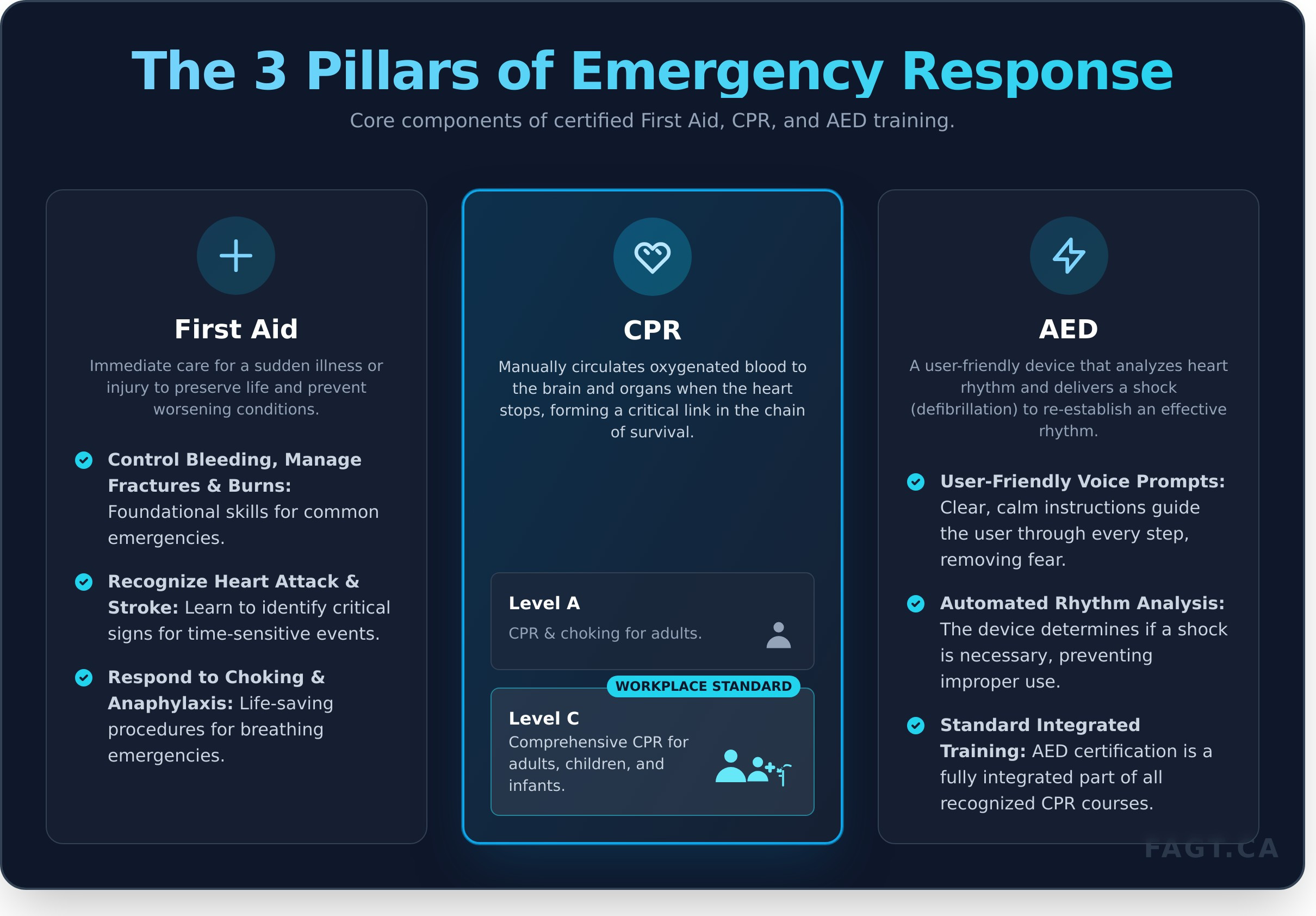
Effective emergency response is built on three life-saving pillars: First Aid, Cardiopulmonary Resuscitation (CPR), and the use of an Automated External Defibrillator (AED). Comprehensive first aid with cpr training equips you with the skills and confidence to manage everything from common household injuries to sudden, life-threatening events like cardiac arrest. It is a critical skill set accessible to everyone; no prior medical experience is necessary to become a certified first responder.
To visualize these life-saving techniques, the following video provides a clear, step-by-step demonstration of CPR:
In Canada, training programs are structured to meet diverse needs, offering different certification levels suitable for workplace safety requirements, community volunteer roles, or simply personal preparedness for your family.
First Aid: Your First Response
First aid is the immediate assistance given to any person suffering a sudden illness or injury, with care provided to preserve life and prevent the condition from worsening. Training focuses on practical skills for a wide range of situations. You will learn to:
- Control severe bleeding, manage fractures, and treat burns.
- Recognize the critical signs of a heart attack or stroke.
- Respond effectively to choking and severe allergic reactions (anaphylaxis).
- Stabilize a person suffering from shock until professional help arrives.
These skills provide a foundation for emergency response, and for those interested in the background, Wikipedia offers a comprehensive overview of first aid principles.
CPR (Cardiopulmonary Resuscitation): The Critical Link
When a person’s heart stops beating, CPR serves as a critical link in the chain of survival. By performing chest compressions and rescue breaths, you manually circulate oxygenated blood to the brain and other vital organs, significantly increasing the chance of survival. Courses typically offer two main levels:
- Level A: Focuses on CPR and choking procedures for adults.
- Level C: A more comprehensive certification covering adults, children, and infants. This is the standard required for most workplaces in Canada.
AED (Automated External Defibrillator): A Modern Lifesaver
An AED is a sophisticated yet user-friendly medical device that can analyze the heart’s rhythm and, if necessary, deliver an electrical shock (defibrillation) to help re-establish an effective rhythm. Modern AEDs provide clear voice prompts to guide the user. Proper first aid with cpr training removes any fear associated with using an AED, building the confidence to act decisively. Today, AED certification is a standard, fully integrated component of all recognized CPR courses across Canada.
The Blended Learning Advantage: Online Theory + In-Class Skills
In today’s fast-paced world, finding time for professional development can be a significant challenge. The blended learning model offers a modern, intelligent solution for certification, combining the convenience of self-paced online learning with the essential, hands-on practice of an in-person class. This hybrid approach is designed to respect your schedule, allowing you to gain life-saving skills without disrupting your work or family commitments. It is the most efficient and effective pathway to completing your first aid with cpr training.
How the Online Component Works
The first phase of your training takes place entirely online. Through our engaging and comprehensive digital platform, you will access a series of modules containing videos, instructional text, and interactive quizzes designed to build a strong theoretical foundation. You will learn the critical principles behind emergency response, from recognizing the signs of a stroke to understanding the mechanics of an AED. By studying resources like the Mayo Clinic’s detailed step-by-step guide to performing CPR, you master the ‘why’ before you ever practice the ‘how’. You can complete this portion from the comfort of your home, whenever it suits your schedule, ensuring you arrive at the in-class session prepared, confident, and ready to apply your knowledge.
Benefits of the Blended Format
This two-part structure offers significant advantages over traditional, fully in-person courses. By completing the theoretical part of your first aid with cpr training online, you gain control over your learning journey and benefit from a more focused, practical classroom experience.
- Flexibility: Fit the online theory modules around your existing work, school, or family life. Learn at your own pace without the pressure of a fixed, multi-day classroom schedule.
- Efficiency: The in-class portion is shorter and dedicated entirely to hands-on skills practice and evaluation with a certified instructor. This reduces your total time away from home or work.
- Effectiveness: Absorbing theoretical knowledge first leads to better skill retention. You can review complex topics online as needed, ensuring you fully understand them before the practical session.
Ready to experience a smarter way to get certified? See our flexible blended course schedules in Mississauga & Hamilton.
What to Expect During Your Hands-On In-Class Training
After completing your online coursework, the in-class session is where theoretical knowledge is transformed into confident, life-saving skill. This is not a lecture; it is a dynamic, supportive, and entirely practical environment led by a certified instructor. The focus shifts completely from theory to application, ensuring you can act effectively in a real emergency. This hands-on component is the most critical part of any certified first aid with cpr training program, building the muscle memory and confidence you need to respond when it matters most.
Practicing on Manikins
You will spend the majority of your time working directly with modern, realistic CPR manikins. This includes practicing chest compressions and rescue breaths on adult, child, and infant models to understand the crucial differences in technique. Your instructor will provide immediate, personalized feedback to help you perfect your hand placement, compression depth, and rate. This coaching ensures your skills align with the latest guidelines from organizations such as the American Heart Association, the leading authority on CPR. You will also use an Automated External Defibrillator (AED) training device in a simulated cardiac arrest.
Scenario-Based Learning
Effective emergency response involves more than just individual skills. In this part of the training, you will work with your classmates to navigate realistic emergency scenarios. These exercises teach you how to first assess a scene for safety, a critical step before providing aid. You will practice integrating your skills to manage situations that may involve severe bleeding, choking, or other common medical emergencies, providing a comprehensive understanding of your role as a first responder.
Your Instructor and Classmates
Our certified instructors are experienced professionals dedicated to creating a non-judgmental and encouraging learning space. They are there to guide you, demonstrate techniques, and answer every question you have. The small group setting allows for personalized attention and collaboration with your peers, as everyone is there to learn and build confidence together. We strongly encourage you to ask questions and practice each skill until you feel completely comfortable and prepared to use your first aid with cpr training in the real world.
Choosing a WSIB-Approved & Red Cross Certified Course
When you invest time in learning life-saving skills, ensuring the quality and validity of your certification is paramount. In the world of emergency response, not all courses are created equal. A generic online video may teach you the basics, but it will not provide the recognized credentials required for most workplaces. Official certification is the only way to prove you have met rigorous training standards. For anyone seeking professional first aid with cpr training in Ontario, this means selecting a program approved by both the WSIB and a national authority like the Canadian Red Cross.
Why WSIB Regulation 1101 Matters
The Workplace Safety and Insurance Board (WSIB) is the governing body for workplace health and safety in Ontario. Its Regulation 1101 is not just a guideline; it is a legal requirement that dictates the specific first aid provisions workplaces must have, including the number of certified staff and the type of training they need. If your employer requires you to be certified, they need proof that your certificate comes from a WSIB-approved provider. This ensures the training curriculum, instructor qualifications, and course duration meet the province’s stringent safety standards.
The Value of a Red Cross Partnership
While WSIB approval ensures provincial compliance, a Canadian Red Cross certification provides a national seal of quality and trust. As Canada’s leading first aid training body, the Red Cross sets the benchmark for curriculum development and instructional excellence. Choosing a training provider that is an official Red Cross partner guarantees several critical benefits:
- Evidence-Based Protocols: Your training is built on the latest scientific evidence and follows international consensus on resuscitation (ILCOR) guidelines, ensuring you learn the most effective techniques.
- Canada-Wide Recognition: Your certificate is not just valid in Ontario; it is respected and transferable to workplaces and organizations across the country, offering you greater professional mobility.
- Superior Instructor Standards: Red Cross instructors are required to complete a comprehensive development program and are regularly recertified, guaranteeing a high-calibre and engaging learning experience.
This dual validation-WSIB approval for legal compliance and Red Cross certification for quality assurance-is the hallmark of a premier training program. Verify our Red Cross partnership and book your WSIB-approved course.
Your Certification: Validity, Renewal, and Next Steps
Successfully completing your blended learning course culminates in an official Canadian Red Cross certificate. This is more than a document; it is a formal validation of your competence and readiness to act decisively in an emergency. It serves as recognized proof of your life-saving skills for employers, volunteer organizations, and regulatory bodies across Canada. Consider this achievement not as an endpoint, but as the foundational step in your ongoing commitment to safety and preparedness.
Certification Validity and Digital Access
Your Canadian Red Cross certificate is valid for three years from the date of issue. Upon successful completion of your course, you will receive a secure digital certificate via email. This format provides immediate, convenient access for verification. We recommend saving a copy to your smartphone and providing one to your employer, ensuring your credentials are always readily available when needed.
The Recertification Process
Maintaining your certification is a streamlined and efficient process designed for busy professionals. You are not required to retake the full course to renew your credentials. Instead, you can enroll in a shorter recertification course that focuses on refreshing your practical skills and updating you on any changes to protocols. This responsible approach ensures your knowledge remains current and your confidence high without a significant time commitment.
Advancing Your Skills
Your initial certification opens the door to a range of advanced and specialized training opportunities. As your responsibilities or interests evolve, you can build upon your foundational knowledge. Continuing your education is the best way to stay confident and ready to manage a variety of situations. Consider these next steps:
- Basic Life Support (BLS): Formerly known as CPR-HCP, this advanced level of CPR training is the standard for healthcare and emergency service professionals.
- Wilderness & Remote First Aid: Essential for those who work or spend time in remote environments where medical help is more than 24 hours away.
- Marine First Aid: Specialized training that meets Transport Canada requirements for those working in the marine industry.
By continuously investing in your skills, you reinforce your role as a capable and responsible individual. To explore specialized first aid with cpr training options tailored for outdoor professionals, visit fagt.ca for relevant courses and resources.
Empower Yourself: Get Certified in First Aid and CPR
Embarking on your journey to certification is a decisive step towards becoming a vital resource in an emergency. We’ve seen that modern training effectively combines online theory with essential in-person practice, making the process more accessible than ever. The key to a valuable credential lies in selecting a program that is officially recognized, ensuring your skills meet the highest standards for both personal confidence and workplace requirements in Ontario. Completing your first aid with cpr training is an investment in your ability to act decisively when it matters most.
Are you ready to gain the competence and confidence to save a life? As an Official Canadian Red Cross Training Partner, we provide fully compliant WSIB-Approved Courses for Ontario Workplaces. With convenient training centres in both Mississauga and Hamilton, becoming a certified first responder has never been easier. Find a WSIB-approved First Aid & CPR course near you and book today! Take the definitive step towards being prepared.
Frequently Asked Questions About Blended First Aid & CPR Training
Is an online-only first aid and CPR course valid in Canada?
In Canada, a valid first aid and CPR certification requires a hands-on skills component evaluated by a certified instructor. Therefore, courses that are 100% online do not meet federal or provincial/territorial occupational health and safety (OH&S) standards for workplace certification. The blended learning model, which combines online theory with a mandatory in-class practical session, is the recognized and compliant format for achieving a valid certificate. Always verify that a course includes this essential in-person component.
How long does a first aid with CPR certificate last?
Most nationally recognized first aid and CPR certificates in Canada, including Standard and Emergency First Aid, are valid for three years from the date of issue. However, some specialized certifications, such as Basic Life Support (BLS) for healthcare professionals, may require annual recertification. It is the certificate holder’s responsibility to track their expiration date and enroll in a recertification course before it lapses to maintain their credentials and ensure their skills remain current.
What is the difference between Standard First Aid and Emergency First Aid?
The primary difference is the duration and scope of training. Emergency First Aid is typically an 8-hour course focused on immediate life-threatening situations like choking, CPR, and severe bleeding. Standard First Aid is a more comprehensive 16-hour course that includes all Emergency First Aid topics plus additional skills for treating secondary injuries, such as bone and joint injuries, head and spine injuries, and environmental emergencies. Your workplace requirements will often dictate which certification level you need.
Do I have to pass a written test to get certified?
Yes, successful certification requires passing both a practical skills assessment and a written knowledge test. The written portion is typically a multiple-choice exam designed to evaluate your understanding of the theoretical concepts covered in the online module. A passing grade, commonly 75% or higher, is required. This comprehensive evaluation ensures that all certified individuals possess both the practical ability and the foundational knowledge to respond effectively in an emergency situation, making the first aid with cpr training truly effective.
What should I wear and bring to my in-class training session?
For the practical in-class session, please wear comfortable, non-restrictive clothing and closed-toe shoes, as you will be kneeling, bending, and performing skills on the floor. You should bring a copy of your online theory completion certificate (digital or printed), a piece of government-issued photo identification for verification, and a notebook and pen for taking notes. A water bottle is also recommended to stay hydrated throughout the hands-on training portion of your course.
How old do you have to be to take a first aid and CPR course?
There is no mandated minimum age for first aid with cpr training in Canada. However, participants must have the physical ability to perform required skills, such as chest compressions on a manikin, and the maturity to comprehend the course material. For these reasons, a minimum age of 12 or 13 is often recommended by training providers to ensure the participant can fully engage with and benefit from the program and its practical requirements.
