
Standard First Aid, Emergency First Aid, BLS… If the world of certification feels like a confusing mix of acronyms and requirements, you are not alone. Choosing the right first aid training can be a daunting task, especially when faced with unclear workplace regulations, concerns about the time commitment, and the natural anxiety of performing life-saving skills under pressure. The stress of ensuring your certificate is WSIB-approved for your specific role can leave you feeling uncertain before you even book a class.
This definitive guide is designed to eliminate that uncertainty. We will demystify the terminology and provide a clear, structured breakdown of the different levels of certification available across Canada. Our goal is to empower you to confidently select the exact course you need-whether for professional compliance, personal preparedness, or to advance your career. By the end of this article, you will feel prepared for your training day and equipped to find a reputable provider, turning confusion into life-saving competence.
Decoding the Core Components of First Aid Training
Before you can select the right certification, it’s essential to understand the foundational skills that form the backbone of any quality first aid training program. These core competencies are designed to empower you with the confidence and knowledge to act decisively in an emergency, building a solid base for any advanced skills you may learn later.
To visualize these fundamental actions, this overview provides a clear demonstration:
What is First Aid? More Than Just Band-Aids
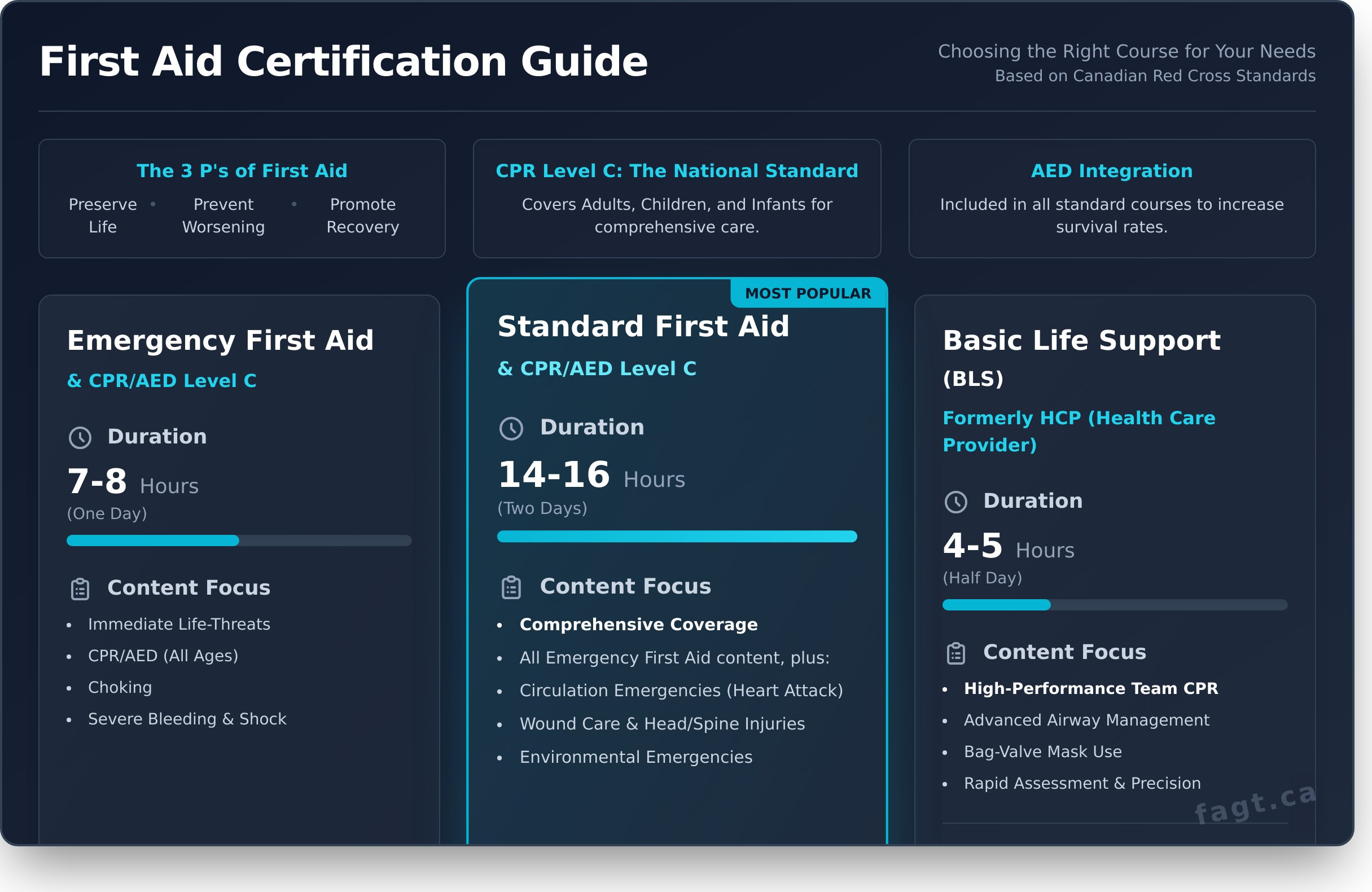
First aid is the immediate assistance given to any person suffering from either a minor or serious illness or injury. The primary goal is to provide care to preserve life until professional medical help arrives. The core components of first aid are guided by three key principles, often called the “3 Ps”:
- Preserve life: The top priority is to prevent the victim’s condition from worsening by addressing life-threatening issues first, such as clearing an airway or stopping severe bleeding.
- Prevent worsening: This involves making the victim comfortable, preventing further injury through scene management, and providing initial care for their condition.
- Promote recovery: Actions include arranging for medical help and providing initial care for conditions like burns, fractures, or choking to aid the healing process.
CPR (Cardiopulmonary Resuscitation): Understanding the Levels
CPR is a critical life-saving technique used when someone’s breathing or heartbeat has stopped. In Canada, CPR training is typically offered in different levels. While Level A focuses solely on adults, the national standard for workplace safety and the most comprehensive option for the general public is CPR Level C. This certification equips you to perform resuscitation techniques on adults, children, and infants, ensuring you are prepared for emergencies involving any age group.
AED (Automated External Defibrillator): A Crucial Link in Survival
An AED is a portable electronic device that automatically diagnoses life-threatening cardiac arrhythmias and is able to treat them through defibrillation-an electrical shock that can restore a normal heart rhythm. Today, AED certification is integrated into all standard CPR courses. Using an AED quickly during sudden cardiac arrest can dramatically increase survival rates. Despite their advanced technology, these devices are designed for simplicity, providing clear voice prompts to guide the user through every step, making them safe and effective for anyone to operate.
Which First Aid Course is Right For You? A Detailed Comparison
Navigating the world of certifications can be confusing, but selecting the correct course is a critical step in ensuring you are both compliant and competent. The right first aid training aligns with your specific personal or professional responsibilities, from workplace safety regulations to advanced medical care. Choosing the right program is a foundational component of comprehensive emergency preparedness training, ensuring you have the precise skills needed when it matters most. This guide compares the most common Canadian Red Cross certifications to help you make an informed and responsible decision.
Standard First Aid & CPR/AED Level C
This is the most comprehensive and widely recognized certification for the general public and most workplaces in Canada. It provides an in-depth understanding of how to respond to a wide range of medical and traumatic emergencies.
- Duration: 14-16 hours (typically over two days).
- Content Focus: Covers all major topics, including CPR/AED for adults, children, and infants; choking; circulation emergencies like heart attack and stroke; wound care; head and spine injuries; and environmental emergencies.
- Who Needs It: This course is the standard for most professions and is required by the Workplace Safety and Insurance Board (WSIB) in Ontario for any workplace with six or more employees on any given shift.
Emergency First Aid & CPR/AED Level C
As a condensed, one-day alternative, this course focuses on the most critical life-threatening situations. It is an excellent starting point for individuals seeking essential skills for personal use or for those in smaller work environments.
- Duration: 7-8 hours (one day).
- Content Focus: Prioritizes immediate threats such as CPR/AED, choking, severe bleeding, and shock. Its scope is significantly narrower than the Standard First Aid course.
- Who Needs It: Ideal for individuals seeking personal preparedness or for workplaces in Ontario with five or fewer employees per shift, as per WSIB regulations.
Basic Life Support (BLS)
Formerly known as HCP (Health Care Provider), BLS is an advanced level of CPR training designed specifically for those in the medical field. This first aid training course goes beyond basic skills to emphasize high-performance teamwork and precision.
- Duration: 4-5 hours.
- Content Focus: High-performance, team-based resuscitation, advanced airway management (e.g., bag-valve masks), and rapid assessment. The CPR techniques are more rigorous and technical than in standard courses.
- Who Needs It: This is a mandatory certification for in-facility and pre-hospital healthcare professionals, including nurses, paramedics, dental hygienists, and physicians.
Choosing Your Training Format: Blended Learning vs. In-Class
Gone are the days of being locked into a rigid classroom schedule. Modern first aid training offers flexible formats designed to fit your busy life without compromising on quality. The two primary, recognized models are the traditional in-class course and the modern blended learning approach. Understanding the differences is key to choosing a program that respects your time while delivering the essential, life-saving skills you need for a valid certificate.
The Traditional In-Class Experience
This is the classic method where all learning-from theory to hands-on practice-happens entirely within a physical classroom. Typically scheduled over one or two full days, this format is straightforward and comprehensive.
- Benefit: It provides an immersive, distraction-free environment with direct, real-time access to your instructor for immediate feedback and group discussion.
- Benefit: You complete the entire course in one go, with no pre-course work required.
- Drawback: The main challenge is the fixed time commitment, which can be difficult to schedule around work and personal obligations.
Blended Learning: The Flexible, Modern Approach
Blended learning has become the most popular and convenient option for most participants. It splits the course into two manageable parts:
- Online Theory: You complete the knowledge portion through an engaging online module at your own pace and on your own schedule.
- In-Class Skills Session: You then attend a shorter, in-person session focused entirely on practicing and demonstrating hands-on skills with an instructor.
This format significantly reduces your required in-class time-often by half-while still providing the mandatory practical experience. Blended learning is fully approved by WSIB and other provincial bodies, offering the exact same valid certificate upon successful completion.
The Truth About 100% Online First Aid Courses
A critical warning: Courses advertised as “100% online first aid certification” are not recognized for workplace safety requirements in Canada. While they can be a useful tool for gaining knowledge, they do not lead to a valid certificate.
The reason is simple: you cannot learn to save a life by only watching a video. Performing effective chest compressions, using an AED, or properly bandaging a wound are physical skills that must be practiced and assessed in person by a certified instructor. This hands-on requirement is a standard across North America, reflected in guidelines for programs like the National Safety Council first aid courses and mandated by provincial workplace safety boards. These practical evaluations are a non-negotiable part of any legitimate first aid training.
For a certificate that meets workplace standards, you must choose an in-class or blended format. Find a WSIB-approved blended course that fits your schedule and provides the certification you need.
What to Expect During Your Course (And How to Prepare)
Stepping into a first aid course for the first time can feel intimidating, but understanding the structure of the day can ease any anxiety. A professional training program is designed to be an engaging, supportive learning environment. The primary goal is to build your confidence and competence, blending essential theory with extensive hands-on practice. At its core, effective first aid training is about preparing you to act decisively and correctly in an emergency.
Hands-On Practice and Realistic Scenarios
The majority of your day will be spent on your feet, not in a lecture. You will work directly with professional equipment, including CPR manikins to perfect chest compressions and rescue breaths, and training AEDs (Automated External Defibrillators) to learn the proper sequence for use. Instructors will guide you through practical skills like applying bandages and managing bleeding. These skills are then integrated into simulated emergencies, allowing you to apply your knowledge in a controlled, realistic context to build muscle memory and confidence.
The Evaluation: What a ‘Test’ Involves
The term ‘test’ can be misleading. Evaluation in a first aid course is a comprehensive process designed to confirm your understanding and ability. It typically includes a multiple-choice written exam to assess theoretical knowledge. However, the more critical component is the continuous practical assessment. Your instructor will observe you as you perform skills throughout the day, providing feedback and guidance. Successful certification is based on 100% attendance, active participation, and demonstrating competency in all required skills. Remember, instructors are there to help you succeed, not to fail you.
Tips for a Successful Training Day
To get the most out of your first aid training experience, a little preparation goes a long way. Follow these simple guidelines to ensure you have a comfortable and productive day:
- Wear comfortable clothing: You will be kneeling, bending, and moving around. Choose practical attire like pants and a t-shirt rather than restrictive clothing.
- Arrive well-rested: The day is both mentally and physically engaging. A good night’s sleep will help you stay focused and retain information.
- Be ready to participate: Don’t be afraid to ask questions or volunteer for scenarios. Active engagement is the key to effective learning and building confidence.
- Pack the essentials: Bring a notebook and pen for notes, a water bottle to stay hydrated, and any snacks or lunch you may need, as breaks can be short.
Your Certification: Validity, Renewals, and Choosing a Provider
Completing your course is a significant achievement, but managing your certification is an ongoing responsibility. Understanding its lifecycle ensures your skills remain current and your credential remains valid, safeguarding the value of your investment in your first aid training. This final step is crucial for ensuring your efforts translate into a recognized and respected qualification.
Certificate Validity and Expiration
Most Canadian Red Cross certificates, such as Standard and Emergency First Aid with CPR/AED, are valid for three years from the date of issue. Your certificate will clearly display both an issue date and an expiration date for your records. It is important to note that some employers, professional associations, or regulatory bodies may require more frequent renewal. Furthermore, specialized certifications like Basic Life Support (BLS) typically have a shorter validity period of only one year.
The Recertification Process
To maintain your credential without interruption, you can complete a recertification course before your current certificate expires. These courses are designed as shorter, challenge-style classes that focus on reviewing skills and updating you on protocol changes. To be eligible, you must present a valid, non-expired certificate from a recognized provider like the Canadian Red Cross. If your certification has lapsed, you are no longer eligible for this expedited process and must retake the full course.
How to Choose a Reputable Training Partner
The quality of your instruction directly impacts your competence and the legitimacy of your certificate. To ensure your time and money are well-spent, verify that your chosen provider meets essential criteria. A reputable partner is more than just a place to get a card; they are a key part of your safety education. Look for the following qualifications:
- Official Authorization: They must be an authorized Canadian Red Cross Training Partner, ensuring the curriculum meets national standards.
- Workplace Compliance: For Ontario workplaces, confirm their courses are WSIB-approved to meet Regulation 1101 requirements.
- Instructor Quality: Seek out providers with experienced, professional instructors. Positive online reviews and testimonials are often a strong indicator of quality.
Choosing a certified and respected provider guarantees that your credential will be recognized and that you have received the highest standard of instruction. See our Red Cross & WSIB-approved courses to find a program that meets your needs.
Take the Decisive Step: Get Your First Aid Certification
Navigating the world of first aid certification requires a clear understanding of your specific needs. As we’ve explored, selecting the appropriate course level, choosing between blended and in-person learning formats, and verifying a provider’s credentials are the foundational steps to ensuring you receive effective and recognized first aid training. This informed approach guarantees your certification will be both valuable and compliant for your workplace or personal goals.
When you are ready to invest in these life-saving skills, choosing a reputable provider is paramount. As an official Canadian Red Cross Training Partner, we deliver WSIB-Approved courses for Ontario workplaces, ensuring your certification meets the highest standards of quality and compliance. With our flexible blended learning options, gaining this critical knowledge has never been more accessible or convenient.
Find your WSIB-approved First Aid & CPR course in Mississauga or Hamilton today!
Take the definitive step towards becoming a confident and capable first responder in any emergency. Your training empowers you to act when it matters most.
Frequently Asked Questions About First Aid Training
How much does a typical first aid training course cost in Ontario?
The cost of a first aid training course in Ontario varies based on the provider and the level of certification. An Emergency First Aid & CPR course typically ranges from C$90 to C$130. A more comprehensive Standard First Aid & CPR course, which is the standard for most workplaces, generally costs between C$120 and C$180. Prices may differ between major urban centres and smaller communities, and blended learning formats can sometimes offer a different price point than fully in-class options.
Is first aid and CPR training difficult to pass?
First aid and CPR courses are designed to be accessible to the general public, regardless of prior medical knowledge. The curriculum focuses on building practical skills and confidence through hands-on practice and clear instruction. Instructors are trained to create a supportive learning environment. Participants who actively engage in the course material and skills practice have a very high success rate. The goal is competence, not complexity, ensuring you leave prepared to act effectively in an emergency.
What is the main difference between Standard First Aid and Emergency First Aid?
The primary distinction is the depth of content and duration. Emergency First Aid is a one-day (8-hour) course focused on immediate, life-threatening emergencies like choking, severe bleeding, and cardiac arrest. Standard First Aid is a more comprehensive two-day (16-hour) course. It includes all content from the Emergency level, plus additional modules covering topics such as head and spine injuries, bone and joint fractures, sudden medical emergencies, and environmental illnesses like hypothermia.
Can I take a first aid course if I have physical limitations?
Yes, accommodations can be made. Reputable training providers are committed to inclusive learning and will adapt course components to meet individual needs where possible. It is essential to contact the training organization before you register to discuss your specific physical limitations. This allows the instructor to plan for necessary modifications to practical skills, such as performing chest compressions or rescue breathing, ensuring you can still meet the certification requirements safely and effectively.
How do I renew my first aid and CPR certification before it expires?
To renew your certification, you must enroll in a recertification course while your current certificate is still valid. Most Standard First Aid & CPR certificates are valid for three years. A recertification course is typically shorter-usually one day instead of two-and serves as a refresher on key skills and any updated protocols. Attempting to recertify with an expired certificate is not permitted; in that case, you would be required to complete the full course again.
What is the difference between CPR Level C and Basic Life Support (BLS)?
The key difference is the intended audience and scope. CPR Level C is designed for lay rescuers and covers rescue techniques for adults, children, and infants. Basic Life Support (BLS) is the standard for healthcare professionals, such as nurses, paramedics, and dental staff. BLS training is more advanced, including two-rescuer CPR, the use of a bag-valve-mask (BVM), and integration with a professional emergency response team. It emphasizes high-performance team dynamics in a clinical setting.
Why is a blended learning course valid when a fully online course is not?
Workplace safety regulations in Canada, including those overseen by Ontario’s WSIB, mandate that first aid certification must include a hands-on, practical skills component. A fully online course cannot provide this essential element. Blended learning is a valid format because it combines online theory with a mandatory in-person session. During this session, an instructor assesses and validates your ability to perform critical skills like CPR and bandaging, ensuring you are competent to provide effective aid.
