
Navigating the requirements for emergency training can be a significant challenge. You may be asking: which certification level does my job require? Is CPR-A sufficient, or do I need CPR-C or even BLS? The uncertainty surrounding course validity and scheduling commitments only adds to the complexity. Making the wrong choice can lead to wasted time and a certificate that isn’t recognized by your employer or a professional body. This is a critical decision, as being properly trained is a fundamental responsibility in ensuring workplace safety and personal preparedness.
This definitive guide is designed to provide clarity and empower you to select the correct first aid and cpr course for your specific needs. We will systematically break down the different levels of training, explain how to verify WSIB-approved providers, and compare the benefits of in-person versus blended learning formats. By the end of this article, you will have the expert knowledge required to confidently choose a program that delivers not only a valid, recognized certification but also the essential skills to act effectively in an emergency.
Understanding the ‘Why’: Who Needs a First Aid and CPR Course?
The fundamental goal of a first aid and cpr course is to empower individuals with the skills and confidence to respond effectively during a medical emergency. It’s about transforming a bystander into a capable first responder. Understanding What is First Aid? is the initial step toward recognizing its critical role in saving lives and preventing further harm. The motivation for seeking this certification typically falls into two distinct categories: professional requirements and personal preparedness.
To visualize some of the life-saving techniques you’ll learn, watch this helpful overview:
Workplace Safety (WSIB) Requirements
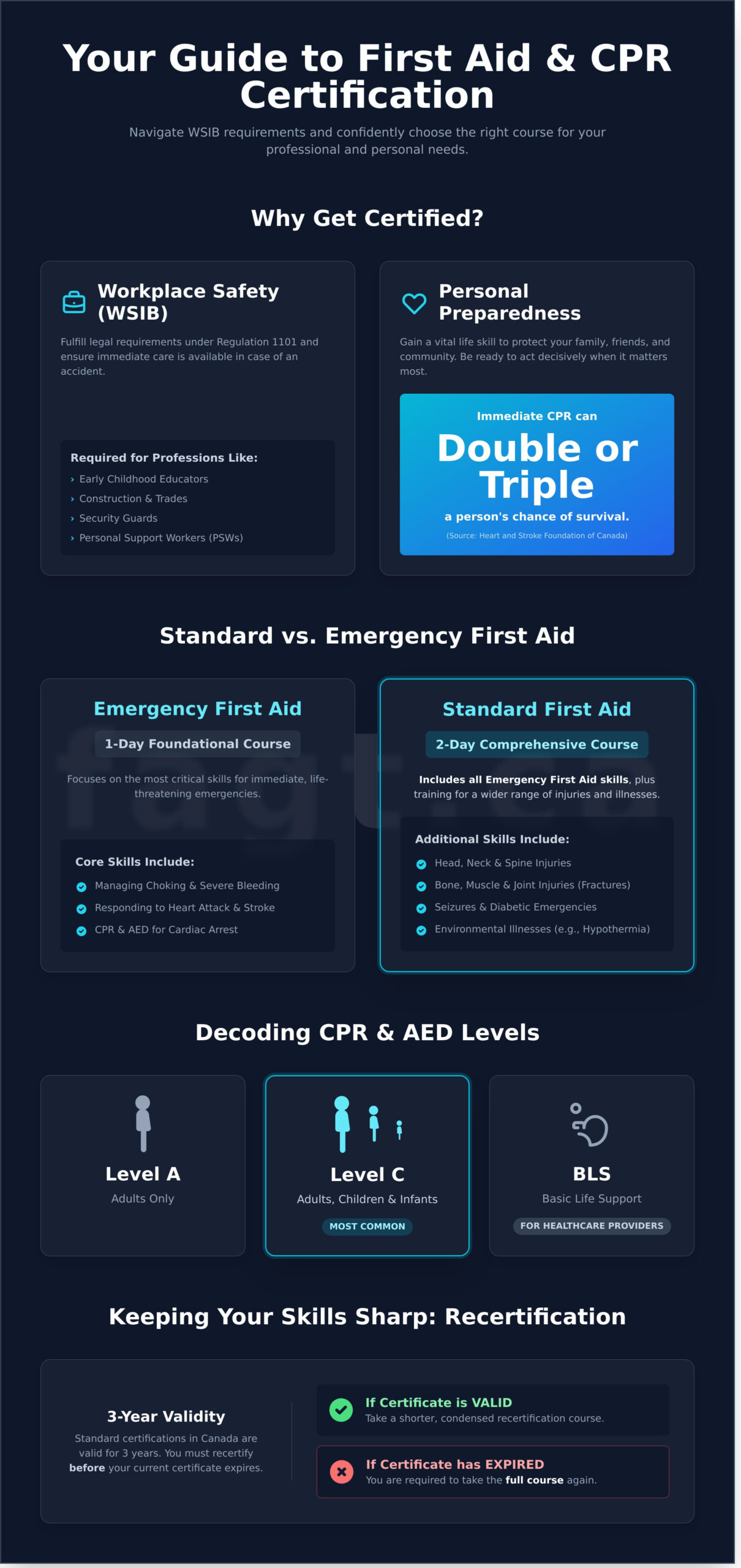
In Ontario, the Workplace Safety and Insurance Board (WSIB) mandates that most workplaces have employees with certified first aid training. This is a legal requirement under Regulation 1101, designed to ensure immediate care is available in case of an accident. The specific course required often depends on the number of employees working per shift. For compliance, it is essential to choose a WSIB-recognized training partner. Many professions require this certification, including:
- Early Childhood Educators and daycare staff
- Construction workers and tradespeople
- Security guards and loss prevention officers
- Personal Support Workers (PSWs)
Personal Preparedness and Community Safety
Beyond any professional obligation, emergencies are an unfortunate reality of everyday life. A sudden cardiac arrest, a choking incident at a family dinner, or an injury at a community park can happen without warning. This is where training transcends the workplace and becomes a vital life skill for everyone. According to the Heart and Stroke Foundation of Canada, when CPR is performed immediately, it can double or even triple a person’s chance of survival. For new parents, grandparents, sports coaches, and community volunteers, being prepared provides not just skills, but the confidence to act decisively when it matters most.
Decoding the Menu: Choosing the Right Type of First Aid Course
Navigating the world of first aid training can feel like reading a restaurant menu in a foreign language. With terms like “Standard,” “Emergency,” “Level C,” and “BLS,” it’s easy to feel uncertain about which option is right for you. The key to making the correct choice lies in understanding your specific requirements, whether they are dictated by provincial workplace safety regulations (such as WSIB) or your own personal preparedness goals.
Standard First Aid vs. Emergency First Aid
Think of it this way: Emergency First Aid equips you with the most critical, life-saving skills, while Standard First Aid provides a more complete education. The right choice depends entirely on the level of risk in your environment.
- Emergency First Aid & CPR/AED: This is a foundational, one-day course focused on immediate, life-threatening scenarios. It is often the minimum requirement for smaller or lower-risk workplaces in Canada. You will learn to manage choking, severe bleeding, heart attack, stroke, and cardiac arrest.
- Standard First Aid & CPR/AED: The comprehensive choice, this two-day course (or blended online equivalent) covers everything in the Emergency course and adds crucial skills for a wider range of injuries and illnesses. Topics include head and spine injuries, bone fractures, seizures, diabetic emergencies, and environmental illnesses like hypothermia. A quality first aid and cpr course will cover a curriculum that meets or exceeds federal and provincial standards, ensuring you are prepared for diverse situations.
Understanding CPR & AED Levels: A, C, and BLS
Cardiopulmonary Resuscitation (CPR) and Automated External Defibrillator (AED) training is a core component of any certification. However, it comes in different levels tailored to specific needs.
- Level A: Teaches CPR and choking response for adults only.
- Level C: Covers skills for adults, children, and infants. This is the most common level included by default in both Standard and Emergency First Aid courses for the general public.
- BLS (Basic Life Support): This advanced level is designed specifically for Healthcare Providers (HCPs) such as nurses, paramedics, dental professionals, and first responders who require more specialized resuscitation skills.
Recertification Courses: Keeping Your Skills Sharp
First aid and CPR certifications in Canada are typically valid for three years. To maintain your credentials, you don’t need to retake the entire course. A recertification is a shorter, condensed course designed to refresh your knowledge and update you on any protocol changes. It is crucial to remember that you can only take a recertification course if your current certificate is still valid and not expired. If your certification lapses, you will be required to complete the full course again.
Not sure which course you need? Contact our experts for guidance.
Flexible Learning: Finding a Training Format That Fits Your Schedule
In today’s fast-paced world, dedicating an entire weekend to training can be a significant challenge. Recognizing this, first aid and CPR course providers now offer various delivery formats to suit different learning styles and schedules. However, while the delivery of theoretical knowledge has become more flexible, the practical, hands-on skills component remains a non-negotiable requirement for any legitimate certification. This is because skills like performing chest compressions or using an AED cannot be mastered through a screen; they require physical practice under the guidance of a certified instructor.
Traditional In-Class Training
This is the classic format where 100% of the training-both theory and practical skills-is conducted in a physical classroom. It offers a structured environment where you can interact directly with the instructor and learn alongside other participants. This group dynamic can be highly beneficial for practicing team-based scenarios.
- Pros: Immediate feedback from instructors, collaborative learning, and no self-study required.
- Cons: Requires a significant, fixed time commitment (often 1-2 full days) and may involve travel.
- Best for: Individuals who learn best in a structured, teacher-led environment and prefer to complete their training all at once.
Blended Learning: The Best of Both Worlds
Blended learning has become the most popular and efficient training model. This format splits the course into two parts: an online theoretical component that you complete at your own pace, followed by a shorter, in-person session focused exclusively on hands-on skills practice and evaluation. This approach respects your time by allowing you to cover the knowledge-based learning from the comfort of your home, significantly reducing your time in the classroom. It provides the ultimate combination of flexibility and certified, hands-on training. Explore our flexible blended learning courses in Mississauga and Hamilton.
The Truth About Online-Only Courses
It is critical for participants in Ontario to understand that 100% online first aid and CPR courses are not recognized by the Workplace Safety and Insurance Board (WSIB). While these courses may seem convenient, they fail to provide the essential hands-on training required to build muscle memory for life-saving skills. You simply cannot learn to properly perform chest compressions on a manikin or apply a tourniquet by watching a video. Be wary of any provider promising “instant certification” entirely online. The valid, modern alternative is a blended learning course that pairs online convenience with the indispensable in-person skills session.
The Provider Checklist: What to Look For in a Training Partner
Once you have identified the right type of certification for your needs, the next critical step is selecting your training partner. The quality of the instruction you receive is as vital as the certificate itself. A superior provider ensures you not only meet compliance requirements but also leave with the genuine confidence and skills to act decisively in an emergency. Use this checklist to evaluate any potential provider and make a responsible, informed choice.
Official Accreditation and Recognition
This is the most crucial checkpoint for any first aid and cpr course. In Canada, look for two key indicators of quality and compliance. First, verify that the provider is an authorized Canadian Red Cross Training Partner. This guarantees the curriculum meets national standards. Second, for workplace training in Ontario, the course must be WSIB-approved. These official designations are your assurance that the training is legitimate, comprehensive, and that your certification will be widely recognized. Aspire First Aid Guide Training Corp proudly meets both of these critical standards, ensuring your certificate is valid and respected across the province and country.
Instructor Quality and Experience
The difference between a memorable, effective course and a forgettable one is the instructor. Theoretical knowledge is a baseline, but real-world experience is what transforms lessons into life-saving skills. When evaluating a provider, look for:
- Professional Background: The best instructors are often active or former first responders, such as paramedics, firefighters, or nurses, who bring invaluable field experience to the classroom.
- Engaging Teaching Style: Check online reviews for comments about an instructor’s ability to make complex topics understandable and keep participants engaged.
- Small Class Sizes: A lower student-to-instructor ratio allows for more personalized coaching, direct feedback, and time to answer your specific questions.
Training Environment and Equipment
A professional learning environment is essential for effective skills development. The facility should be clean, organized, and easily accessible. More importantly, the equipment must be modern and well-maintained. You need sufficient hands-on time to build muscle memory for procedures like CPR. Inquire about the student-to-manikin ratio-a low ratio means less waiting and more practicing. High-quality CPR manikins with feedback technology and modern AED trainers are the standard for any top-tier training provider. Aspire First Aid Guide Training Corp is committed to this standard, offering accessible and fully-equipped training centres in both Mississauga and Hamilton.
From Registration to Certification: What to Expect
Embarking on a first aid and cpr course is a commitment to safety and preparedness. The entire process is structured to be clear, accessible, and effective, even for individuals with no prior medical experience. This section outlines the complete journey, from the moment you register to the day you receive your certification, ensuring you feel confident and ready every step of the way.
Before the Course: Registration and Preparation
The process begins with a simple online booking system. For blended courses, which combine online theory with in-class skills, you will receive access to a self-paced digital learning module upon registration. It is essential to complete this online component before your scheduled session. To prepare for the hands-on training day, we recommend you:
- Wear comfortable, non-restrictive clothing suitable for kneeling and moving.
- Bring a water bottle and a notebook for any personal notes.
- Ensure you have your completion certificate from the online module ready.
During the Course: Skills Practice and Scenarios
The in-class portion of your training is highly interactive and practical. A certified instructor will guide you through a combination of direct instruction, videos, and extensive hands-on practice. You will work with industry-standard manikins to master essential skills like high-quality CPR, using an Automated External Defibrillator (AED), and responding to choking. You will also engage in realistic emergency scenarios to build the confidence needed to act decisively. The session concludes with a knowledge evaluation, which is typically open-book and designed to reinforce key safety concepts.
After the Course: Your Certification
Upon successful completion of both the practical skills evaluation and the knowledge test, you will earn your certification. In Canada, official Canadian Red Cross certificates are issued digitally and can be accessed anytime through your secure online account. This certification is nationally recognized for occupational health and safety requirements and remains valid for three years. Completing your training is a straightforward and empowering process that equips you with verified life-saving skills.
Ready to get certified? View our upcoming course schedule now!
Take the Final Step: Become a Certified First Responder
Choosing the right training is a critical decision that empowers you to act confidently in an emergency. This guide has equipped you to assess your specific needs, select the appropriate course level, and identify a reputable provider. Remember, the goal is not just to earn a certificate, but to gain practical, life-saving skills from a trusted source.
Investing in a professional first aid and cpr course is an investment in the safety of your family, colleagues, and community. As an Authorized Canadian Red Cross Training Partner, we are committed to delivering the highest standard of instruction. Our courses are WSIB-Approved for Ontario Workplaces, and our Flexible Blended Learning Options make it easier than ever to fit this essential training into your busy schedule.
You have the knowledge to make an informed choice. Now, take action. Don’t wait for an emergency to wish you were prepared. Book your WSIB-approved First Aid & CPR course today! Be ready to make a difference when it matters most.
Frequently Asked Questions
How much does a first aid and CPR course typically cost in Ontario?
In Ontario, the cost for a Standard First Aid & CPR Level C course typically ranges from C$130 to C$160. Prices can vary based on the training provider, location, and the specific level of certification required. For example, a basic Emergency First Aid course will cost less than the more comprehensive Standard First Aid program. It is advisable to confirm the total cost, including any materials or certification fees, directly with the training organization before registering for a course.
How long is a Standard First Aid & CPR certificate valid for?
A Standard First Aid & CPR certificate is valid for three years from the date of issue. This is a nationally recognized standard set by major training bodies like the Canadian Red Cross and the Lifesaving Society. To maintain a valid certification, you must complete a recertification course before your current certificate expires. Some workplaces or regulatory bodies may require more frequent training, so it is essential to verify your specific requirements with your employer.
I’m nervous about the practical test. What if I can’t perform the skills correctly?
Instructors are trained to create a supportive learning environment. Their primary objective is to ensure you master the skills with confidence. If you struggle with a practical component, the instructor will provide constructive feedback and additional practice opportunities. The goal of a first aid and CPR course is competency, not just passing a test. Reputable training providers focus on helping every participant succeed, ensuring they are prepared to respond effectively in a real emergency.
Is there a minimum age to take a first aid and CPR course?
While there is often no strict legislative minimum age, most training agencies recommend participants be at least 12 years old. This recommendation is based on the physical strength required to perform skills like chest compressions on an adult manikin and the maturity needed to comprehend the course material. The ultimate discretion lies with the training provider and the instructor, who must ensure the participant can safely and effectively perform all required skills to earn certification.
What is the difference between CPR Level C and Basic Life Support (BLS)?
CPR Level C is designed for the general public and workplace responders. It covers CPR, choking, and AED use for adults, children, and infants. Basic Life Support (BLS) is a more advanced certification intended for healthcare professionals (e.g., nurses, paramedics, dental professionals). BLS includes all CPR-C skills but adds components like team-based resuscitation, use of a Bag-Valve-Mask (BVM), and advanced airway management. For most workplace requirements, CPR Level C is the appropriate standard.
Can my employer refuse to accept a blended learning certificate?
Employers in Canada are generally required to accept blended learning certificates, provided the training provider is recognized by the provincial Workplace Safety and Insurance Board (WSIB) or an equivalent regulatory body. These courses meet the same legislative requirements as fully in-person training. However, it is always a prudent measure to confirm your specific employer’s policy before enrolling to ensure compliance with their internal standards and to verify the provider’s accreditation.
