
As a healthcare professional or student, you know that Basic Life Support (BLS) certification is a non-negotiable requirement. Yet, the process of finding the right training can be a source of frustration. You need a course that is officially recognized for your profession, you may be unsure how BLS differs from standard CPR, and you’re trying to fit this essential training into an already demanding schedule. The search for a reputable BLS Toronto provider shouldn’t be another hurdle in your career.
This patient-centered approach extends beyond emergency care into all areas of health and wellness. For professionals interested in how new technologies are addressing quality-of-life concerns, you can find out more about SONICWAVE Therapy as an example of a modern, non-invasive treatment in men’s health.
This guide is designed to provide clarity and direction. We will outline exactly what a Red Cross Basic Life Support course entails, the critical skills you will master, and how to identify a legitimate program that meets professional and academic standards. Consider this your definitive resource for finding the best BLS courses in the Toronto area and getting certified efficiently, confidently, and with a trusted provider.
What is BLS (Basic Life Support) and Who Needs It in Toronto?
When seeking BLS certification in Toronto, it is essential to clarify that this guide pertains to medical Basic Life Support, a critical training standard for healthcare, and not the visa processing service with the same acronym. Basic Life Support (BLS) is the professional-level standard for CPR and cardiovascular emergency response. It is designed specifically for Healthcare Providers (HCPs) and first responders who have a duty to act in clinical or pre-hospital settings.
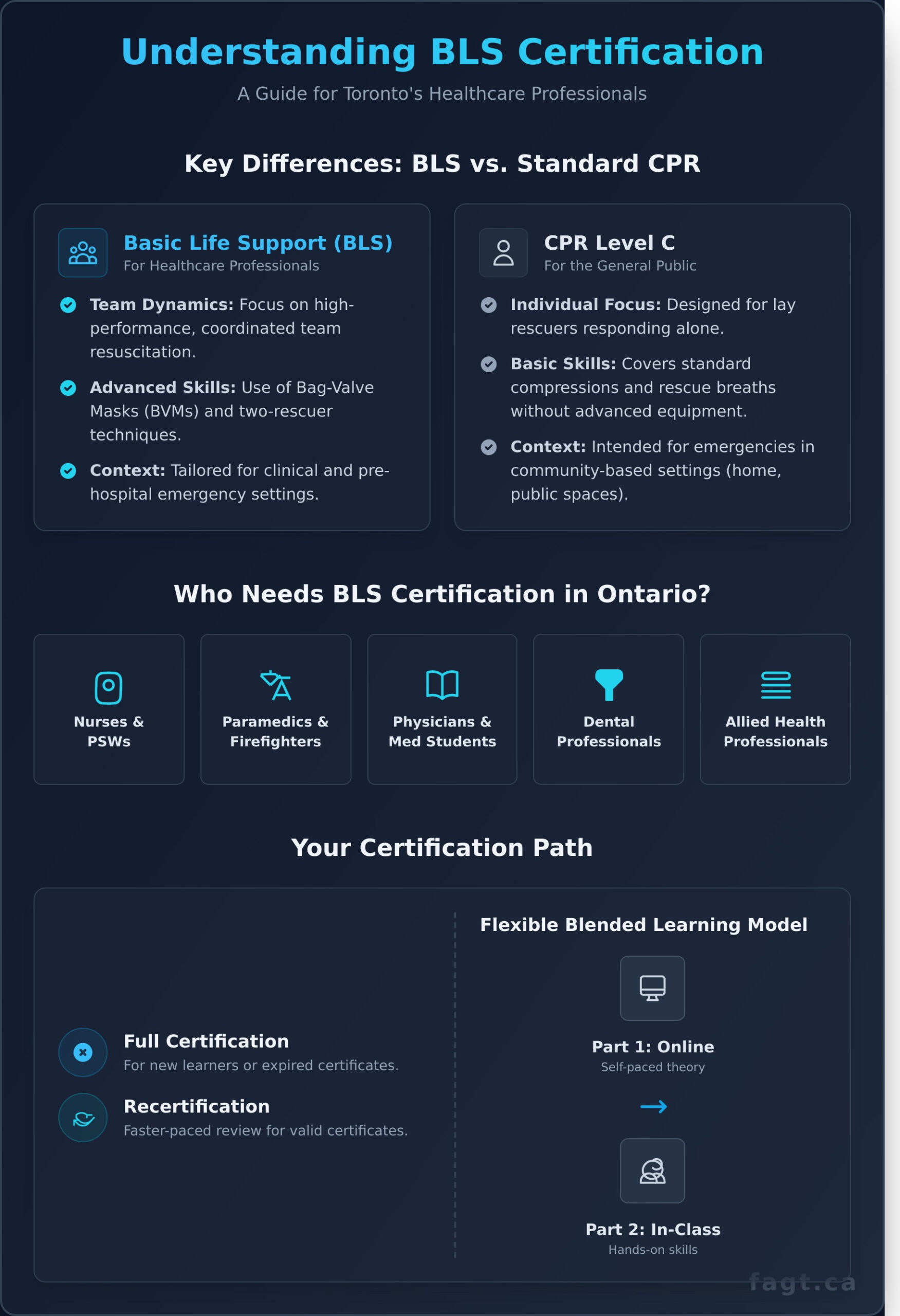
To better understand the core concepts of a professional BLS response, consider this overview:
Unlike standard first aid courses for the public, BLS focuses on developing the skills for high-performance, team-based resuscitation. The curriculum emphasizes systematic patient assessment, effective chest compressions, advanced airway management, and seamless integration within a resuscitation team to improve outcomes in cardiac arrest situations. For a foundational overview, Wikipedia provides an excellent resource on What is Basic Life Support (BLS), outlining its core principles and history. The training ensures that professionals can provide immediate, high-quality care until more advanced life support is available.
Key Differences: BLS vs. CPR Level C
While both certifications teach life-saving skills, they are intended for different responders and environments. Understanding the distinction is crucial for choosing the correct course.
- Responder Level: CPR Level C is designed for lay rescuers (the general public), while BLS is the required standard for healthcare professionals and professional responders.
- Team Dynamics: BLS places a significant emphasis on high-performance CPR within a coordinated team, focusing on communication and defined roles during a resuscitation event.
- Advanced Skills: BLS training includes the use of advanced equipment like bag-valve masks (BVMs) and techniques for two-rescuer scenarios not covered in standard CPR.
- Context: BLS scenarios are tailored to the clinical and pre-hospital settings where professionals work, whereas CPR-C focuses on community-based emergencies.
Professions Requiring BLS Certification in Ontario
In Ontario, maintaining a valid BLS certification is a mandatory prerequisite for employment and professional licensure in a wide range of healthcare and emergency service fields. If you work in one of the following roles in the Greater Toronto Area, you will need a current bls toronto certificate.
- Nurses (Registered Nurses, Registered Practical Nurses), Personal Support Workers, and nursing students.
- Paramedics, firefighters, and other professional first responders.
- Physicians, medical residents, and medical students.
- Dentists, dental hygienists, and dental assistants.
- Allied health professionals such as physiotherapists, respiratory therapists, and pharmacists.
The demand for these certified professionals is growing in all areas of healthcare, from acute hospital settings to community-based services. Patient-centered models, such as the home nursing and physiotherapy offered by providers like AVIAN Care, rely on highly skilled staff to deliver expert medical support directly in a patient’s home.
Choosing the Right BLS Course in the Toronto Area
Selecting the appropriate Basic Life Support (BLS) training is a critical decision for healthcare professionals and first responders. In a major centre like Toronto, numerous options are available, but not all certifications are created equal. The right course depends on your professional requirements, current certification status, and learning preferences. Key considerations include the certifying body, provincial workplace approval, and the course format itself.
In Canada, the two most recognized certifying bodies are the Heart & Stroke Foundation and the Canadian Red Cross. Both adhere to rigorous, evidence-based guidelines. However, for your certification to be valid for workplace requirements in Ontario, it is essential to choose a training partner approved by the Workplace Safety and Insurance Board (WSIB). This ensures your training meets provincial occupational health and safety standards, a non-negotiable factor for employers in the healthcare sector. When reviewing providers for BLS Toronto training, always confirm their WSIB-approved status.
Full Certification vs. Recertification: What’s the Difference?
It is vital to enroll in the correct course type. A full certification course is designed for first-time participants or individuals whose previous BLS certificate has expired. This comprehensive program covers all theoretical and practical components from the ground up. In contrast, a recertification course is a shorter, faster-paced session for those holding a current, valid BLS certificate. It serves as a focused review and skills assessment. Always verify your certificate’s expiry date before booking to ensure you are eligible for recertification.
Understanding the Blended Learning Model
To accommodate demanding schedules, many leading providers now offer a blended learning format for BLS certification. This modern approach divides the training into two manageable parts, providing significant flexibility without compromising on quality. The course content, which aligns with international standards such as the AHA Basic Life Support certification, requires active participation and mastery of key skills.
- Online Module: You complete the theoretical portion at your own pace through an interactive online portal before the in-class session.
- In-Class Session: This hands-on component is dedicated entirely to practical skills training, practice, and evaluation with a certified instructor.
This model is particularly beneficial for busy healthcare professionals, minimizing time away from work while ensuring you receive the essential hands-on training required for competence.
What to Expect in Your BLS Hands-On Training
The theoretical knowledge of Basic Life Support is critical, but the ability to perform life-saving skills under pressure is what truly makes a difference. Your hands-on BLS Toronto training is designed to move beyond textbooks and into practical application. This immersive session focuses on scenario-based learning in a collaborative, team-focused environment, ensuring you build not just competence, but the confidence to act decisively during a real medical emergency.
Led by a certified Red Cross instructor, the training is dynamic and interactive. Your instructor acts as a coach, providing immediate, constructive feedback to refine your technique and answer your questions. You will work with professional-grade equipment, including high-fidelity manikins, Automated External Defibrillator (AED) trainers, and Bag-Valve-Masks (BVMs), to simulate realistic resuscitation events.
Core Skills Covered in a BLS Course
The curriculum is structured to ensure you master the essential components of emergency response. You will gain proficiency in:
- High-quality CPR: You will practice the correct techniques for chest compressions and rescue breaths for adults, children, and infants. Our instructors ensure your technique for compression depth, rate, and chest recoil aligns with the most current clinical guidelines for CPR.
- Effective AED Use: Learn to quickly and correctly operate an AED, a critical step in treating sudden cardiac arrest.
- Assisted Ventilation: Master the use of a Bag-Valve-Mask (BVM) to provide effective oxygenation for a patient who is not breathing.
- Team Dynamics: Practice clear communication and defined roles within a resuscitation team, a key factor in successful outcomes.
The Certification Process
Your certification is earned through demonstrated competence. The evaluation consists of two main parts: a practical skills test where you will respond to simulated emergency scenarios, and a written knowledge test to confirm your theoretical understanding. Upon successful completion, you will receive a Red Cross Basic Life Support certificate, which is valid for one year. Your certificate is delivered digitally, providing you with immediate, verifiable proof of your life-saving credentials.
Find Your BLS Course: Convenient Options for the GTA
When healthcare professionals and students search for BLS Toronto certification, they are often looking for a course that is not only high-quality but also convenient. While downtown training centres exist, they frequently come with the significant drawbacks of traffic congestion, limited access, and expensive daily parking. Aspire First Aid provides a more practical and efficient solution with our strategically located training centres in the Greater Toronto Area.
We offer a professional training environment without the logistical challenges of a downtown location. Our goal is to make your certification or recertification process as seamless as possible, allowing you to focus entirely on mastering essential life-saving skills.
Why Train in Mississauga or Hamilton?
Choosing Aspire First Aid’s Mississauga or Hamilton locations is a strategic decision for busy professionals across the GTA. These centres are designed to eliminate common travel frustrations and provide a superior learning experience. Key benefits include:
- Avoid Downtown Hassles: Forget the stress of navigating downtown traffic and the high cost of parking. Our facilities offer ample, complimentary parking for all participants.
- Exceptional Accessibility: Our locations are easily reachable from anywhere in the region, with direct access from major highways including the QEW, Highway 401, and Highway 403. This makes us a convenient choice for residents of Toronto, Brampton, Oakville, Burlington, and beyond.
- Modern, Professional Facilities: Both centres are equipped with the latest training manikins, AEDs, and instructional technology, ensuring you receive a comprehensive and effective hands-on education from certified instructors.
Ready to experience a more convenient way to get your BLS certification? See our Mississauga BLS course schedule.
How to Register for Your BLS Course
Securing your spot in an Aspire First Aid BLS course is a straightforward and efficient process. Our online registration system is designed for your convenience, allowing you to book your training in just a few minutes. Simply follow these steps:
- Select Your Location: Choose between our modern training centres in Mississauga or Hamilton.
- Choose Your Course: Select the program that meets your needs – either the full Basic Life Support (BLS) certification for new participants or the concise BLS recertification course for renewing your credentials.
- Book Your Date: View the schedule for your chosen location and select a date and time that works for you, then complete the secure online payment.
Once you register, you will receive an instant confirmation with all the details you need for your training day. Don’t delay in securing the credentials you need for your career. Book your Hamilton BLS course today!
Your Path to Lifesaving Skills with BLS in Toronto
Earning your Basic Life Support certification is a vital investment in your professional capabilities and your community’s safety. As we’ve covered, this essential training is crucial for healthcare providers and first responders across the GTA. The key to effective learning lies in selecting a course that prioritizes comprehensive, hands-on practice, ensuring you can confidently apply your skills when faced with a real-world cardiac emergency. It’s about moving beyond theory to build true competence and readiness.
When choosing your provider for bls toronto certification, it is essential to select a trusted and officially recognized organization. We are proud to be an official Canadian Red Cross Training Partner, offering WSIB-approved courses that meet the highest industry standards. Every session is led by experienced healthcare professionals who are dedicated to providing practical, real-world instruction, so you leave feeling prepared and capable.
Are you ready to gain the skills that save lives? View upcoming BLS course dates and register online today! Taking this step is a powerful commitment to your career and to the well-being of those around you.
Frequently Asked Questions About BLS Certification
What is the main difference between BLS and Standard First Aid?
Basic Life Support (BLS) is a specialized certification designed for healthcare providers and professional first responders. It focuses intensely on high-performance CPR, team-based resuscitation, advanced airway management, and AED use in a clinical setting. In contrast, Standard First Aid is intended for the general public and workplace safety, covering a broader range of topics like bleeding control, burns, and fractures. BLS provides a higher level of training specific to life-threatening cardiovascular emergencies.
How long is a Canadian Red Cross BLS certification valid for?
A Canadian Red Cross Basic Life Support (BLS) certification is valid for one year (12 months) from the date it is issued. This annual renewal requirement ensures that healthcare professionals maintain proficiency and stay current with the latest international resuscitation guidelines and scientific evidence. It is the certificate holder’s responsibility to complete a recertification course before their current certificate expires to maintain continuous validation for their professional role.
Is the BLS certification from Aspire First Aid recognized across Canada?
Yes, absolutely. The Basic Life Support certification you earn through Aspire First Aid is a Canadian Red Cross program, which is nationally recognized and respected in every province and territory. Our courses adhere to the highest standards set by the Red Cross, ensuring your credential meets the stringent requirements for healthcare professionals, educational institutions, and employers across Canada. This provides you with a portable and trusted certification wherever your career may take you.
Can I get my BLS certification entirely online?
No, a legitimate Canadian Red Cross BLS certification cannot be completed entirely online. While we offer a blended learning option where the theoretical knowledge portion is completed online at your convenience, a mandatory in-person session is required. This hands-on component is essential for practicing and demonstrating practical skills, such as high-quality CPR and team dynamics, under the direct supervision of a certified instructor. This ensures you are competent and confident in a real emergency.
What do I need to bring with me to the in-class portion of my BLS course?
When attending the in-class skills session for your bls toronto certification, please bring proof of completion for the online theory module. It is essential to wear comfortable, non-restrictive clothing as you will be actively practicing skills on the floor. You may also wish to bring a water bottle and a notebook for personal notes. All required training equipment, including manikins and AED trainers, will be provided for you at our facility.
I lost my BLS card. How can I get a replacement?
If you have misplaced your BLS certificate, you can access a permanent digital copy through your online My Red Cross account. Simply log in to the portal on the official Canadian Red Cross website to view, download, or print your certification at any time. If you have trouble accessing your account or require further assistance, please contact our administrative team directly. We are available to help you retrieve your certification details and ensure you have proof of your valid training.
